 Indietro
Protein Structure and Function: Foundations of Life
Guida di studio - Note intelligenti
 Appunti personalizzati basati sui tuoi materiali, ampliati con definizioni chiave, esempi e contesto.
Chapter 3: Protein Structure and Function
Introduction to Proteins
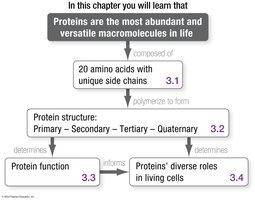
Proteins are the most abundant and versatile macromolecules in living organisms. They are essential for nearly every process within cells, from catalyzing metabolic reactions to providing structural support. Understanding protein structure is fundamental to understanding their diverse functions in biology.
3.1 Amino Acids and Their Polymerization
Structure of Amino Acids
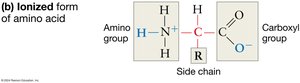
Amino acids are the building blocks of proteins, each composed of a central (alpha) carbon atom bonded to four groups:
A hydrogen atom (H)
An amino group (–NH2)
A carboxyl group (–COOH)
An R group (side chain) that varies among the 20 standard amino acids
In aqueous solutions, amino and carboxyl groups ionize, which helps amino acids stay in solution and affects their chemical reactivity.
The Nature of Side Chains (R-Groups)
The R-group or side chain is what makes each amino acid unique.
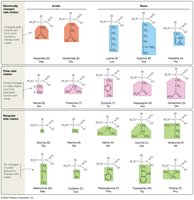
Side chains can be nonpolar, polar, or charged, influencing the amino acid's solubility and reactivity.
Some side chains contain functional groups that participate in chemical reactions, while others are composed only of carbon and hydrogen.
Polarity and Charge of R-Groups Affect Solubility
Polar and charged R-groups are hydrophilic and interact with water.
Nonpolar R-groups are hydrophobic and do not form hydrogen bonds with water.
Amino acids can be classified by asking:
Does the side chain have a negative charge? (Acidic)
Does the side chain have a positive charge? (Basic)
If uncharged, does it contain an oxygen atom? (Uncharged polar)
If none of the above, it is nonpolar.
Polymerization: Formation of Peptide Bonds
Amino acids link via peptide bonds, which are covalent bonds formed by a condensation reaction between the carboxyl group of one amino acid and the amino group of another.
This process creates a polypeptide chain with directionality: the N-terminus (amino end) and the C-terminus (carboxyl end).

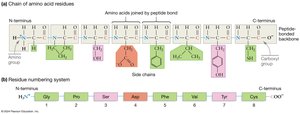
The peptide-bonded backbone has three key features:
R-group orientation: Side chains extend out, allowing interactions.
Directionality: N-terminus to C-terminus.
Flexibility: Peptide bond is rigid, but single bonds on either side can rotate.
Short chains (<50 amino acids) are called oligopeptides or peptides; longer chains are polypeptides. A protein is a complete, functional polypeptide.
Polymerization of Proteins in Early Earth
Experiments show amino acids can form under prebiotic conditions and polymerize into stable chains, but it remains unclear if proteins were the first biological macromolecules.
3.2 What Do Proteins Look Like?
Protein structure is hierarchical and determines function. The diversity of protein shapes and sizes arises from the sequence and properties of their amino acids.
Levels of Protein Structure
Primary structure: Unique sequence of amino acids in a polypeptide. Even a single amino acid change can drastically affect function (e.g., sickle cell hemoglobin).
Secondary structure: Local folding patterns stabilized by hydrogen bonds (e.g., alpha-helices and beta-pleated sheets).
Tertiary structure: Overall 3D shape formed by interactions among R-groups, including hydrogen bonds, hydrophobic interactions, van der Waals forces, covalent disulfide bonds, and ionic bonds.
Quaternary structure: Association of multiple polypeptide subunits into a functional protein complex (e.g., hemoglobin, ribosome).
Summary Table: Levels of Protein Structure
Level | Description | Stabilizing Bonds/Interactions |
|---|---|---|
Primary | Sequence of amino acids | Peptide bonds |
Secondary | Alpha-helix, beta-sheet | Hydrogen bonds |
Tertiary | 3D folding of polypeptide | Hydrogen bonds, hydrophobic interactions, van der Waals, disulfide bonds, ionic bonds |
Quaternary | Multiple polypeptides | Same as tertiary (between subunits) |
*Additional info: Table inferred from context as "Table 3.1 Protein Structure" was referenced but not fully shown in the text.*
3.3 Folding and Function
Proper protein folding is crucial for function and is often spontaneous due to chemical interactions.
Denatured (unfolded) proteins lose their function.
Molecular chaperones are proteins that assist in the correct folding of other proteins, preventing aggregation and misfolding (e.g., heat shock proteins like Hsp90).
Some proteins are flexible and only adopt their final shape upon binding specific molecules.
Misfolded proteins can be "infectious" (prions), causing diseases by inducing normal proteins to misfold (e.g., mad cow disease).
3.4 Protein Functions Are as Diverse as Protein Structures
Proteins perform a wide variety of functions in cells, including:
Catalysis: Enzymes speed up chemical reactions by lowering activation energy.
Structure: Provide support and shape to cells and tissues.
Movement: Motor proteins move cells or molecules within cells.
Signaling: Transmit signals between cells.
Transport: Move substances across membranes or throughout the body.
Defense: Antibodies protect against pathogens.
Why Are Enzymes Good Catalysts?
Enzymes are proteins that function as biological catalysts.
They bind reactants (substrates) at their active site, holding them in a precise orientation to facilitate the reaction.
Did Life Arise from a Self-Replicating Enzyme?
While proteins can catalyze reactions, they do not store genetic information. The origin of life likely required molecules capable of both catalysis and information storage, such as nucleic acids.
