 Indietro
Protein Structure and Function: Foundations of Biomolecular Diversity
Guida di studio - Note intelligenti
 Appunti personalizzati basati sui tuoi materiali, ampliati con definizioni chiave, esempi e contesto.
Protein Structure and Function
Introduction to Organic Molecules and Biomolecules
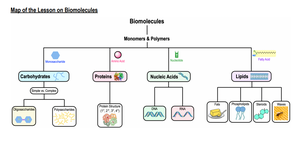
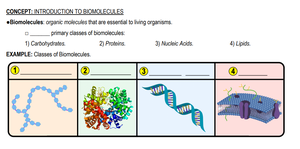
Organic molecules are compounds that contain both carbon and hydrogen atoms. In living organisms, four major classes of organic molecules, also known as biomolecules, are essential: carbohydrates, lipids, proteins, and nucleic acids. These biomolecules are fundamental to cellular structure and function, and their diversity arises from the unique properties of carbon and the presence of functional groups.
Carbohydrates: Serve as energy sources and structural components.
Lipids: Function in energy storage, membrane structure, and signaling.
Proteins: Perform a vast array of cellular functions, including catalysis, structure, transport, and defense.
Nucleic acids: Store and transmit genetic information.
The Properties of Carbon and Functional Groups
Carbon atoms are small, with four electrons in their outer shell, allowing them to form up to four covalent bonds with other atoms. This property enables the formation of stable, diverse organic molecules, including long chains, rings, and branched structures. The carbon skeleton of organic molecules can be modified by the addition of functional groups, which are specific clusters of atoms that confer characteristic chemical properties and reactivity.
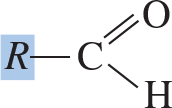
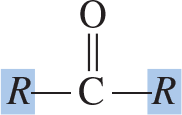
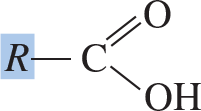
Functional groups determine the polarity, solubility, and reactivity of organic molecules.
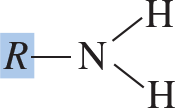
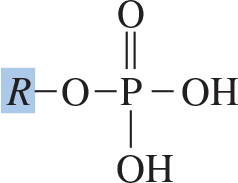
Examples include hydroxyl (-OH), carboxyl (-COOH), amino (-NH2), phosphate (-PO4), and others.
Monomers, Polymers, and the Synthesis of Biomolecules
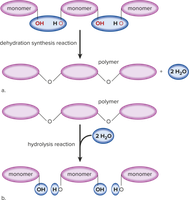
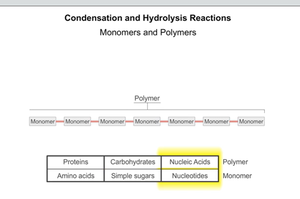
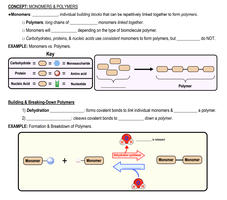
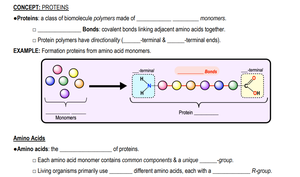
Most biomolecules are polymers, composed of repeating subunits called monomers. The process of linking monomers to form polymers is called dehydration synthesis (or condensation), while the breakdown of polymers into monomers occurs via hydrolysis.
Dehydration synthesis: A covalent bond forms between monomers, releasing a molecule of water.
Hydrolysis: A water molecule is added to break a covalent bond, separating monomers.
Amino Acids: Structure and Properties
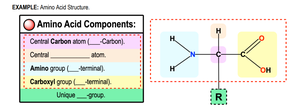
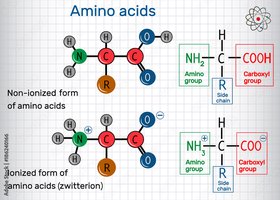
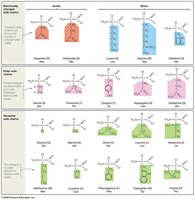
Amino acids are the monomers of proteins. Each amino acid has a central carbon atom (the alpha carbon) bonded to a hydrogen atom, an amino group (-NH2), a carboxyl group (-COOH), and a unique side chain (R group). The properties of the R group determine the characteristics and reactivity of each amino acid.
There are 20 standard amino acids, each with a distinct R group.
Amino acids can be classified as nonpolar (hydrophobic), polar (hydrophilic), acidic (negatively charged), or basic (positively charged) based on their side chains.
Peptide Bonds and Protein Polymerization
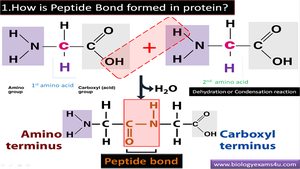
Amino acids are linked together by peptide bonds, which form between the carboxyl group of one amino acid and the amino group of another through a dehydration reaction. The resulting chain of amino acids is called a polypeptide.
Proteins have directionality, with an N-terminus (amino end) and a C-terminus (carboxyl end).
Peptide bonds are covalent and provide the backbone for protein structure.

Levels of Protein Structure
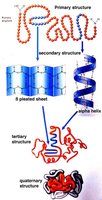
Proteins have four levels of structure, each contributing to the molecule's overall shape and function:
Primary structure: The unique sequence of amino acids in a polypeptide chain.
Secondary structure: Local folding patterns stabilized by hydrogen bonds, including alpha helices and beta-pleated sheets.
Tertiary structure: The overall three-dimensional shape of a single polypeptide, determined by interactions among R groups (hydrogen bonds, ionic bonds, hydrophobic interactions, van der Waals forces, and disulfide bridges).
Quaternary structure: The association of two or more polypeptide chains to form a functional protein complex.
Level | Description |
|---|---|
Primary | Sequence of amino acids |
Secondary | Alpha helix and beta sheet structures formed by hydrogen bonding |
Tertiary | Three-dimensional folding due to R group interactions |
Quaternary | Assembly of multiple polypeptide subunits |
Protein Folding and Function
Proper protein folding is essential for biological activity. The final folded structure is the most energetically stable conformation. Misfolded proteins can lead to loss of function and diseases such as cystic fibrosis and prion diseases. Molecular chaperones assist in the correct folding of proteins within cells.
Denaturation is the loss of protein structure (and function) due to environmental changes (e.g., heat, pH).
Chaperone proteins help prevent aggregation and misfolding.
Functions of Proteins in Living Systems
Proteins are the most functionally diverse biomolecules in cells. Their roles include:
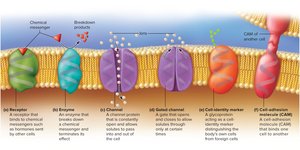
Catalysis: Enzymes accelerate biochemical reactions.
Structure: Provide support and shape to cells and tissues (e.g., collagen, keratin).
Transport: Move molecules across membranes and throughout the body (e.g., hemoglobin, membrane channels).
Signaling: Transmit signals within and between cells (e.g., hormones, receptors).
Movement: Motor proteins enable movement of cells and cellular components (e.g., actin, myosin).
Defense: Antibodies and other proteins protect against pathogens.
Summary Table: Protein-Related Terms
Term | Length of Amino Acid Chain |
|---|---|
Amino acid | Single protein unit or monomer |
Peptide | 2 to ~50 covalently linked amino acids |
Polypeptide | More than 50 covalently linked amino acids |
Protein | One or more polypeptide chains in their folded, functional forms |
Additional info: Protein structure is hierarchical, and even a single amino acid change can dramatically affect protein function, as seen in diseases like sickle cell anemia and cystic fibrosis. Protein folding is regulated and sometimes requires the assistance of molecular chaperones. Misfolded proteins can be infectious, as in prion diseases.
