 Indietro
Protein Structure and Function: Study Notes
Guida di studio - Note intelligenti
 Appunti personalizzati basati sui tuoi materiali, ampliati con definizioni chiave, esempi e contesto.
Protein Structure and Function
Introduction to Proteins
Proteins are essential macromolecules in all living organisms, responsible for a wide range of biological functions. Their structure is determined by the sequence of amino acids, which ultimately dictates their function.
Amino acids: The building blocks of proteins, each containing an amino group, a carboxyl group, and a unique side chain (R group).
Peptide bond: The covalent bond formed between amino acids during protein synthesis.
Polypeptide: A chain of amino acids linked by peptide bonds.
Protein: One or more polypeptides folded into a specific three-dimensional structure.
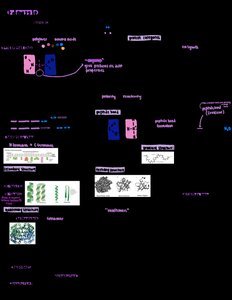
Levels of Protein Structure
Proteins exhibit four levels of structural organization, each contributing to their overall shape and function.
Primary structure: The linear sequence of amino acids in a polypeptide chain.
Secondary structure: Local folding patterns such as alpha helices and beta sheets, stabilized by hydrogen bonds.
Tertiary structure: The overall three-dimensional shape of a single polypeptide, formed by interactions among side chains.
Quaternary structure: The arrangement of multiple polypeptide subunits in a protein complex.
Protein Folding and Stability
Protein folding is a spontaneous process driven by the chemical properties of amino acids. Proper folding is essential for protein function, and misfolding can lead to disease.
Hydrophobic interactions: Nonpolar side chains tend to cluster away from water, stabilizing the protein's interior.
Hydrogen bonds: Form between backbone atoms and side chains, contributing to secondary and tertiary structure.
Disulfide bonds: Covalent bonds between cysteine residues, providing additional stability.
Chaperones: Proteins that assist in the folding of other proteins.
Protein Function
Proteins perform a variety of functions in cells, including catalysis, transport, signaling, and structural support.
Enzymes: Proteins that catalyze biochemical reactions by lowering activation energy.
Transport proteins: Move substances across cell membranes.
Signaling proteins: Transmit signals within and between cells.
Structural proteins: Provide support and shape to cells and tissues.
Enzyme Structure and Mechanism
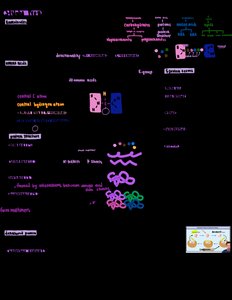
Enzymes are specialized proteins that accelerate chemical reactions. Their activity depends on the precise arrangement of amino acids in the active site.
Active site: The region of the enzyme where substrate binding and catalysis occur.
Substrate: The molecule upon which an enzyme acts.
Induced fit: The enzyme changes shape to accommodate the substrate.
Enzyme specificity: Each enzyme recognizes a specific substrate due to the shape and chemical properties of its active site.
Protein Synthesis
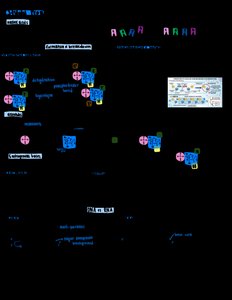
Proteins are synthesized in cells through the processes of transcription and translation. The sequence of nucleotides in DNA determines the sequence of amino acids in a protein.
Transcription: The process by which DNA is copied into messenger RNA (mRNA).
Translation: The process by which mRNA is decoded by ribosomes to assemble a polypeptide.
Ribosome: The cellular machinery responsible for protein synthesis.
Protein Classification
Proteins can be classified based on their structure and function.
Globular proteins: Compact, spherical proteins with dynamic functions (e.g., enzymes, transport proteins).
Fibrous proteins: Elongated, structural proteins (e.g., collagen, keratin).
Summary Table: Levels of Protein Structure
Level | Description | Stabilizing Interactions |
|---|---|---|
Primary | Sequence of amino acids | Peptide bonds |
Secondary | Local folding (alpha helix, beta sheet) | Hydrogen bonds |
Tertiary | 3D shape of polypeptide | Hydrophobic interactions, hydrogen bonds, disulfide bonds |
Quaternary | Multiple polypeptides | Same as tertiary, plus subunit interactions |
Protein Denaturation
Denaturation is the loss of protein structure due to external stress such as heat, pH changes, or chemicals. Denatured proteins lose their function.
Reversible denaturation: Some proteins can refold after denaturation.
Irreversible denaturation: Most proteins cannot regain their original structure once denatured.
Equations and Formulas
Peptide bond formation:
Enzyme kinetics (Michaelis-Menten equation):
Additional info:
Protein misfolding is associated with diseases such as Alzheimer's and Parkinson's.
Enzyme inhibitors can regulate metabolic pathways.
