 Indietro
Protein Structure and Function: Study Notes for General Biology
Guida di studio - Note intelligenti
 Appunti personalizzati basati sui tuoi materiali, ampliati con definizioni chiave, esempi e contesto.
Protein Structure and Function
Organic Molecules and Biomolecules
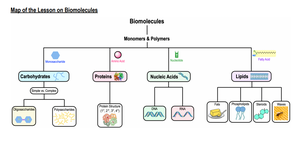
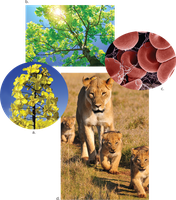
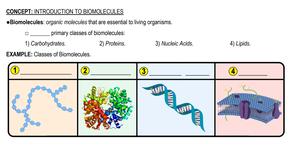
Organic molecules are compounds containing both carbon and hydrogen atoms. Living organisms are composed of four main classes of organic molecules, known as biomolecules: carbohydrates, lipids, proteins, and nucleic acids. These biomolecules serve diverse functions in cells, including energy storage, structural support, catalysis, and information storage.
Carbohydrates: Provide energy and structural support.
Lipids: Store energy, form membranes, and act as signaling molecules.
Proteins: Catalyze reactions, provide structure, transport molecules, and defend against pathogens.
Nucleic Acids: Store and transmit genetic information.
Monomers and Polymers
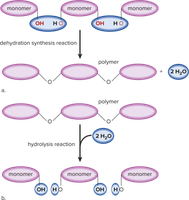
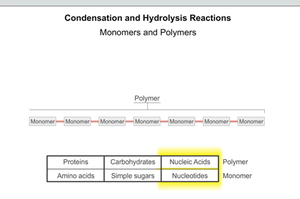
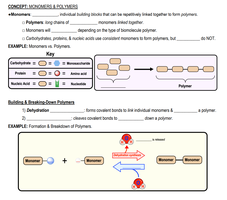
Most biomolecules are polymers, composed of repeating units called monomers. The process of joining monomers to form polymers is called dehydration synthesis, while breaking polymers into monomers is called hydrolysis.
Monomers: Small, individual building blocks (e.g., amino acids, nucleotides, monosaccharides).
Polymers: Long chains of monomers (e.g., proteins, nucleic acids, polysaccharides).
Dehydration Synthesis: Joins monomers by removing water.
Hydrolysis: Breaks polymers by adding water.
Functional Groups and Chemical Reactivity
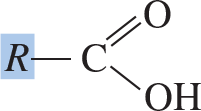
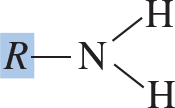
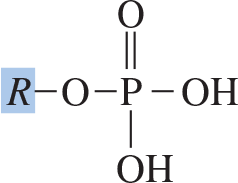
Functional groups are specific clusters of atoms attached to the carbon skeleton of organic molecules. They determine the chemical reactivity and polarity of molecules. Common functional groups include hydroxyl, carbonyl, carboxyl, amino, phosphate, and sulfhydryl.
Group | Structure | Compound | Significance |
|---|---|---|---|
Hydroxyl | R-OH | Alcohols | Polar, forms hydrogen bonds |
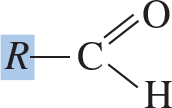
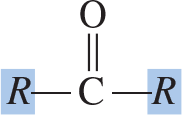
Carbonyl |
| Aldehydes, Ketones | Polar, found in sugars |
Carboxyl |
| Carboxylic acids | Acidic, donates H+ |
Amino |
| Amines | Basic, accepts H+ |
Phosphate |
| Organic phosphates | Energy transfer |
 ,
The Carbon Atom and Diversity of Organic Molecules
Carbon is a small atom with four valence electrons, allowing it to form four covalent bonds. This enables the creation of stable, diverse structures such as chains, rings, and branches. Carbon's versatility is fundamental to the complexity of organic molecules.
Stable C–C bonds: Allow formation of long chains and rings.
Bonding with other elements: Carbon bonds with hydrogen, oxygen, nitrogen, phosphorus, and sulfur.
Complexity: Branches and multiple bond types (single, double, triple) increase diversity.
Amino Acids: Structure and Properties
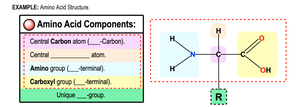
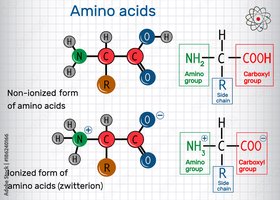
Amino acids are the monomers of proteins. Each amino acid consists of a central carbon atom bonded to a hydrogen atom, an amino group, a carboxyl group, and a variable R group (side chain). The properties of the R group determine the chemical behavior of the amino acid.
Core structure: Central carbon, amino group (NH2), carboxyl group (COOH), hydrogen, and R group.
Ionization: In water, amino and carboxyl groups ionize, affecting solubility and reactivity.
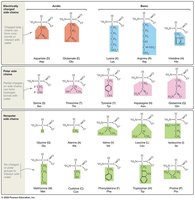
R group: Unique for each amino acid; can be nonpolar, polar, or charged.
Polarity and Charge of Amino Acid Side Chains
The nature of the R group affects the solubility of amino acids. Polar and charged R groups are hydrophilic, while nonpolar R groups are hydrophobic. Amino acids are classified based on their side chain properties:
Charged: Acidic (negative charge) or basic (positive charge).
Uncharged polar: Contains oxygen, forms polar covalent bonds.
Nonpolar: Mostly carbon and hydrogen, hydrophobic.
Polymerization: Peptide Bond Formation
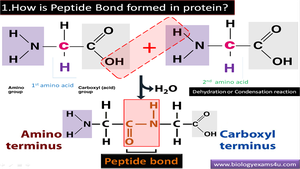
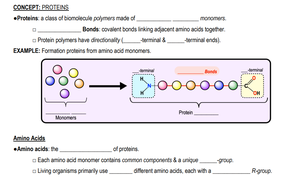
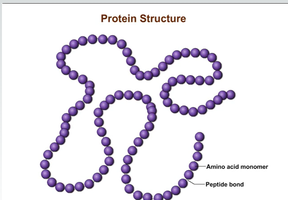
Amino acids link together via peptide bonds, formed between the carboxyl group of one amino acid and the amino group of another through a dehydration reaction. This process creates a polypeptide chain with directionality (N-terminus to C-terminus).
Peptide bond: Covalent bond joining amino acids.
Directionality: N-terminus (amino end) and C-terminus (carboxyl end).
Flexibility: Peptide bond is rigid, but adjacent single bonds allow rotation.

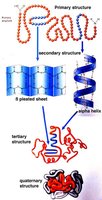
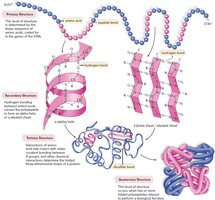
Levels of Protein Structure
Proteins exhibit four levels of structural organization, each contributing to their function:
Primary structure: Unique sequence of amino acids.
Secondary structure: Hydrogen bonding forms alpha helices and beta-pleated sheets.
Tertiary structure: Three-dimensional folding due to interactions among R groups.
Quaternary structure: Association of multiple polypeptide chains.
Protein Folding and Function
Proper protein folding is essential for function. Folding is driven by chemical interactions and often assisted by molecular chaperones. Misfolded proteins can lead to diseases, such as cystic fibrosis and prion diseases.
Molecular chaperones: Assist in proper folding and prevent aggregation.
Denaturation: Loss of structure leads to loss of function.
Prions: Misfolded proteins that can induce misfolding in others.
Functions of Proteins in Living Systems
Proteins perform a wide range of functions in cells:
Catalysis: Enzymes speed up chemical reactions.
Structure: Provide support and shape to cells and tissues.
Movement: Motor proteins move cells and molecules.
Signaling: Transmit signals between cells.
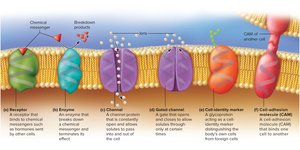
Transport: Move molecules across membranes and throughout the body.
Defense: Antibodies attack pathogens.
Enzymes as Catalysts
Enzymes are proteins that catalyze biochemical reactions by binding substrates at their active sites, orienting them for reaction, and lowering activation energy.
Active site: Region where substrates bind and react.
Specificity: Enzymes are highly specific for their substrates.
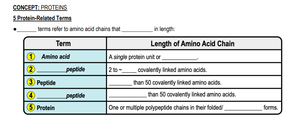
Summary Table: Protein Structure Terms
Term | Length of Amino Acid Chain |
|---|---|
Amino acid | Single protein unit or monomer |
Peptide | 2 to 50 covalently linked amino acids |
Polypeptide | More than 50 covalently linked amino acids |
Protein | One or multiple polypeptide chains in their folded forms |
Additional info:
Protein structure is hierarchical: primary structure determines secondary, which folds into tertiary, and multiple tertiary structures form quaternary.
Single amino acid changes can have dramatic effects on protein function (e.g., sickle cell anemia, cystic fibrosis).
