 Indietro
Protein Structure and Function: Study Notes for General Biology
Guida di studio - Note intelligenti
 Appunti personalizzati basati sui tuoi materiali, ampliati con definizioni chiave, esempi e contesto.
Protein Structure and Function
Organic Molecules and Biomolecules
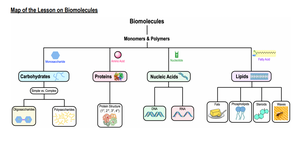
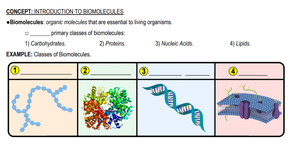
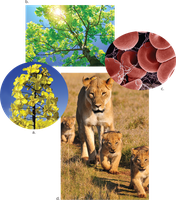
Organic molecules are compounds containing both carbon and hydrogen atoms. Living organisms are composed of four main classes of organic molecules, known as biomolecules: carbohydrates, lipids, proteins, and nucleic acids. Each class plays a distinct role in cellular structure and function.
Carbohydrates: Provide energy and structural support.
Lipids: Store energy, form membranes, and act as signaling molecules.
Proteins: Catalyze reactions, provide structure, transport molecules, and more.
Nucleic Acids: Store and transmit genetic information.
Functional Groups and Chemical Reactivity
Functional groups are specific clusters of atoms attached to the carbon skeleton of organic molecules. They determine the chemical reactivity and polarity of molecules, influencing their interactions and biological roles.
Hydroxyl (-OH): Increases solubility and reactivity.
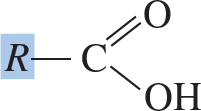
Carboxyl (-COOH): Acts as an acid, donating protons.
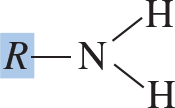
Amino (-NH2): Acts as a base, accepting protons.
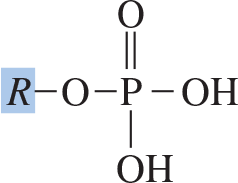
Phosphate (-PO4): Transfers energy and is found in nucleic acids.
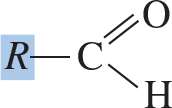
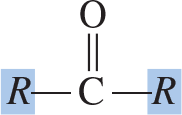
Carbonyl (C=O): Found in aldehydes and ketones, increases reactivity.
Carbon Atom Properties and Diversity of Organic Molecules
The carbon atom is uniquely suited to form diverse organic molecules due to its ability to make four covalent bonds, allowing for chains, rings, and branches. This versatility enables the formation of complex biomolecules essential for life.
Carbon forms stable bonds with elements like hydrogen, oxygen, nitrogen, phosphorus, and sulfur.
Can create single, double, and triple bonds, as well as ring structures.
Complex branching allows for a wide variety of molecular shapes and functions.
Monomers, Polymers, and Biomolecule Structure
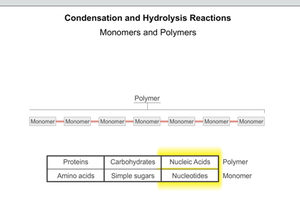
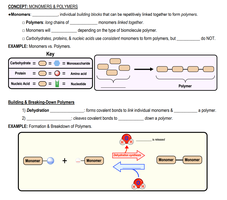
Biomolecules are often polymers, composed of repeating units called monomers. The process of joining monomers to form polymers is essential for building cellular structures.
Monomer: A single building block (e.g., amino acid, nucleotide).
Polymer: A chain of monomers (e.g., protein, nucleic acid).
Carbohydrates: Monomer = monosaccharide; Polymer = polysaccharide.
Proteins: Monomer = amino acid; Polymer = polypeptide.
Nucleic Acids: Monomer = nucleotide; Polymer = DNA/RNA.
Lipids: Not true polymers; composed of fatty acids and glycerol.
Dehydration Synthesis and Hydrolysis
Two key reactions govern the formation and breakdown of polymers:
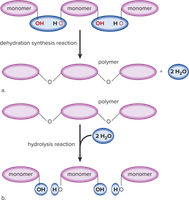
Dehydration Synthesis: Joins monomers by removing a water molecule, forming a covalent bond.
Hydrolysis: Breaks covalent bonds in polymers by adding a water molecule, releasing monomers.
Amino Acids: Structure and Properties
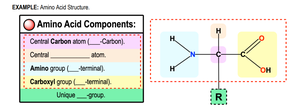
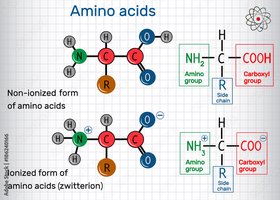
Amino acids are the monomers of proteins. Each amino acid has a central carbon atom bonded to a hydrogen atom, an amino group, a carboxyl group, and a unique R group (side chain).
Amino group (-NH2): Basic, can accept protons.
Carboxyl group (-COOH): Acidic, can donate protons.
R group: Determines the properties and reactivity of the amino acid.
In water, amino and carboxyl groups ionize, affecting solubility and reactivity.
Classification of Amino Acids
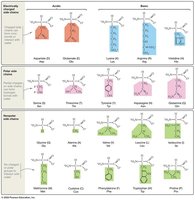
Amino acids are classified based on the properties of their R groups:
Nonpolar (hydrophobic): R groups contain mostly carbon and hydrogen.
Polar (hydrophilic): R groups contain oxygen or nitrogen, form hydrogen bonds.
Charged: Acidic (negative charge) or basic (positive charge), interact with water.
Peptide Bond Formation and Protein Polymerization
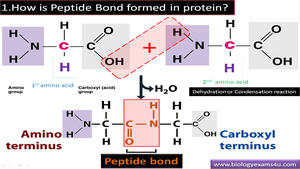
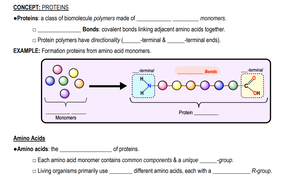
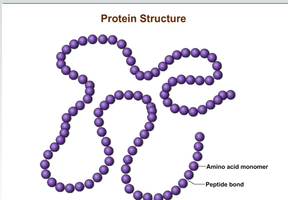
Amino acids link together via peptide bonds, formed by a dehydration reaction between the carboxyl group of one amino acid and the amino group of another. This process creates polypeptide chains, which fold into functional proteins.
Peptide bond: Covalent bond joining amino acids.
Directionality: N-terminus (amino end) to C-terminus (carboxyl end).
Proteins can be oligopeptides (few amino acids), polypeptides (many amino acids), or complete proteins (functional form).

Levels of Protein Structure
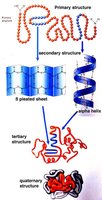
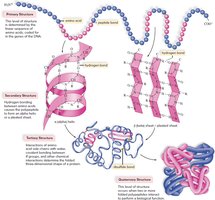
Proteins exhibit four levels of structural organization, each contributing to their function:
Primary Structure: Unique sequence of amino acids in a polypeptide.
Secondary Structure: Regular patterns (alpha helix, beta sheet) formed by hydrogen bonding between backbone atoms.
Tertiary Structure: Three-dimensional folding due to interactions among R groups (hydrogen bonds, hydrophobic interactions, ionic bonds, disulfide bridges).
Quaternary Structure: Association of multiple polypeptide chains into a functional protein complex.
Protein Folding and Function
Proper protein folding is essential for biological activity. Folding is driven by chemical interactions and often assisted by molecular chaperones. Misfolded proteins can lead to diseases, such as prion disorders and cystic fibrosis.
Molecular chaperones: Assist in correct folding and prevent aggregation.
Denaturation: Loss of structure leads to loss of function.
Prions: Misfolded proteins that can induce misfolding in other proteins, causing disease.
Functions of Proteins in Living Systems
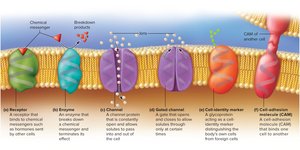
Proteins are involved in nearly every cellular process:
Catalysis: Enzymes accelerate chemical reactions.
Structure: Provide support and shape to cells and tissues.
Movement: Motor proteins enable cellular and organismal movement.
Signaling: Transmit signals within and between cells.
Transport: Move substances across membranes and throughout the body.
Defense: Antibodies and other proteins protect against pathogens.
Enzymes as Catalysts
Enzymes are proteins that catalyze biochemical reactions by binding substrates at their active sites, orienting them for reaction, and lowering activation energy.
Active site: Region where substrate binds and reaction occurs.
Specificity: Enzymes are highly specific for their substrates.
Summary Table: Levels of Protein Structure
Level | Description | Example |
|---|---|---|
Primary | Sequence of amino acids | Sickle cell hemoglobin mutation |
Secondary | Alpha helix, beta sheet | Keratin, silk |
Tertiary | 3D folding due to R-group interactions | Enzymes, antibodies |
Quaternary | Multiple polypeptides assembled | Hemoglobin, collagen |
Summary Table: Biomolecules
Category | Monomer | Polymer |
|---|---|---|
Proteins | Amino acids | Polypeptides |
Carbohydrates | Monosaccharides | Polysaccharides |
Nucleic Acids | Nucleotides | DNA/RNA |
Lipids | Fatty acids, glycerol | Not true polymers |
Key Equations
Dehydration Synthesis:
Hydrolysis:
Peptide Bond Formation:
Additional info: Some content was expanded for clarity and completeness, including definitions, examples, and summary tables to ensure the notes are self-contained and suitable for exam preparation.
