 Indietro
Proteins: Structure, Folding, and Function – General Biology Study Notes
Guida di studio - Note intelligenti
 Appunti personalizzati basati sui tuoi materiali, ampliati con definizioni chiave, esempi e contesto.
Proteins, Energy, and Enzymes
Polypeptides and Amino Acids
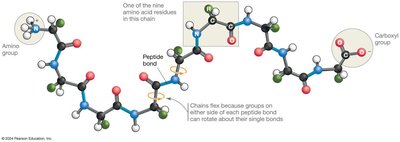
Proteins are polymers composed of amino acid monomers, which are linked together by peptide bonds to form polypeptides. The diversity and function of proteins are determined by the sequence and chemical properties of their constituent amino acids.
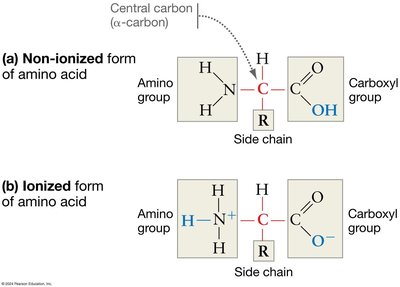
Amino acids are organic molecules containing an amino group, a carboxyl group, a hydrogen atom, and a unique side chain (R group) attached to a central carbon (α-carbon).
Polypeptides are chains of amino acids joined by peptide bonds, formed through condensation reactions (dehydration synthesis).
Peptide bonds are covalent bonds between the carboxyl group of one amino acid and the amino group of another.
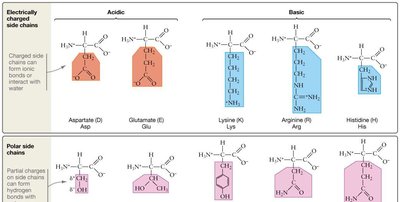
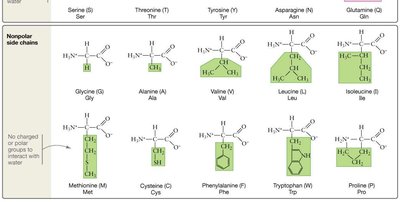
Protein diversity arises from the 20 different amino acids, each with distinct side chains, allowing for a vast number of possible sequences and structures.
Example: Using 20 amino acids, a peptide of 5 residues can have possible sequences, while using only 10 amino acids yields sequences.

Functional Groups in Amino Acids
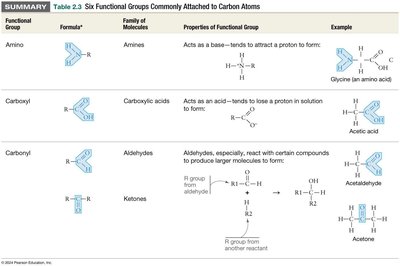
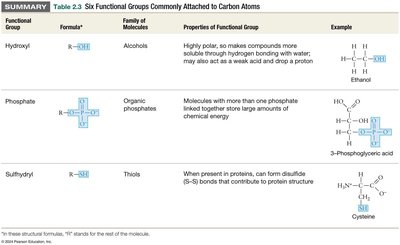
Amino acids contain several functional groups that influence their chemical behavior and interactions within proteins.
Amino group (–NH2): Acts as a base, accepting protons.
Carboxyl group (–COOH): Acts as an acid, donating protons.
Side chain (R group): Determines the specific properties of each amino acid, such as polarity, charge, and hydrophobicity.
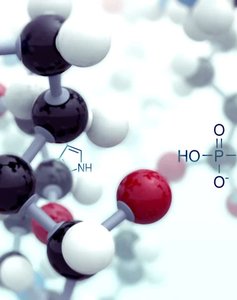
Other functional groups: Hydroxyl, phosphate, sulfhydryl, and carbonyl groups contribute to protein structure and function.
Protein Structure and Folding
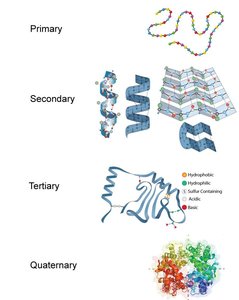
Proteins adopt complex three-dimensional structures that are essential for their biological functions. The structure of a protein is organized into four hierarchical levels:
Primary structure: The linear sequence of amino acids in a polypeptide, determined by genetic information.
Secondary structure: Regular local structures stabilized by hydrogen bonds, including α-helices and β-pleated sheets.
Tertiary structure: The overall three-dimensional shape of a single polypeptide, stabilized by interactions among side chains (R groups), including hydrogen bonds, ionic bonds, hydrophobic interactions, van der Waals forces, and disulfide bonds.
Quaternary structure: The arrangement of multiple polypeptide subunits in a protein complex.
Protein Folding and Function
Protein folding is the process by which a polypeptide chain acquires its functional three-dimensional structure. Proper folding is critical for protein activity, and misfolding can lead to diseases.
Molecular chaperones assist in the correct folding of proteins, preventing aggregation and misfolding.
Functional proteins are folded into specific shapes required for their biological roles, such as enzymes, structural proteins, and transport proteins.
Example: Hemoglobin is a quaternary protein composed of four polypeptide subunits, each with its own tertiary structure.
Protein Structure and Disease
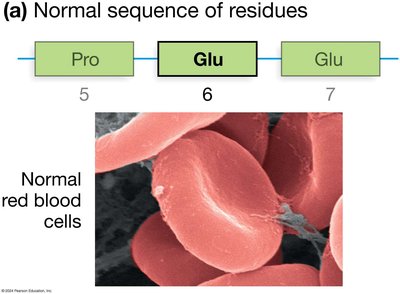
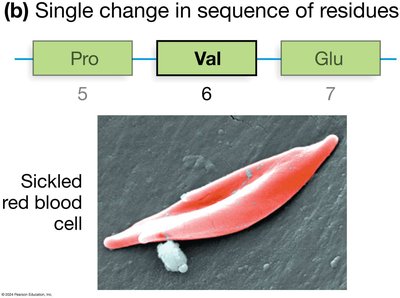
Changes in the amino acid sequence can alter protein structure and function, sometimes resulting in disease.
Sickle cell anemia is caused by a single amino acid substitution (valine for glutamate) in the hemoglobin protein, leading to abnormal red blood cell shape and impaired function.
Summary Table: Protein Structure Levels
Level | Description | Stabilized by | Example |
|---|---|---|---|
Primary | The sequence of amino acids in a polypeptide | Peptide bonds | Gly, Ser, Asp, Cys |
Secondary | Formation of α-helices and β-pleated sheets in a polypeptide (depends on primary structure) | Hydrogen bonding between groups along the peptide-bonded backbone | One α-helix |
Tertiary | Overall three-dimensional shape of a polypeptide (includes contribution from secondary structures) | Bonds and other interactions between R-groups, or between R-groups and the peptide-bonded backbone | One of hemoglobin's subunits |
Quaternary | Shape produced by combinations of polypeptides (tertiary structures), combinations of tertiary structures | Bonds and other interactions between R-groups, and between peptide backbones of different polypeptides | Hemoglobin consists of four polypeptide subunits |
Additional info:
Protein folding is often assisted by molecular chaperones, which prevent aggregation and facilitate proper structure formation.
Protein function is directly related to its structure; even small changes in sequence can have significant effects on activity and stability.
Proteins are involved in nearly all cellular processes, including catalysis (enzymes), structural support, transport, signaling, and immune response.
