 Indietro
Protist Diversity: Major Clades, Characteristics, and Life Cycles
Guida di studio - Note intelligenti
 Appunti personalizzati basati sui tuoi materiali, ampliati con definizioni chiave, esempi e contesto.
Protist Diversity and Major Eukaryotic Clades
Introduction to Protists and Eukaryotic Phylogeny
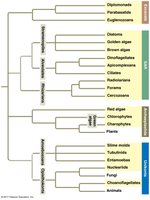
Protists are a diverse group of eukaryotic organisms that are not classified as plants, animals, or fungi. They represent most of the eukaryotic lineages and are crucial for understanding the evolution and diversity of life. The major eukaryotic clades include Archaeplastida, Excavata, the SAR clade, and Unikonta. Each clade contains unique groups with distinct evolutionary histories and biological features.
Archaeplastida
Defining Features and Major Groups
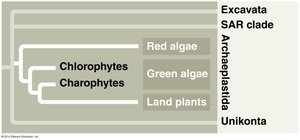
The Archaeplastida clade is defined by plastids derived from primary endosymbiosis, and all members use chlorophyll a as their main photosynthetic pigment. This clade includes red algae, green algae (chlorophytes and charophytes), land plants, and glaucophytes.
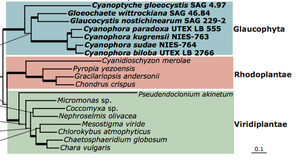
Glaucophytes: Rare, unicellular freshwater algae with chloroplasts that retain a peptidoglycan layer, similar to cyanobacteria. They contain both chlorophyll a and phycoerythrin.
Red Algae (Rhodophyta): Mostly multicellular and marine, red algae contain phycoerythrin, which gives them their red color. They lack flagellated cells and often exhibit alternation of generations in their life cycles.
Green Algae: A paraphyletic group including chlorophytes and charophytes. They contain both chlorophyll a and b, and can be unicellular, colonial, or multicellular. Land plants evolved from charophyte ancestors.
Glaucophytes
Glaucophytes are a small group of rare, unicellular freshwater algae. Their chloroplasts are unique among eukaryotes for retaining a peptidoglycan layer, a feature inherited from their cyanobacterial ancestors. They also contain the pigment phycoerythrin.
Red Algae (Rhodophyta)
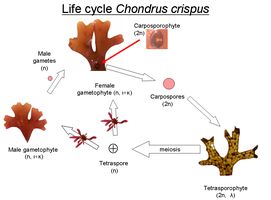
Red algae are primarily marine and multicellular. Their red color is due to the pigment phycoerythrin. They have complex life cycles, often with alternation of generations, and lack flagellated cells. Red algae are ecologically and economically important.
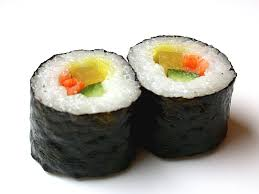
Nori: Edible red algae used in sushi.
Agar: A polysaccharide from red algae, used as a growth medium in laboratories.
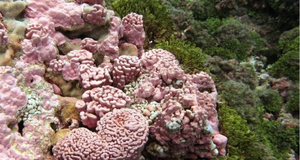
Coralline red algae: Secrete calcium carbonate, contributing to coral reef formation.
Green Algae
Green algae include both chlorophytes and charophytes. They are found in freshwater, marine, and terrestrial environments. Some are unicellular (e.g., Chlamydomonas), some are colonial (e.g., Volvox), and others are multicellular (e.g., Ulva). Green algae share chlorophyll b with land plants.
Excavata
Defining Features and Major Groups
The Excavata clade is primarily defined by DNA sequence data. All members are unicellular, and some have a characteristic "feeding groove." Major groups include diplomonads, parabasalids, and Euglenozoa.
Diplomonads: Lack plastids, have reduced mitochondria called mitosomes, and are often parasitic (e.g., Giardia lamblia).
Parabasalids: Have reduced mitochondria called hydrogenosomes, function in anaerobic respiration, and include human parasites (e.g., Trichomonas vaginalis).
Euglenozoa: Unicellular flagellates with diverse nutritional modes, including photoautotrophs, chemoheterotrophs, and mixotrophs. Includes euglenids and kinetoplastids (e.g., Trypanosoma and Leishmania).
SAR Clade
Defining Features and Major Groups
The SAR clade is a large, diverse group defined by DNA data. The name comes from its three major subgroups: Stramenopiles, Alveolates, and Rhizarians.
Stramenopiles: Includes diatoms (unicellular, silica cell walls, major primary producers), golden algae (mostly unicellular, some colonial), and brown algae (all multicellular, includes giant kelp).
Alveolates: All unicellular, with membrane-bound sacs (alveoli) under the plasma membrane. Includes dinoflagellates (some cause harmful algal blooms), apicomplexans (obligate parasites, e.g., Plasmodium and Toxoplasma), and ciliates (unicellular, move with cilia, have micronuclei and macronuclei).
Rhizarians: All unicellular, with threadlike pseudopodia. Includes foraminiferans (calcium carbonate shells), cercozoans, and radiolarians (silica skeletons).
Unikonta
Defining Features and Major Groups
Unikonta is a large clade defined by DNA data. Cells have a single flagellum, if present. The two major subclades are amoebozoans and opisthokonts.
Amoebozoans: Amoeboid cells with lobe-shaped pseudopods. Includes tubulinids (free-living amoebas), entamoebas (parasitic), and slime molds (plasmodial and cellular types).
Opisthokonts: Includes fungi, animals, and their protist relatives (nucleariids and choanoflagellates).
Life Cycles in Eukaryotes
Types of Life Cycles
Eukaryotes exhibit three main types of life cycles:
Haplontic: The multicellular stage is haploid; only the zygote is diploid.
Diplontic: The multicellular stage is diploid; gametes are the only haploid cells.
Alternation of Generations: Both haploid and diploid multicellular stages occur (e.g., in plants and some algae).
Sex and Reproduction in Ciliates
Separation of Sex and Reproduction
In ciliates, sex (genetic recombination) and reproduction (formation of new individuals) are separate processes. Sex occurs via conjugation, where two cells exchange micronuclei, resulting in genetic recombination without producing new individuals. Reproduction occurs by mitosis.
Key Terms and Concepts
Phytoplankton: Photosynthetic plankton, including many protists.
Harmful algal bloom: Rapid increase of algae, often dinoflagellates, that can produce toxins.
Chlorophyll a, b: Photosynthetic pigments found in various protist groups.
Phycoerythrin: Red pigment found in red algae and cyanobacteria.
Feeding groove: Characteristic of some Excavata.
Mitosome, hydrogenosome: Reduced mitochondria in diplomonads and parabasalids, respectively.
Kinetoplast: DNA-containing structure in the mitochondrion of kinetoplastids.
Holdfast, stipe, blades: Structures in brown algae analogous to roots, stems, and leaves.
Alveoli: Membrane-bound sacs in alveolates.
Pseudopodia: Extensions of the cell used for movement and feeding in amoeboid protists.
Summary Table: Major Protist Clades and Subgroups
Clade | Subgroups | Key Features |
|---|---|---|
Archaeplastida | Glaucophytes, Red algae, Green algae, Land plants | Primary plastids, chlorophyll a, phycoerythrin (in some) |
Excavata | Diplomonads, Parabasalids, Euglenozoa | Unicellular, feeding groove, reduced mitochondria |
SAR clade | Stramenopiles, Alveolates, Rhizarians | Diverse, secondary plastids (in some), unique cell structures |
Unikonta | Amoebozoans, Opisthokonts | Single flagellum (if present), lobe-shaped pseudopods (in amoebozoans) |
