 Indietro
Protist Diversity: Red and Green Algae, Classification, and Evolutionary Context
Guida di studio - Note intelligenti
 Appunti personalizzati basati sui tuoi materiali, ampliati con definizioni chiave, esempi e contesto.
Protist Diversity
Notes -
all photosynthetic organisms have cholorphyll a (main pigment) and accessory pigments
Photosynthetic protists - algae
Multicellular protists - seaweeds
Agar - gel
nori - dried black seaweed that sushi is wrapped in
carageenan - emulsifier, a thickening agent
Caulerpa - invasive pests
two domains of prokaryotes - bacteria and archaea
Archaea - really weird, some live in very extreme environments like boiling water and super salty environments. They're the only ones that can make methane gas, they combine hydrogen and carbon to make methane gas, and they release methane gas as a byproduct, they receive energy. They live in low oxygen areas like swamps, pluff mud in lagoons. They will make so much methane gas that it can be burned.
Viruses are neither pro nor eukaryotes, it is a rogue piece of genetic info They use cells to make more viruses. They use transduction in horizontal gene transfer
Horizontal gene transfer
Conjugation - cell to cell, they connect to each other
Transformation - bacteria picks up genes from the environment
1% of bacteria are harmful to people
Know the ones that are gram positive
Gram-positive bacteria are known as gram-positive
Means u have a certain structure in the cell wall, and because u have that u pick a thing called gram stain
Pennicillin can be used to treat infected g-positive bacteria
Examples - staph bacteria, streptocc
Actinomycetes - sources of alot of antibiotics, they produce antibiotics to kill off their competitors
Proteobacteria - largest group of bacteria, e. coli, vibrio cholerae causes cholera
Spirochetes - long and corkscrew shaped, have flagella inside of them that spins and it makes the bacterial cell spin around in certain ways, they cause syphilis and lyme disease
Eukarya is characterized in difference to bacteria by linear dna (bacteria is circular), many chromosomes (instead of bacteria's 1) and nuclei
4 kingdoms of Prokarya
Fungi, Plants, Protists, Animals
The one that is generally unicellular is Protists
Eukaryotes have flagella that they use for mobility, in comparison to bacteria, its 9 + 2. 9 pairs microtubule, 2 central microtubule, surrounded by a membrane. Also has back n forth (whiplash) movement.
Bacteria flagellum - 1 filament, narrower than microtubule, no membrane, and it spins around like a propellar
Flagella vs Cilia
Cilia also has 9 + 2, there are hundreds of thousands of them
Flagella only has 1 or 2, maybe 4
Strammenopiles have a tinsil flagellum, characterized by a tinsil and whiplash flagellum
It will include the ending of community and ecosystem ecology
Overview of Protists
Protists are a diverse group of eukaryotic organisms, many of which play crucial roles in aquatic ecosystems and evolutionary biology. They include both unicellular and multicellular forms and are classified within the domain Eukarya.
Protists are not a monophyletic group but include organisms from several evolutionary lineages.
They are found in both freshwater and marine environments.
Protists exhibit a wide range of morphologies, life cycles, and nutritional strategies.
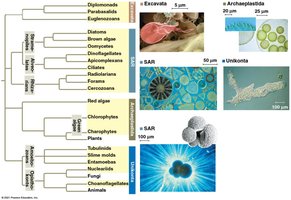
Classification: Prokaryotes vs. Eukaryotes
Biological classification distinguishes between prokaryotes and eukaryotes, with protists belonging to the latter.
Prokaryotes include two domains: Bacteria and Archaea.
Eukaryotes are classified into four kingdoms: Protista, Plantae, Fungi, and Animalia.
Protists are highly diverse within the kingdom Protista.
Red Algae (Rhodophyta)
Characteristics of Red Algae
Red algae are a group of mostly marine, multicellular protists known for their distinctive pigments and economic importance.
Almost all red algae are marine and multicellular.
Contain chlorophyll a and phycoerythrin, a pigment that gives them their red color and allows photosynthesis in deeper waters.
Sources of agar, nori (used in sushi), and carrageenan (a thickening agent).
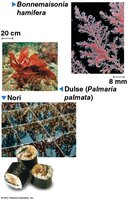
Economic and Ecological Importance
Red algae are harvested for food and industrial products.
They contribute to marine ecosystems as primary producers.
Some species are used in biotechnology and microbiology as sources of agar.
Green Algae (Chlorophyta and Charophyta)
Characteristics of Green Algae
Green algae are found in both freshwater and marine environments and are closely related to land plants.
Can be unicellular or multicellular.
Contain chlorophyll a and chlorophyll b, as well as carotenoids and xanthophylls.
Share photosynthetic pigments with land plants.
Some green algae are more closely related to plants than others; sometimes classified as "plants".
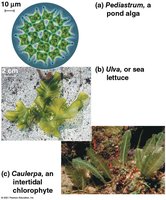
Evolutionary Relationship to Plants
Green algae are considered the closest protistan relatives to land plants.
Charophytes, a subgroup of green algae, share several key traits with land plants.
Life Cycles and Reproduction in Algae
Alternation of Generations
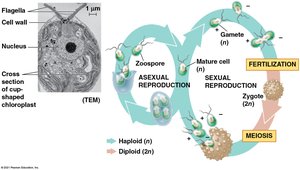
Many algae exhibit complex life cycles, including alternation of generations, which involves both haploid and diploid stages.
Asexual reproduction produces zoospores.
Sexual reproduction involves gametes, fertilization, and meiosis.
Alternation of generations is a key evolutionary feature shared with land plants.
Summary Table: Red vs. Green Algae
Feature | Red Algae | Green Algae |
|---|---|---|
Habitat | Mostly marine | Freshwater & marine |
Cellularity | Multicellular | Unicellular & multicellular |
Main Pigments | Chlorophyll a, phycoerythrin | Chlorophyll a & b, carotenoids, xanthophylls |
Relation to Plants | Distant | Closest protistan relatives |
Economic Uses | Agar, nori, carrageenan | Food, biofuels, research |
Key Takeaways
Protists include diverse groups such as red and green algae, which are important for understanding evolutionary relationships and ecological roles.
Red algae are marine, multicellular, and economically valuable; green algae are diverse and closely related to land plants.
Classification of life distinguishes prokaryotes (Bacteria, Archaea) from eukaryotes (including Protista).
Algae exhibit complex life cycles, including alternation of generations.
Additional info: Academic context was added to clarify evolutionary relationships, pigment functions, and classification details.
