 Indietro
Protist Diversity: Structure, Classification, and Key Groups
Guida di studio - Note intelligenti
 Appunti personalizzati basati sui tuoi materiali, ampliati con definizioni chiave, esempi e contesto.
Protist Diversity
Notes -
Viruses (not cellular) - alive?
Domain Bacteria
Domain Archaea
Domain Eukarya
Kingdom Animalia
Kingdom Plantar
Kingdom Fungi
Kingdom Protista -garbage can taxon
Introduction to Protists
Protists are a diverse group of mostly unicellular eukaryotic organisms that do not fit into the traditional kingdoms of plants, animals, or fungi. They exhibit a wide range of morphologies, life cycles, and ecological roles. Historically, protists were grouped in the Kingdom Protista, but modern classification divides them into several supergroups based on molecular and structural evidence.
Protozoa: Animal-like protists, often motile and heterotrophic.
Algae: Plant-like protists, primarily photosynthetic.
Protistan Fungi: Fungus-like protists, such as slime molds.
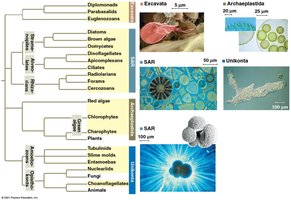
SAR Supergroup
Overview of SAR
The SAR supergroup is a major clade of protists that includes three large groups: Stramenopiles, Alveolates, and Rhizarians. These groups are united by genetic similarities but display diverse morphologies and lifestyles.
Stramenopiles
Stramenopiles are characterized by the presence of two distinct flagella at some stage in their life cycle: a 'tinsel' (hairy) flagellum and a 'whiplash' (smooth) flagellum. Many are photosynthetic but differ from plants in pigment composition and cellular structure.
Tinsel flagellum: Covered with fine, hair-like projections.
Whiplash flagellum: Smooth and typically used for locomotion.
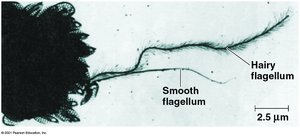
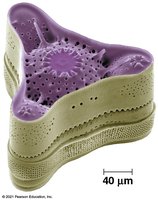
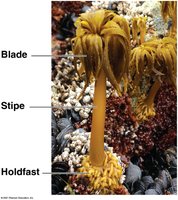
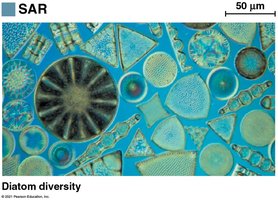
Examples of stramenopiles include diatoms, brown algae, and oomycetes.
Diatoms: Unicellular algae with silica cell walls, important in aquatic ecosystems.
Brown algae: Multicellular, marine organisms such as kelp.
Alveolates
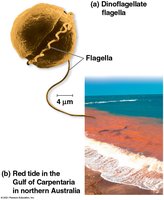
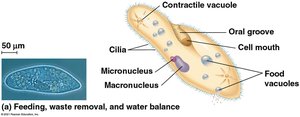
Alveolates are defined by the presence of membrane-bound sacs (alveoli) just beneath the plasma membrane. This group includes dinoflagellates and ciliates, both of which play significant ecological roles.
Dinoflagellates: Mostly marine plankton, some cause harmful algal blooms (red tides).
Ciliates: Possess numerous cilia for movement and feeding; complex cell structure with specialized organelles.
Rhizarians
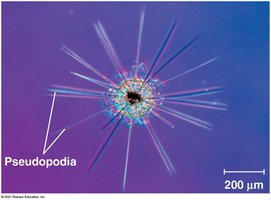
Rhizarians are amoeboid protists with threadlike pseudopodia, often extending through intricate shells. They are important contributors to marine sediments.
Foraminifera: Have porous shells made of calcium carbonate; pseudopods extend through shell openings.
Radiolaria: Possess glassy (silica) skeletons with radiating pseudopodia.
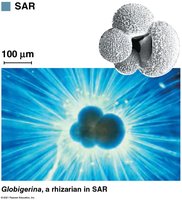
Amoebozoans
Characteristics of Amoebozoans
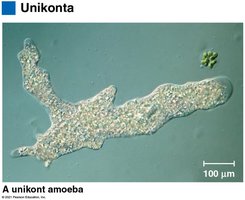
Amoebozoans are a group of protists that move and feed using lobe-shaped pseudopodia. They lack an outer wall or shell and are mostly single-celled, though some form multicellular aggregates.
Amoebas: Free-living or parasitic; move by extending pseudopodia.
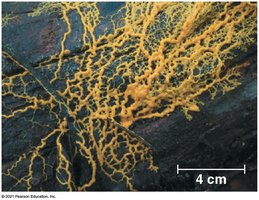
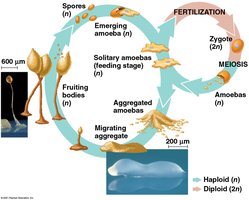
Slime molds: Exhibit both unicellular and multicellular stages; important in studying cell communication and differentiation.
Summary Table: Major Protist Groups
Group | Key Features | Examples |
|---|---|---|
Stramenopiles | Two flagella (hairy & smooth), many photosynthetic | Diatoms, Brown algae |
Alveolates | Alveoli under plasma membrane | Dinoflagellates, Ciliates |
Rhizarians | Amoeboid, threadlike pseudopodia, shells | Foraminifera, Radiolaria |
Amoebozoans | Lobe-shaped pseudopodia, no shell | Amoebas, Slime molds |
Additional info: Modern protist classification is based on molecular phylogeny, which has revealed that traditional groupings (e.g., "Kingdom Protista") are paraphyletic. The SAR and Unikonta supergroups are two of the major eukaryotic lineages that include protists.
