 Indietro
Protists and Endosymbiosis: Origins of Mitochondria and Plastids
Guida di studio - Note intelligenti
 Appunti personalizzati basati sui tuoi materiali, ampliati con definizioni chiave, esempi e contesto.
Protists: Endosymbiosis
What is Endosymbiosis?
Endosymbiosis is a biological process in which one organism lives inside another, and both organisms benefit from the relationship. This concept is central to understanding the origin of key eukaryotic organelles, such as mitochondria and chloroplasts, which are believed to have evolved from free-living bacteria that were engulfed by ancestral eukaryotic cells.
Definition: Endosymbiosis refers to a symbiotic relationship where one organism resides within the cells of another.
Mutual Benefit: The host cell gains metabolic capabilities from the endosymbiont, while the endosymbiont receives protection and nutrients.
Origins of Organelles: The theory explains the origins of mitochondria (from aerobic bacteria) and chloroplasts (from photosynthetic bacteria) in eukaryotic cells.
Key Steps: An ancestral eukaryote engulfed an aerobic bacterium (leading to mitochondria), and later, some lineages engulfed a photosynthetic bacterium (leading to plastids/chloroplasts).
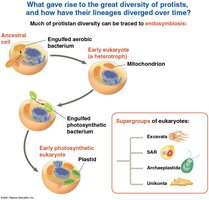
Example: Modern mitochondria and chloroplasts retain features of their bacterial ancestors, supporting the endosymbiotic theory.
Evidence of Endosymbiosis
Several lines of evidence support the endosymbiotic origin of mitochondria and chloroplasts:
DNA Structure: Both organelles contain their own DNA, which is circular (ring-shaped) like bacterial chromosomes.
Membranes: Mitochondria and chloroplasts have double (or more) membranes, consistent with engulfment by a host cell.
Division: These organelles reproduce by binary fission, similar to bacteria.
Size: Their size is comparable to that of bacteria.
Metabolic Membranes: The inner membranes of mitochondria and chloroplasts are involved in energy metabolism, resembling bacterial membranes.
Secondary Endosymbiosis in Plastids
Primary and Secondary Endosymbiosis
While primary endosymbiosis refers to the initial engulfment of a cyanobacterium by a eukaryote (leading to red and green algae), secondary endosymbiosis describes the process where a eukaryotic alga is itself engulfed by another eukaryote. This has led to the diversity of plastids found in various protist groups.
Primary Endosymbiosis: A heterotrophic eukaryote engulfs a cyanobacterium, resulting in a primary plastid (as seen in red and green algae).
Secondary Endosymbiosis: A eukaryote engulfs a red or green alga, leading to plastids with additional membranes and greater diversity among protists.
Membrane Evidence: Secondary plastids often have three or four membranes, reflecting their complex origin.
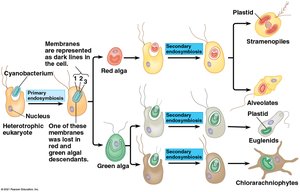
Example: Stramenopiles, alveolates, and euglenids possess plastids derived from secondary endosymbiosis.
Summary Table: Key Features of Endosymbiotic Organelles
Organelle | Origin | Membranes | Division | DNA Type |
|---|---|---|---|---|
Mitochondrion | Aerobic bacterium | 2 | Binary fission | Circular |
Chloroplast (primary) | Cyanobacterium | 2 | Binary fission | Circular |
Plastid (secondary) | Engulfed alga | 3-4 | Binary fission | Circular |
Additional info: Secondary endosymbiosis has played a major role in the evolution and diversification of protists, leading to the complex cell structures observed in modern eukaryotes.
