 Indietro
Protists: Diversity, Evolution, and Ecological Roles
Guida di studio - Note intelligenti
 Appunti personalizzati basati sui tuoi materiali, ampliati con definizioni chiave, esempi e contesto.
Protists: Introduction and Overview
What are Protists?
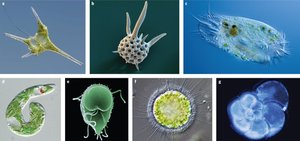
Protists are a diverse group of mostly unicellular eukaryotic organisms that are not classified as plants, animals, or fungi. They exhibit a wide range of structural and functional diversity and play crucial roles in ecological and evolutionary processes.
Key Features: Membrane-bound organelles, including a nucleus, mitochondria, and sometimes plastids.
Habitat: Mostly aquatic, but also found in moist terrestrial environments.
Cellularity: Unicellular, colonial, and multicellular forms exist.
Nutritional Diversity: Includes photoautotrophs (with chloroplasts), heterotrophs (ingest food), and mixotrophs (combine both strategies).
Reproduction: Both sexual and asexual reproduction are observed.
Origin and Evolution of Eukaryotes
Fossil Evidence and Complexity
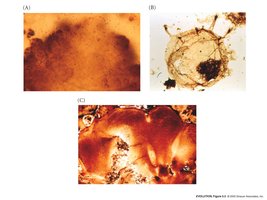
The oldest eukaryotic fossils date back to approximately 2.1–1.8 billion years ago. Eukaryotes are more complex than prokaryotes, possessing a nuclear envelope, mitochondria, endoplasmic reticulum, and a cytoskeleton.
Endosymbiotic Theory
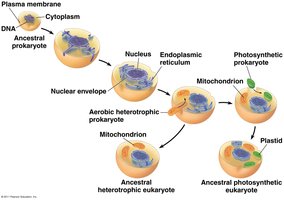
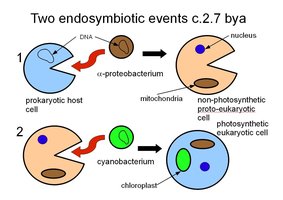
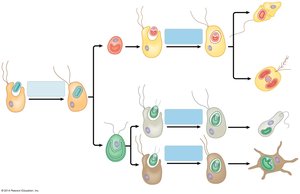
The endosymbiotic theory explains the origin of mitochondria and plastids (such as chloroplasts) in eukaryotic cells. According to this theory, these organelles originated as small prokaryotes that began living within larger host cells, eventually becoming integrated as essential cellular components.
Mitochondria: Evolved before plastids; likely originated from an aerobic heterotrophic prokaryote (α-proteobacterium).
Plastids: Originated from photosynthetic prokaryotes (cyanobacteria) via primary endosymbiosis, followed by secondary endosymbiosis in some lineages.
Serial Endosymbiosis: Mitochondria were acquired first, followed by plastids in some groups.
Evidence Supporting Endosymbiotic Theory
Inner membranes of mitochondria and plastids resemble prokaryotic plasma membranes.
These organelles divide similarly to prokaryotes and contain their own DNA and ribosomes, which are more similar to those of prokaryotes than eukaryotes.
Phylogenetic analyses show mitochondria are closely related to α-proteobacteria, and plastids to cyanobacteria.
Classification and Diversity of Protists
Protists Are Not a Monophyletic Group
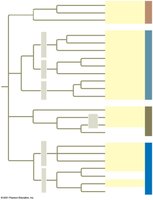
Protists are considered a paraphyletic group, meaning they include some but not all descendants of a common ancestor. There are no unique synapomorphies that define all protists, and their classification has changed with advances in molecular phylogenetics.
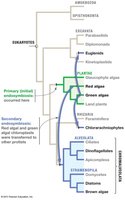
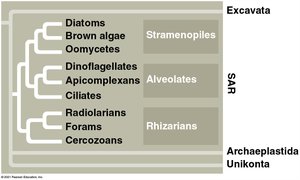
Four major supergroups: Excavata, SAR Clade, Archaeplastida, Unikonta.
Major clades within these supergroups are based on morphology and genetic data.
Major Protist Supergroups and Examples
Supergroup | Major Groups | Key Features | Examples |
|---|---|---|---|
Excavata | Diplomonads, Parabasalids, Euglenozoans | Excavated feeding groove, modified mitochondria, unique flagella | Giardia, Trichomonas, Euglena |
SAR Clade | Stramenopiles, Alveolates, Rhizarians | Hairy and smooth flagella, membrane-enclosed sacs (alveoli), threadlike pseudopodia | Diatoms, Brown algae, Dinoflagellates, Plasmodium, Paramecium, Forams |
Archaeplastida | Red algae, Green algae, Land plants | Plant-type chloroplasts, phycoerythrin pigment (red algae) | Porphyra, Ulva, Volvox |
Unikonta | Amoebozoans, Opisthokonts | Lobe- or tube-shaped pseudopodia | Amoeba, Slime molds, Animals, Fungi |
Endosymbiosis and the Evolution of Plastids
Primary and Secondary Endosymbiosis
Primary endosymbiosis involved the engulfment of a cyanobacterium by a heterotrophic eukaryote, leading to the origin of red and green algae. Secondary endosymbiosis occurred when these algae were engulfed by other eukaryotes, resulting in plastids with three or four membranes.
Photosynthetic protists are distinguished by their pigments, which absorb specific wavelengths of light and reduce competition.
Protist Structure, Locomotion, and Nutrition
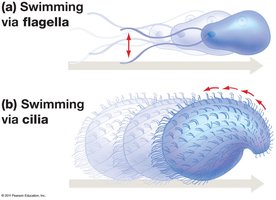
Locomotion
Protists exhibit diverse forms of movement, including:
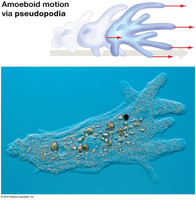
Amoeboid motion: Sliding via streaming pseudopodia.
Flagella: Swimming using one or more long, whip-like structures.
Cilia: Swimming using numerous short, hair-like structures.
Nutrition
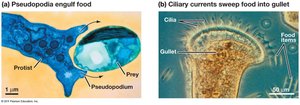
Protists have evolved various methods for obtaining nutrients:
Ingestion: Engulfing food particles or cells.
Absorption: Taking up dissolved organic molecules from the environment.
Photosynthesis: Using chloroplasts to convert light energy into chemical energy.
Major Protist Groups
Excavata
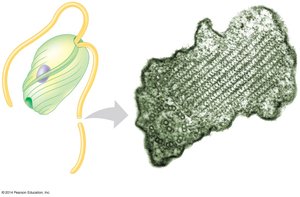
Characterized by an excavated feeding groove, modified mitochondria, and unique flagella. Includes important groups such as euglenozoans, which can be heterotrophic, autotrophic, or mixotrophic.
Kinetoplastids: Free-living or parasitic (e.g., Trypanosoma, causes sleeping sickness).
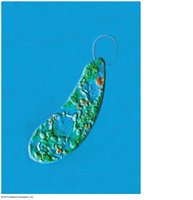
Euglenids: Possess one or two flagella, can be mixotrophic (e.g., Euglena).
SAR Clade
This supergroup includes Stramenopiles, Alveolates, and Rhizarians. It is defined largely by DNA evidence and includes many ecologically important protists.
Stramenopiles: Diatoms (photosynthetic, silica cell walls), brown algae (multicellular, marine "seaweeds"), golden algae.
Alveolates: Dinoflagellates (two flagella, red tides), apicomplexans (parasites, e.g., Plasmodium), ciliates (move/feed with cilia, e.g., Paramecium).
Rhizarians: Amoebas with threadlike pseudopodia (e.g., forams, radiolarians).
Archaeplastida
Includes red algae, green algae, and land plants. These groups are united by the presence of plastids derived from primary endosymbiosis with cyanobacteria.
Red algae: Contain phycoerythrin pigment, mostly multicellular, abundant in tropical waters.
Green algae: Paraphyletic group; includes chlorophytes and charophytes (the latter closely related to land plants).
Unikonta
Includes amoebozoans (with lobe- or tube-shaped pseudopodia) and opisthokonts (animals, fungi, and related protists).
Amoebozoans: Slime molds (plasmodial and cellular), tubulinids, entamoebas (parasitic).
Opisthokonts: Animals, fungi, and some protists.
Life Cycles: Alternation of Generations
Alternation of Generations
Many protists, especially algae, exhibit alternation of generations, alternating between multicellular haploid (n) and diploid (2n) forms. The diploid sporophyte produces haploid spores by meiosis, which develop into haploid gametophytes. Gametes fuse during fertilization to form a diploid zygote.
Ecological Roles of Protists
Environmental Importance
Protists are found in most wet habitats and play key roles as symbionts, mutualists, and primary producers. Photosynthetic protists are major producers in aquatic ecosystems, forming the base of many food webs. Some protists are important pathogens or cause harmful algal blooms.
Symbiosis: Dinoflagellates with coral, protists in termite guts.
Producers: Diatoms, dinoflagellates, and algae contribute significantly to global oxygen production and carbon cycling.
Summary Table: Major Protist Supergroups
Supergroup | Major Groups | Key Morphological Characteristics | Specific Examples |
|---|---|---|---|
Excavata | Diplomonads, Parabasalids, Euglenozoans | Modified mitochondria, spiral/crystalline rod in flagella | Giardia, Trichomonas, Euglena, Trypanosoma |
SAR Clade | Stramenopiles, Alveolates, Rhizarians | Hairy/smooth flagella, alveoli, threadlike pseudopodia | Diatoms, Brown algae, Dinoflagellates, Plasmodium, Paramecium, Forams |
Archaeplastida | Red algae, Green algae, Land plants | Phycoerythrin pigment, plant-type chloroplasts | Porphyra, Ulva, Volvox, Mosses, Ferns |
Unikonta | Amoebozoans, Opisthokonts | Lobe/tube-shaped pseudopodia | Amoeba, Dictyostelium, Animals, Fungi |
Review Questions
How are protists different from bacteria and archaea?
How did mitochondria and plastids evolve? What organisms were involved?
What are the major groups of protists and their key features?
What is alternation of generations, and what alternates?
What ecological roles do protists play in the environment?
