 Indietro
Protists: Diversity, Evolution, and Ecological Roles
Guida di studio - Note intelligenti
 Appunti personalizzati basati sui tuoi materiali, ampliati con definizioni chiave, esempi e contesto.
Protists: The Big Picture
Introduction to Protists
Protists are a diverse group of eukaryotic organisms that are primarily unicellular, but also include colonial and multicellular forms. They exhibit a wide range of nutritional strategies, structural features, and life cycles. Understanding protists is essential for grasping the evolution of eukaryotes and their ecological significance.
Eukaryotes possess a nucleus and membrane-bound organelles, distinguishing them from prokaryotes (bacteria and archaea).
Protists are not a monophyletic group; they are paraphyletic, meaning they include some but not all descendants of their most recent common ancestor.
They play crucial roles in aquatic ecosystems as primary producers, symbionts, and pathogens.
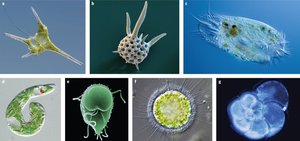
Origin and Evolution of Eukaryotes
Fossil Evidence and Complexity
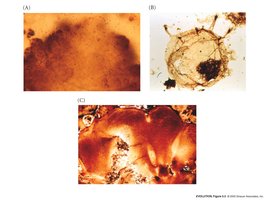
The oldest eukaryotic fossils date back to approximately 2.1–1.8 billion years ago. Eukaryotes are more structurally complex than prokaryotes, typically possessing a nuclear envelope, mitochondria, endoplasmic reticulum, and a cytoskeleton.
Early eukaryotic fossils include unicellular and multicellular algae.
Multicellularity evolved independently in several eukaryotic lineages, giving rise to algae, plants, fungi, and animals.
Endosymbiotic Theory
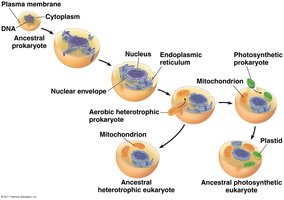
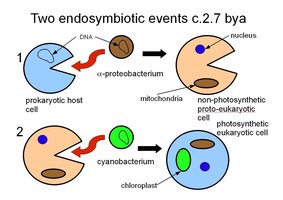
The endosymbiotic theory explains the origin of mitochondria and plastids (chloroplasts and related organelles) in eukaryotic cells. According to this theory, these organelles originated as free-living prokaryotes that were engulfed by ancestral eukaryotic cells.
Mitochondria evolved from an alphaproteobacterial ancestor.
Plastids (including chloroplasts) evolved from a cyanobacterial ancestor.
Serial endosymbiosis: mitochondria originated before plastids.
Evidence Supporting Endosymbiotic Theory
Inner membranes of mitochondria and plastids resemble prokaryotic membranes.
These organelles divide by fission, similar to prokaryotes.
They contain their own DNA and ribosomes, which are more similar to those of prokaryotes than eukaryotes.
Phylogenetic analyses show mitochondria are closely related to alphaproteobacteria, and plastids to cyanobacteria.
Protist Diversity and Classification
Major Supergroups of Eukaryotes
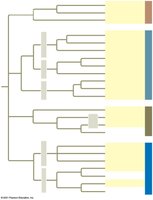
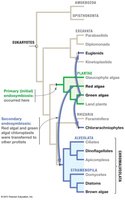
Protists are distributed among four major eukaryotic supergroups, each with unique characteristics and evolutionary histories:
Excavata: Characterized by an excavated feeding groove, modified mitochondria, and unique flagella.
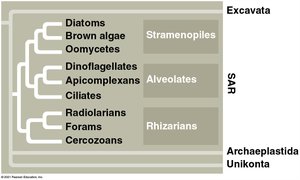
SAR Clade: Includes Stramenopiles (e.g., diatoms, brown algae), Alveolates (e.g., dinoflagellates, ciliates), and Rhizarians (e.g., forams, radiolarians).
Archaeplastida: Includes red algae, green algae, and land plants (the latter discussed in later chapters).
Unikonta: Includes amoebozoans (e.g., slime molds, tubulinids) and opisthokonts (animals, fungi, and related protists).
Protist Nutrition and Life Cycles
Photoautotrophs: Use chloroplasts to perform photosynthesis.
Heterotrophs: Ingest food particles or absorb organic molecules.
Mixotrophs: Combine photosynthesis and heterotrophic nutrition.
Reproduction can be sexual or asexual, with some groups exhibiting alternation of generations.
Endosymbiosis: Primary and Secondary
Primary Endosymbiosis
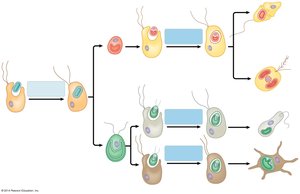
Primary endosymbiosis refers to the engulfment of a prokaryote (e.g., cyanobacterium) by a eukaryotic host, leading to the origin of mitochondria and primary plastids.
All Archaeplastida plastids trace to a single primary endosymbiotic event.
Secondary Endosymbiosis
Secondary endosymbiosis occurs when a eukaryotic cell engulfs another eukaryotic cell that already contains a primary plastid, resulting in plastids with three or four membranes.
Many photosynthetic protists (e.g., euglenids, dinoflagellates) acquired plastids this way.
Protist Structure and Locomotion
Cellular Organization
Protists exhibit a range of cellular organizations, from unicellular to colonial and multicellular forms. Their cells are generally more complex than those of prokaryotes.
Locomotion
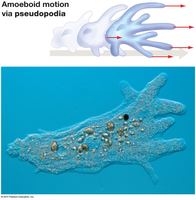
Amoeboid movement: Sliding via streaming pseudopodia (extensions of the cytoplasm).
Flagella: Long, whip-like structures used for swimming.
Cilia: Short, hair-like structures that beat in coordinated waves for movement or feeding.
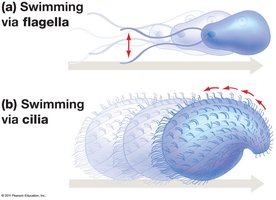
Nutrition in Protists
Feeding Mechanisms
Ingestion: Engulfing food particles or prey using pseudopodia or oral grooves.
Absorption: Taking up dissolved nutrients from the environment, often after external digestion.
Photosynthesis: Using light energy to synthesize organic molecules.
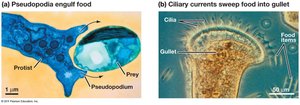
Major Protist Groups: Key Features and Examples
Excavata
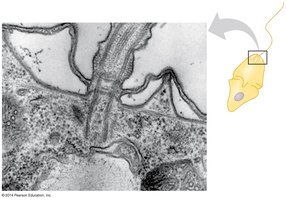
Characterized by an excavated feeding groove and unique flagellar structure (crystalline rod).
Includes euglenozoans (e.g., Euglena, Trypanosoma).
Kinetoplastids are often parasitic; euglenids can be mixotrophic.
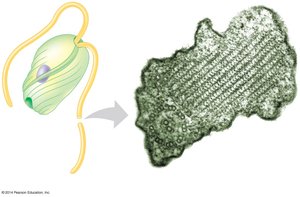
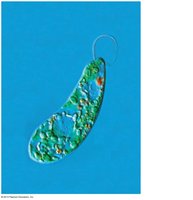
SAR Clade
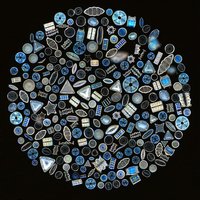
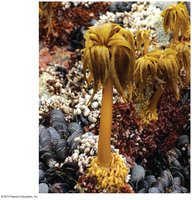
Stramenopiles: Diatoms (silica walls), golden algae (carotenoid pigments), brown algae (kelp, multicellular).
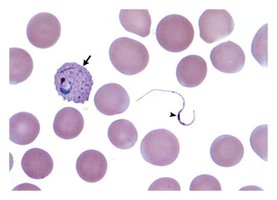
Alveolates: Dinoflagellates (two flagella, cellulose plates, red tides), apicomplexans (parasites, e.g., Plasmodium), ciliates (cilia, macro- and micronuclei, conjugation).
Rhizarians: Threadlike pseudopodia, includes forams and radiolarians.
Archaeplastida
Includes red algae (phycoerythrin pigment), green algae (chlorophyll a & b), and land plants.
Red algae are mostly multicellular and abundant in tropical waters.
Green algae include colonial (Volvox), multicellular (Ulva), and multinucleate (Caulerpa) forms.
Unikonta
Amoebozoans: Lobe- or tube-shaped pseudopodia, includes slime molds (plasmodial and cellular), tubulinids, and entamoebas.
Opisthokonts: Includes animals, fungi, and related protists.
Life Cycles: Alternation of Generations
Alternation of Generations
Some protists (and all plants) exhibit alternation of generations, alternating between multicellular haploid (n) and diploid (2n) forms.
The diploid sporophyte produces haploid spores by meiosis.
Haploid spores grow into multicellular gametophytes, which produce gametes by mitosis.
Gametes fuse during fertilization to form a diploid zygote, which grows into a new sporophyte.
Ecological Roles of Protists
Environmental Importance
Protists are key primary producers in aquatic ecosystems, forming the base of many food webs.
They engage in symbiotic relationships (e.g., dinoflagellates with coral, protists in termite guts).
Some protists are important pathogens or cause harmful algal blooms (e.g., red tides).
Types of Ecological Interactions
Classification of Interactions
Mutualism (+,+): Both partners benefit.
Commensalism (+,0): One benefits, the other is unaffected.
Parasitism (+,−): One benefits at the expense of the other.
Competition (−,−): Both are harmed by vying for the same resource.
Amensalism (0,−): One is harmed, the other is unaffected.
Summary Table: Major Protist Groups
Eukaryote Supergroup | Major Groups | Key Morphological Characteristics | Specific Examples |
|---|---|---|---|
Excavata | Diplomonads, Parabasalids, Euglenozoans (Kinetoplastids, Euglenids) | Modified mitochondria, spiral/crystalline rod in flagella | Giardia, Trichomonas, Trypanosoma, Euglena |
SAR | Stramenopiles (Diatoms, Brown algae), Alveolates (Dinoflagellates, Apicomplexans, Ciliates), Rhizarians (Forams, Radiolarians) | Hairy and smooth flagella, membrane-enclosed sacs (alveoli), threadlike pseudopodia | Phytophthora, Laminaria, Pfiesteria, Plasmodium, Paramecium, Globigerina |
Archaeplastida | Red algae, Green algae, Land plants | Phycoerythrin pigment, plant-type chloroplasts | Porphyra, Chlamydomonas, Ulva, mosses, ferns, conifers, flowering plants |
Unikonta | Amoebozoans (Slime molds, Tubulinids, Entamoebas), Opisthokonts (Animals, Fungi, some protists) | Lobe- or tube-shaped pseudopodia, highly variable | Amoeba, Dictyostelium, Choanoflagellates, nucleariids, animals, fungi |
Review Questions for Practice
How are protists different from bacteria and archaea?
How did mitochondria and plastids evolve? What organisms were involved?
What are the major groups of protists and their key features?
What is alternation of generations, and what alternates?
What ecological roles do protists perform?
