 Indietro
Protists: Diversity, Structure, and Evolution (Campbell Biology Chapter 28)
Guida di studio - Note intelligenti
 Appunti personalizzati basati sui tuoi materiali, ampliati con definizioni chiave, esempi e contesto.
Protists: Diversity, Structure, and Evolution
Introduction to Protists
Protists are a diverse group of mostly unicellular eukaryotes that are not classified as plants, animals, or fungi. They exhibit remarkable structural and functional diversity and play key roles in ecological systems. - Protist is an informal term for eukaryotes that are not plants, animals, or fungi. - Protists are no longer considered a single kingdom due to their varied evolutionary relationships. - Eukaryotic cells, including protists, have a nucleus and membrane-enclosed organelles, making them more complex than prokaryotes. - The cytoskeleton allows eukaryotic cells to change shape and maintain asymmetry. 
Structural and Functional Diversity in Protists
Protists display greater structural and functional diversity than any other group of eukaryotes. - Most protists are unicellular, but some are colonial or multicellular. - Unicellular protists are highly complex, carrying out all life functions within a single cell. - Some protists possess unique organelles, such as the ocelloid (an eye-like structure in dinoflagellates). 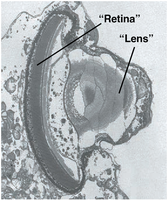 - Protists can be photoautotrophs (with chloroplasts), heterotrophs, or mixotrophs. - Reproduction varies: some reproduce only asexually, others have both sexual and asexual phases.
Endosymbiosis and Plastid Evolution
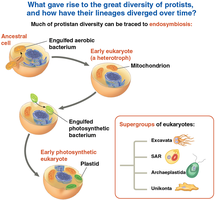
The origin of eukaryotes and their organelles is closely tied to endosymbiosis. - Endosymbiosis is the process by which one organism lives inside another, leading to the evolution of mitochondria and plastids. - Mitochondria originated when an ancestral eukaryote engulfed an aerobic bacterium. - Plastids (chloroplasts) arose when a heterotrophic eukaryote engulfed a photosynthetic cyanobacterium, giving rise to red and green algae. - Secondary endosymbiosis occurred when red or green algae were engulfed by other eukaryotes, leading to further diversity. 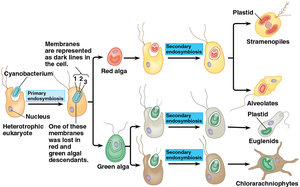
Supergroups of Eukaryotes
Modern classification divides eukaryotes into four supergroups, reflecting evolutionary relationships. - The four supergroups are: Excavata, SAR, Archaeplastida, and Unikonta. - The root of the eukaryotic tree is still uncertain. 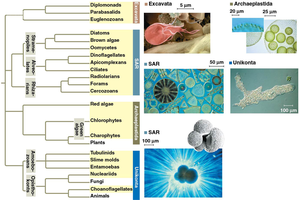
Exploring Protist Diversity
Excavata
- Includes three clades: parabasalids, diplomonads, and euglenozoans. - Giardia intestinalis is a diplomonad parasite causing intestinal infections. 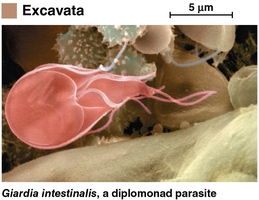
SAR
- Composed of Stramenopila, Alveolata, and Rhizaria. - Diatoms are photosynthetic stramenopiles. - Many rhizarians are amoebas with threadlike pseudopodia, such as Globigerina. 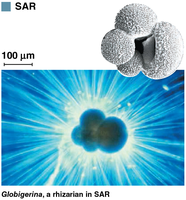
Archaeplastida
- Includes red and green algae, and plants. - Volvox is a multicellular green alga.
Unikonta
- Includes amoebas with lobe- or tube-shaped pseudopodia, animals, fungi, and related protists. - Amoeba proteus is a tubulinid amoeba.
Key Features of Excavata
- Excavates have modified mitochondria and unique flagella. - Characterized by a cytoskeleton and sometimes an "excavated" feeding groove. - Includes diplomonads, parabasalids, and euglenozoans.
Diplomonads and Parabasalids
- Lack plastids, have reduced mitochondria, and live in anaerobic environments. - Diplomonads have mitosomes (reduced mitochondria), two nuclei, multiple flagella, and are often parasitic. - Parabasalids have hydrogenosomes (reduced mitochondria), generate energy anaerobically, and include Trichomonas vaginalis, a sexually transmitted parasite.
Euglenozoans
- Includes predatory heterotrophs, autotrophs, mixotrophs, and parasites. - Kinetoplastids have a single mitochondrion with a kinetoplast (DNA mass). - Euglenids have one or two flagella and can switch between autotrophic and heterotrophic modes.
SAR Supergroup
Stramenopiles
- Important photosynthetic organisms with "hairy" and "smooth" flagella. - Includes diatoms, oomycetes, and brown algae.
Diatoms
- Unicellular algae with glass-like walls of silicon dioxide. - Walls withstand high pressure and protect from predators. - Diatoms are abundant in phytoplankton and influence global CO2 levels.
Brown Algae
- Largest and most complex multicellular algae. - Marine, plantlike structures (holdfast, stipe, blades), but lack true tissues. - Used as food and in processed foods (algin).
Alternation of Generations
- Life cycle with multicellular haploid (gametophyte) and diploid (sporophyte) stages. - Fertilization produces a diploid zygote, which develops into a sporophyte. - Heteromorphic species have structurally different stages; isomorphic species have similar stages.
Oomycetes
- Water molds, white rusts, and downy mildews. - Cell walls of cellulose (not chitin), not closely related to fungi. - Acquire nutrients by parasitism or decomposition.
Alveolates
- Have membrane-enclosed sacs (alveoli) under the plasma membrane. - Includes dinoflagellates, apicomplexans, and ciliates.
Dinoflagellates
- Marine and freshwater phytoplankton with two flagella in cellulose plates. - Cause "red tides" due to carotenoids; toxic blooms can kill marine life.
Apicomplexans
- Animal parasites with complex organelles for host penetration. - Life cycles include sexual and asexual stages, often requiring multiple hosts. - Plasmodium causes malaria.
Ciliates
- Use cilia for movement and feeding. - Have micronuclei and macronuclei; conjugation exchanges micronuclei for genetic variation. - Reproduce asexually by binary fission.
Rhizarians
- Mostly amoebas with threadlike pseudopodia. - Includes radiolarians (silica skeletons), forams (calcium carbonate shells), and cercozoans.
Archaeplastida
- Red and green algae are closest relatives of plants. - Plastids originated from cyanobacterial endosymbionts. - Plants descended from green algae.
Red Algae
- Accessory pigment phycoerythrin gives red color. - Mostly multicellular; sexual reproduction with alternation of generations. - Some species are edible (e.g., Porphyra used in sushi).
Green Algae
- Green chloroplasts similar to plants. - Includes charophytes (closest to plants) and chlorophytes. - Larger size and complexity evolved via colonies, multicellular bodies, or nuclear division without cytoplasmic division. - Complex life cycles with sexual and asexual stages; alternation of generations in some species.
Unikonta
- Includes animals, fungi, and some protists. - Two major clades: amoebozoans (tubulinids, slime molds, entamoebas) and opisthokonts (animals, fungi, related protists).
Amoebozoans
- Amoebas with lobe- or tube-shaped pseudopodia. - Tubulinids are active predators or detritus feeders. - Slime molds produce fruiting bodies; plasmodial slime molds form a "supercell" plasmodium, cellular slime molds aggregate for migration and reproduction.
Entamoebas
- Parasitic amoebas; Entamoeba histolytica causes amoebic dysentery.
Ecological Roles of Protists
Symbiotic Protists
- Some protists benefit hosts (e.g., dinoflagellates in corals, protists in termite guts). - Others are parasites (e.g., Plasmodium, Pfiesteria shumwayae, Phytophthora ramorum).
Photosynthetic Protists
- Producers that convert CO2 into organic compounds using light energy. - Populations are limited by nutrients; blooms occur when nutrients are added. - Phytoplankton communities depend on upwelling of nutrient-rich water; warming oceans may disrupt this and affect global carbon cycles.
Summary Table: Major Protist Supergroups and Examples
Supergroup | Key Clades | Representative Example | Key Features |
|---|---|---|---|
Excavata | Diplomonads, Parabasalids, Euglenozoans | Giardia intestinalis | Modified mitochondria, unique flagella |
SAR | Stramenopiles, Alveolates, Rhizarians | Globigerina | Photosynthetic, diverse amoebas, complex life cycles |
Archaeplastida | Red algae, Green algae, Plants | Volvox | Photosynthetic, multicellular forms |
Unikonta | Amoebozoans, Opisthokonts | Amoeba proteus | Lobe-shaped pseudopodia, close to animals/fungi |
Additional info: This summary expands on the original notes with definitions, examples, and context for each supergroup and major protist clade, as well as ecological roles and evolutionary history.
