 Indietro
Protostome Animals: Diversity, Structure, and Function
Guida di studio - Note intelligenti
 Appunti personalizzati basati sui tuoi materiali, ampliati con definizioni chiave, esempi e contesto.
Protostome Animals
Introduction to Protostomes
Protostomes are a major group within the animal kingdom, characterized by their developmental mode and remarkable diversity. They play essential ecological and economic roles, occupying nearly every habitat and serving as food sources, ecosystem engineers, and sometimes as pests or disease vectors.
Definition: Protostomes are animals in which the mouth develops from the primary embryonic opening (blastopore).
Diversity: Of the 30 described animal phyla, 22 are protostomes, including arthropods, mollusks, annelids, and flatworms.
Ecological Roles: Protostomes can be detritivores, herbivores, or carnivores, and are found in aquatic and terrestrial environments.
Human Importance: They provide food, ecosystem services, materials (e.g., silk, pearls), and include model organisms such as Drosophila melanogaster and Caenorhabditis elegans.

Developmental Characteristics of Protostomes
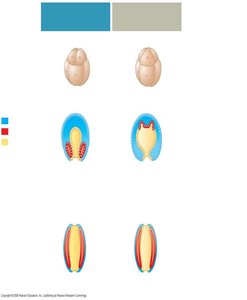
Protostomes are traditionally distinguished from deuterostomes by their embryonic development. Recent molecular data support two major protostome subgroups: Lophotrochozoa and Ecdysozoa.
Cleavage: Protostomes exhibit spiral, determinate cleavage; deuterostomes have radial, indeterminate cleavage.
Coelom Formation: In protostomes, the coelom forms by splitting of the mesoderm (schizocoely); in deuterostomes, it forms by outpocketing of the archenteron (enterocoely).
Blastopore Fate: In protostomes, the blastopore becomes the mouth; in deuterostomes, it becomes the anus.
Major Protostome Lineages
Lophotrochozoa: Includes mollusks, annelids, and flatworms. Characterized by the presence of a lophophore (feeding structure), trochophore larvae, and spiral cleavage.
Ecdysozoa: Includes nematodes and arthropods. Characterized by growth through molting (ecdysis) of a cuticle or exoskeleton.
Water-to-Land Transition in Protostomes
Adaptations for Terrestrial Life
The transition from aquatic to terrestrial environments required significant adaptations in protostomes to facilitate gas exchange, prevent desiccation, and support their bodies.
Gas Exchange: High surface-area-to-volume ratios in roundworms and earthworms facilitate gas exchange; some arthropods and mollusks have internalized gills or respiratory structures.
Water Conservation: Insects evolved a waxy cuticle and can close respiratory openings; eggs of terrestrial species are resistant to desiccation.
Structural Support: Adaptations to support body weight outside water include exoskeletons and muscular hydrostats.
Phylum Porifera (Sponges)
Structure and Function
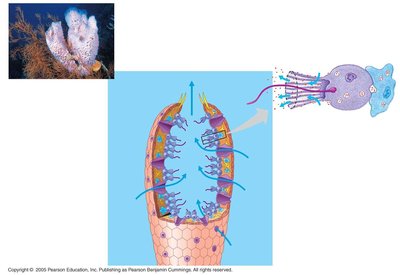
Sponges are basal animals lacking true tissues and organs. They are sessile suspension feeders, filtering water to capture food particles.
Body Structure: Composed of two cell layers separated by a noncellular mesohyl; water flows through pores into the spongocoel and out the osculum.
Choanocytes: Flagellated collar cells that generate water currents and capture food by phagocytosis.
Amoebocytes: Cells in the mesohyl involved in digestion and structural support.
Reproduction: Most sponges are hermaphrodites, functioning as both male and female.
Phylum Cnidaria
Body Plan and Function
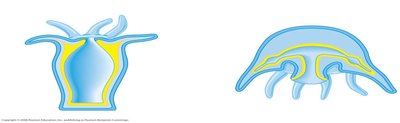
Cnidarians are diploblastic animals with radial symmetry and a simple body plan. They include jellies, corals, and hydras.
Gastrovascular Cavity: Central digestive compartment with a single opening serving as both mouth and anus.
Body Forms: Two main forms: sessile polyp and motile medusa.
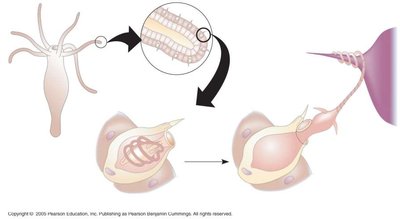
Cnidocytes: Specialized cells containing nematocysts for prey capture and defense.
Classification of Cnidarians
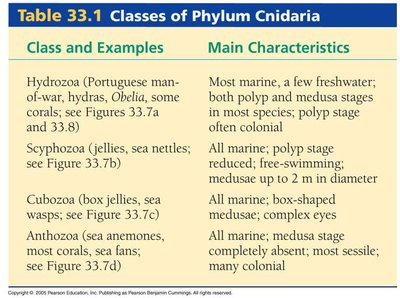
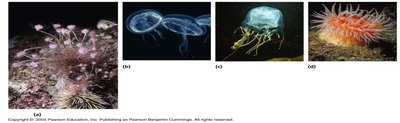
Cnidarians are divided into four major classes, each with distinct characteristics and life cycles.
Class and Examples | Main Characteristics |
|---|---|
Hydrozoa (hydras, Obelia, some corals) | Most marine, some freshwater; both polyp and medusa stages; polyp stage often colonial |
Scyphozoa (jellies, sea nettles) | All marine; polyp stage reduced; free-swimming medusae up to 2 m in diameter |
Cubozoa (box jellies, sea wasps) | All marine; box-shaped medusa; complex eyes |
Anthozoa (sea anemones, most corals, sea fans) | All marine; medusa stage absent; most sessile; many colonial |
Life Cycle of Hydrozoans (Obelia)
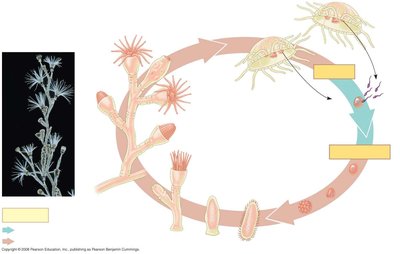
Hydrozoans often alternate between polyp and medusa forms, with both sexual and asexual reproduction.
Asexual Reproduction: Budding of polyps forms colonies.
Sexual Reproduction: Medusae produce gametes; fertilization leads to a planula larva, which settles and develops into a new polyp.
Lophotrochozoans
Defining Features
Lophotrochozoans are a diverse group within protostomes, united by the presence of a lophophore, trochophore larvae, or spiral cleavage.
Lophophore: A ciliated feeding structure surrounding the mouth.
Trochophore Larva: A free-swimming larval stage with a ring of cilia.
Spiral Cleavage: Unique embryonic cell division pattern.


Key Lineages of Lophotrochozoans
Lophotrochozoans include several important phyla, each with unique adaptations and ecological roles.
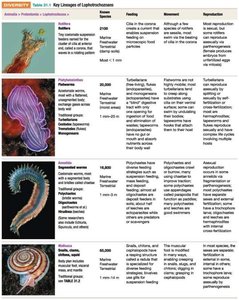
Phylum | Habitat | Feeding | Movement | Reproduction |
|---|---|---|---|---|
Platyhelminthes (Flatworms) | Marine, freshwater, damp terrestrial | Free-living or parasitic; some have no digestive tract | Cilia, muscles | Sexual and asexual; some hermaphroditic |
Annelida (Segmented worms) | Marine, freshwater, terrestrial | Deposit feeders, suspension feeders, predators | Segmented muscles, parapodia | Sexual and asexual; some hermaphroditic |
Mollusca (Mollusks) | Marine, freshwater, terrestrial | Herbivores, filter feeders, predators | Muscular foot, tentacles | Sexual; some hermaphroditic |
Flatworms (Platyhelminthes)
Structure and Diversity
Flatworms are acoelomate, unsegmented worms with a flattened body. They lack specialized systems for gas exchange and circulation, relying on diffusion.
Major Lineages: Turbellaria (free-living), Cestoda (tapeworms), Trematoda (flukes), Monogenea (ectoparasites).
Feeding: Turbellarians are predators or scavengers; cestodes and trematodes are parasitic.


Cestoda (Tapeworms)
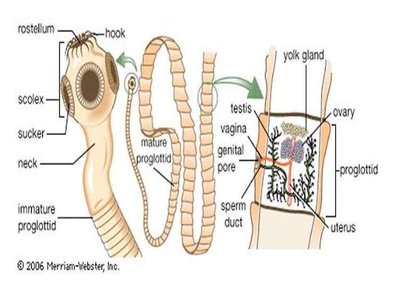
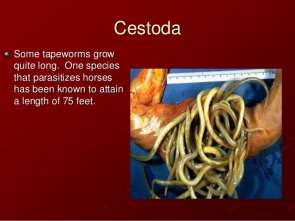
Tapeworms are endoparasites of vertebrates, lacking a digestive tract and absorbing nutrients across their body surface.
Structure: Composed of a scolex (head) with hooks and suckers, and a chain of proglottids (reproductive segments).
Transmission: Humans acquire tapeworms by eating undercooked meat containing larvae.
Trematoda (Flukes)
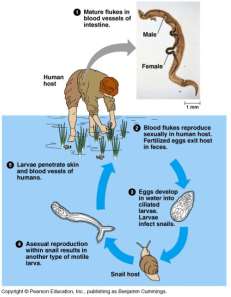
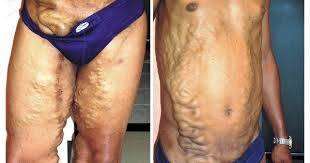
Flukes are endoparasites or ectoparasites of various animals. Some, like Schistosoma, cause significant human diseases such as schistosomiasis.
Life Cycle: Complex, often involving multiple hosts (e.g., snails and humans).
Monogenea
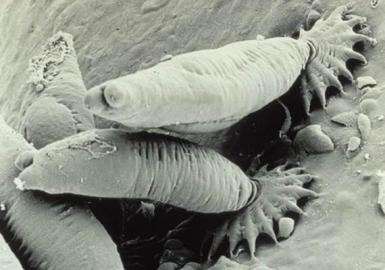
Monogeneans are tiny ectoparasites, usually found on the skin or gills of fish.
Annelida (Segmented Worms)
Structure and Function
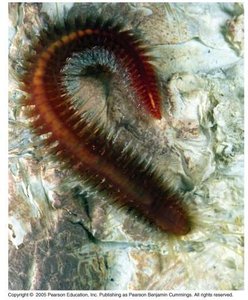
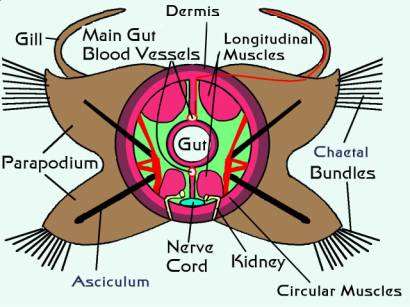
Annelids are segmented worms with a true coelom, a complete digestive tract, and bristle-like chaetae extending from parapodia.
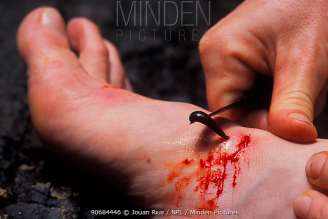
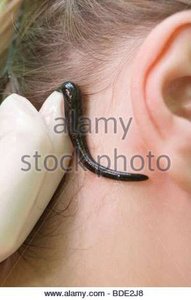
Major Groups: Polychaeta (marine worms), Oligochaeta (earthworms), Hirudinea (leeches).
Ecological Roles: Earthworms aerate soil and recycle nutrients; leeches are mostly ectoparasites.


Mollusca (Mollusks)
Body Plan and Diversity
Mollusks are a diverse group with a characteristic body plan consisting of a muscular foot, visceral mass, and mantle. They have undergone extensive adaptive radiation.
Foot: Used for movement; modified as tentacles in cephalopods or digging appendages in bivalves.
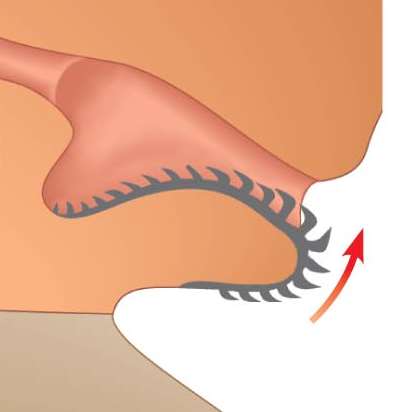
Visceral Mass: Contains internal organs and, in many, a rasping feeding structure called a radula.
Mantle: Secretes the shell (if present) and may form siphons or lungs.
Major Lineages: Chitons, bivalves, gastropods, cephalopods.



Shells and Mantle Adaptations
The mantle may secrete a shell of calcium carbonate, which provides protection but can limit mobility. Some mollusks have reduced or lost their shells entirely. The mantle also forms siphons for feeding and locomotion in bivalves and cephalopods.
Jet Propulsion: Cephalopods move by expelling water through a siphon.
Respiration: In some terrestrial snails, the mantle forms a lung.
Summary Table: Key Lineages of Lophotrochozoans
Phylum | Habitat | Feeding | Movement | Reproduction |
|---|---|---|---|---|
Platyhelminthes | Marine, freshwater, terrestrial | Predators, scavengers, parasites | Cilia, muscles | Sexual/asexual |
Annelida | Marine, freshwater, terrestrial | Deposit/suspension feeders, predators | Segmented muscles, parapodia | Sexual/asexual |
Mollusca | Marine, freshwater, terrestrial | Herbivores, filter feeders, predators | Muscular foot, tentacles | Sexual |
