 Indietro
Pyruvate Metabolism: Oxidation and Reduction in Cellular Respiration and Fermentation
Guida di studio - Note intelligenti
 Appunti personalizzati basati sui tuoi materiali, ampliati con definizioni chiave, esempi e contesto.
Pyruvate Metabolism in Cellular Respiration and Fermentation
Overview of Cellular Respiration
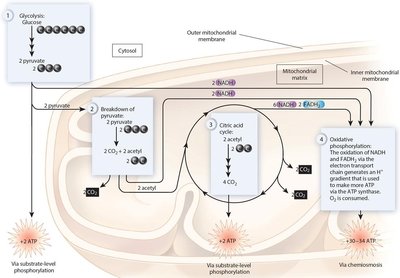
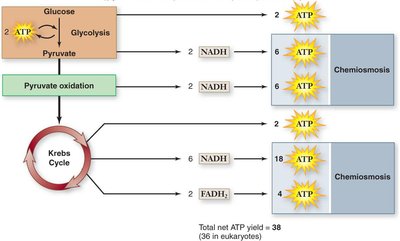
Cellular respiration is the process by which cells extract energy from organic molecules, primarily glucose. The fate of pyruvate, a key intermediate, depends on the presence or absence of oxygen. Understanding the flow of electrons, carbons, and phosphates is essential for grasping the mechanisms of energy production in cells.
Key Pathways: Glycolysis, Pyruvate Oxidation, Krebs Cycle, Electron Transport Chain, Fermentation
Cellular Locations: Cytosol (glycolysis), mitochondrial matrix (pyruvate oxidation, Krebs cycle), inner mitochondrial membrane (electron transport chain)
Follow the Electrons: Electrons are transferred via carriers (NADH, FADH2) to generate ATP
 `
Summary Equation of Cellular Respiration
The overall reaction for aerobic cellular respiration is:

Fate of Pyruvate: Oxidation vs. Reduction
Pyruvate Oxidation (Aerobic Conditions)
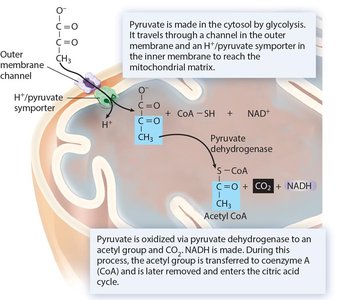
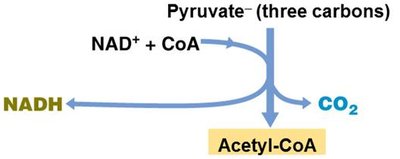
When oxygen is present, pyruvate undergoes oxidation in the mitochondrial matrix. This process is catalyzed by the enzyme pyruvate dehydrogenase, resulting in the formation of acetyl-CoA, NADH, and CO2.
Location: Mitochondrial matrix
Process: Pyruvate is transported across the mitochondrial membranes via a H+/pyruvate symporter
Reaction: Pyruvate + NAD+ + CoA → Acetyl-CoA + NADH + CO2
Products per glucose: 2 Acetyl-CoA, 2 NADH, 2 CO2
Structure and Function of Acetyl-CoA
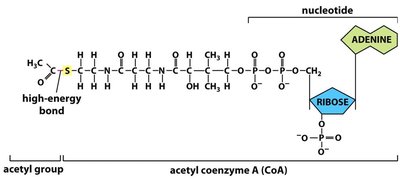
Acetyl-CoA is a central molecule in metabolism, formed from the acetyl group and coenzyme A. It enters the Krebs cycle for further oxidation.
High-energy bond: The acetyl group is linked to CoA via a thioester bond, which is hydrolyzed to release energy for subsequent reactions.
Krebs Cycle and Electron Transport Chain
Acetyl-CoA enters the Krebs cycle, where it is further oxidized, producing NADH, FADH2, and CO2. These electron carriers donate electrons to the electron transport chain, leading to ATP synthesis via oxidative phosphorylation.
ATP Yield: Most ATP is generated during oxidative phosphorylation, not directly in glycolysis or the Krebs cycle.
Terminal Electron Acceptor: Oxygen (O2) is the final electron acceptor in aerobic respiration.
Fermentation: Reduction of Pyruvate (Anaerobic Conditions)
Fermentation Pathways
When oxygen is absent, cells perform fermentation to regenerate NAD+ and allow glycolysis to continue. Pyruvate is reduced to either lactate or ethanol, depending on the organism.
Main Purpose: Regenerate NAD+ for glycolysis
ATP Yield: Only 2 ATP per glucose (from glycolysis)
Electron Acceptors: Organic molecules (pyruvate or acetaldehyde)
Does not require O2 or electron transport chain
Lactic Acid Fermentation
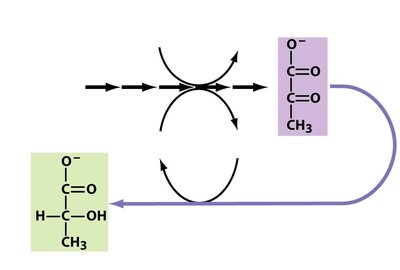
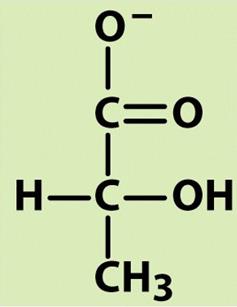
Occurs in muscle cells and some bacteria. Pyruvate is directly reduced to lactate by NADH.
Reaction: Pyruvate + NADH → Lactate + NAD+
Example: Human muscle cells during intense exercise
Alcohol Fermentation
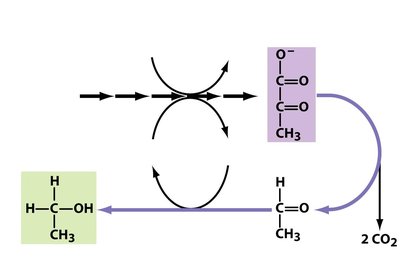
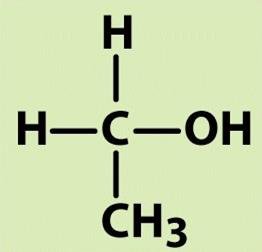
Occurs in yeast and some bacteria. Pyruvate is first converted to acetaldehyde, which is then reduced to ethanol by NADH.
Reaction: Pyruvate → Acetaldehyde + CO2; Acetaldehyde + NADH → Ethanol + NAD+
Example: Yeast cells in brewing and baking
Comparison: Cellular Respiration vs. Fermentation
Feature | Cellular Respiration | Fermentation |
|---|---|---|
O2 Requirement | Required (aerobic) | Not required (anaerobic) |
ATP Yield | ~36-38 ATP per glucose | 2 ATP per glucose |
End Products | CO2, H2O | Lactate or Ethanol + CO2 |
Electron Transport Chain | Present | Absent |
Electron Acceptors | O2 | Organic molecules (pyruvate or acetaldehyde) |
Key Concepts and Questions
What happens to pyruvate? It is oxidized in aerobic conditions (cellular respiration) or reduced in anaerobic conditions (fermentation).
Why is NAD+ regeneration important? Without NAD+, glycolysis would stop, halting ATP production.
Does fermentation extract additional energy from pyruvate? No, most bond energy remains in the end products.
How is ATP generated in fermentation? Only via substrate-level phosphorylation during glycolysis.
Additional info: Fermentation byproducts (lactate, ethanol) can be further metabolized in some organisms, but do not yield significant energy compared to aerobic respiration.
