 Indietro
Regulation of Gene Expression and Genetic Mutations in Eukaryotes
Guida di studio - Note intelligenti
 Appunti personalizzati basati sui tuoi materiali, ampliati con definizioni chiave, esempi e contesto.
Regulation of Gene Expression in Eukaryotes
Differential Gene Expression
Although all cells in a multicellular organism inherit the same genetic material, they can look and function differently due to differential gene expression. This process allows cells to produce specific proteins only when needed, in the right amount, and in particular cell types.
Differential gene expression: The selective activation or silencing of genes in different cells.
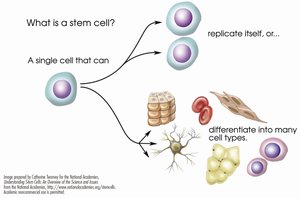
Example: Stem cells can differentiate into various cell types by expressing different sets of genes.
Levels of Gene Expression Regulation
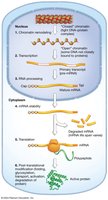
Gene expression in eukaryotes is regulated at multiple levels, ensuring precise control over protein production.
Transcriptional level: Regulation of whether a gene is transcribed into mRNA.
Chromatin remodeling: Changes in chromatin structure affect gene accessibility.
mRNA processing: Includes alternative splicing and modifications.
Translational level: Control of mRNA translation into protein.
Post-translational level: Modifications after protein synthesis.
Chromatin Remodeling
Structure and Function of Chromatin
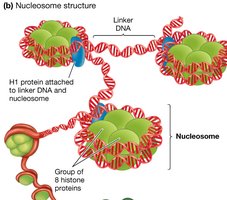
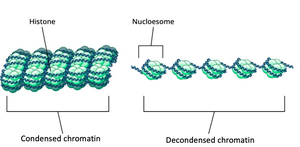
Chromatin consists of DNA wrapped around histone proteins, forming nucleosomes. Chromatin can exist in condensed (packed) or decondensed (unpacked) forms, which influences gene accessibility for transcription.
Nucleosome: The basic unit of chromatin, composed of DNA and histone proteins.
Condensed chromatin: Genes are hidden and not accessible for transcription.
Decondensed chromatin: Genes are exposed and can be transcribed.
Chromatin Modifications
Chromatin remodeling is regulated by chemical modifications to DNA and histones, which can be influenced by environmental factors.
DNA methylation: Addition of methyl groups (–CH3) to DNA, typically silences genes.
Histone acetylation: Addition of acetyl groups to histones, usually opens chromatin and promotes transcription.
Histone deacetylation: Removal of acetyl groups, leading to chromatin condensation and gene silencing.
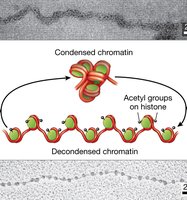
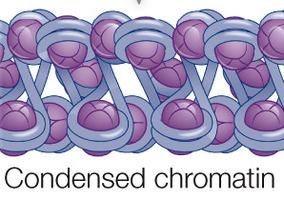
Epigenetic Inheritance
Epigenetic modifications, such as DNA methylation and histone acetylation, can be inherited through cell division and sometimes from parents to offspring. These modifications do not change the DNA sequence but affect gene expression.
Epigenetic inheritance: Transmission of chromatin modifications across generations.
Example: Environmental factors and upbringing can cause lasting epigenetic changes.
Transcriptional Regulation
Promoters, Enhancers, and Silencers
Transcription is initiated when RNA polymerase binds to the promoter region of a gene, often with the help of general transcription factors. Regulatory DNA sequences, such as enhancers and silencers, modulate transcription rates.
Promoter: DNA sequence where RNA polymerase and transcription factors bind.
Enhancer: DNA region that increases transcription when bound by activator proteins.
Silencer: DNA region that decreases transcription when bound by repressor proteins.
Mediator complex: Protein complex that facilitates communication between distant regulatory elements and the transcription machinery.
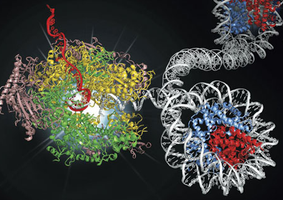
Alternative Splicing
Generating Multiple Proteins from One Gene
Alternative splicing allows a single gene to produce multiple protein variants by removing introns and joining exons in different combinations during mRNA processing.
Pre-mRNA: The initial transcript containing both exons and introns.
Alternative splicing: Process by which different mature mRNAs are produced from the same pre-mRNA.
Example: Humans have about 25,000 genes but can produce over 100,000 proteins due to alternative splicing.
Regulation by microRNAs
microRNA-Mediated mRNA Stability and Translation
MicroRNAs (miRNAs) are small RNA molecules that regulate gene expression by binding to specific mRNAs, leading to their degradation or blocking their translation.
microRNA: Small RNA (~20 bases) that binds to complementary mRNA sequences.
Perfect match: Leads to mRNA cleavage and rapid degradation.
Imperfect match: Blocks translation without degrading the mRNA.
Effect of Genetic Mutations
Types of Mutations and Their Consequences
Mutations are permanent changes in the DNA sequence. Point mutations, which affect one or a few base pairs, are the most common and can alter the protein coded by a gene.
Silent mutation: Changes a base pair but does not alter the amino acid sequence due to redundancy in the genetic code.
Missense mutation: Changes one amino acid in the protein, potentially affecting its function.
Nonsense mutation: Converts a codon to a stop codon, resulting in a truncated protein.
Frameshift mutation: Addition or deletion of nucleotides shifts the reading frame, drastically altering the protein sequence.
Type of Mutation | Effect on Protein |
|---|---|
Silent | No change in amino acid sequence |
Missense | One amino acid replaced by another |
Nonsense | Early stop codon, truncated protein |
Frameshift | Altered sequence after mutation |
Examples and Applications
Mutations in the insulin gene can lead to altered insulin protein and cause diseases such as type I diabetes. The impact of a mutation depends on its type and location within the gene.
Example: A missense mutation may change a hydrophobic amino acid to a hydrophilic one, affecting protein structure and function.
Equation: Central Dogma:
Summary Table: Levels of Gene Expression Regulation
Level | Mechanism | Effect |
|---|---|---|
Chromatin Remodeling | DNA/histone modifications | Gene accessibility |
Transcriptional | Promoters, enhancers, silencers | Transcription rate |
mRNA Processing | Alternative splicing | Protein diversity |
Translational | microRNA binding | Protein synthesis |
Post-translational | Protein modifications | Protein activity |
