 Indietro
Regulation of Gene Expression: Mechanisms and Examples
Guida di studio - Note intelligenti
 Appunti personalizzati basati sui tuoi materiali, ampliati con definizioni chiave, esempi e contesto.
Regulation of Gene Expression
Overview
Regulation of gene expression is a fundamental process that determines when, where, and how much a gene is expressed. This process allows cells to respond to environmental changes and differentiate into specialized cell types, despite having the same genome. Gene expression can be regulated at multiple stages, from DNA to protein.
Regulation of Gene Expression in Bacteria
Mechanisms of Regulation
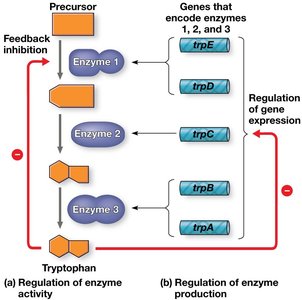
Bacterial cells regulate enzyme activity and production through two main mechanisms:
Feedback inhibition: Controls the activity of existing enzymes by inhibiting their function when the end product accumulates.
Gene regulation: Controls the production of enzymes by regulating the transcription of their genes.
Operons: The Basic Concept
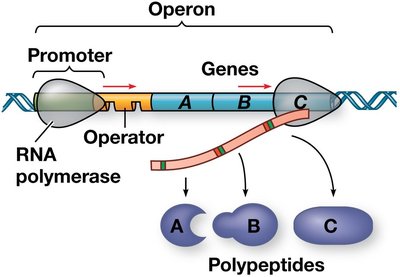
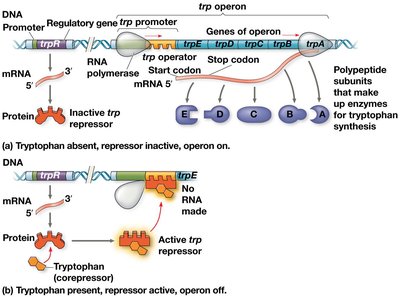
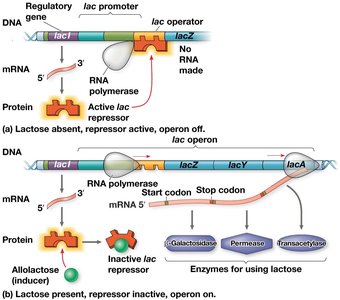
An operon is a stretch of DNA that includes a promoter, operator, and genes encoding functionally related proteins. The operator acts as an on-off switch for transcription, and a repressor protein can bind to the operator to turn transcription off. A corepressor works with the repressor to switch the operon off.
Types of Operons: Repressible and Inducible
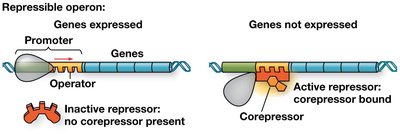
Repressible operon: Usually ON; binding of a repressor (with a corepressor) shuts OFF transcription. Example: trp operon.
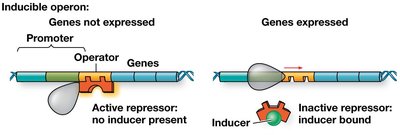
Inducible operon: Usually OFF; an inducer inactivates the repressor and turns ON transcription. Example: lac operon.
The trp Operon: A Repressible Operon
The trp operon in E. coli is responsible for tryptophan synthesis. When tryptophan is absent, the operon is ON; when tryptophan is present, it acts as a corepressor, activating the repressor and turning the operon OFF.
The lac Operon: An Inducible Operon
The lac operon in E. coli is responsible for lactose metabolism. When lactose is absent, the operon is OFF; when lactose is present, allolactose (an inducer) inactivates the repressor, turning the operon ON.
Positive Regulation of the lac Operon
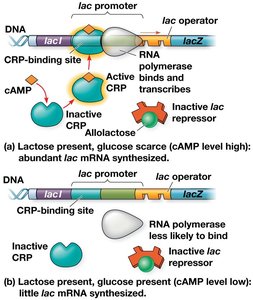
Transcription of the lac operon is also regulated by glucose levels. Low glucose leads to high cAMP, which activates CRP (cAMP receptor protein), enhancing transcription. High glucose results in low cAMP and inactive CRP, reducing transcription.
Regulation of Gene Expression in Eukaryotes
Differential Gene Expression
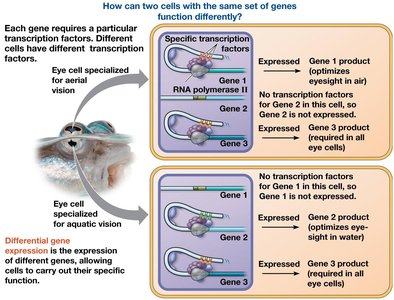
In multicellular organisms, cells with the same genome can express different sets of genes, allowing for cell specialization. This is known as differential gene expression.
Stages of Regulation
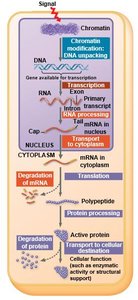
Gene expression in eukaryotes can be regulated at multiple stages:
Chromatin modification
Transcription
RNA processing and degradation
Translation
Protein processing and degradation
Regulation of Chromatin Structure
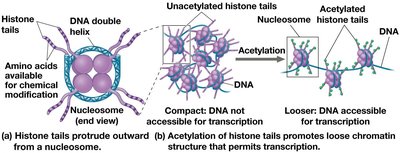
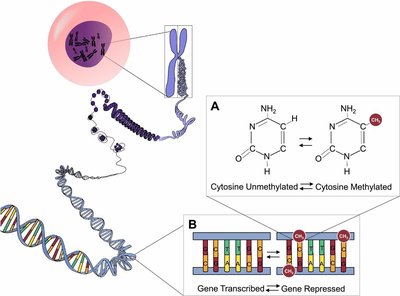
Chromatin structure determines DNA accessibility for transcription. Genes within tightly packed heterochromatin are usually not expressed. Chemical modifications of histones and DNA can alter chromatin structure and gene expression.
Histone Acetylation
Histone acetylation: Addition of acetyl groups to histone tails results in looser chromatin and increased transcription.
DNA Methylation
DNA methylation: Addition of methyl groups to DNA reduces transcription and can contribute to long-term gene silencing.
Epigenetic Inheritance
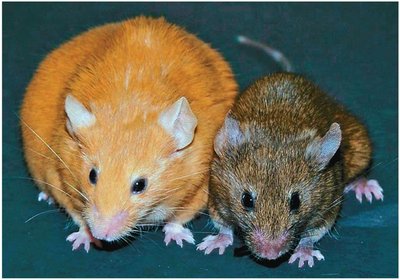
Chromatin modifications can affect gene expression without changing the DNA sequence. Some modifications are heritable, a phenomenon known as epigenetic inheritance. This can explain why identical twins may differ in disease susceptibility.
Control Elements and Transcription Factors
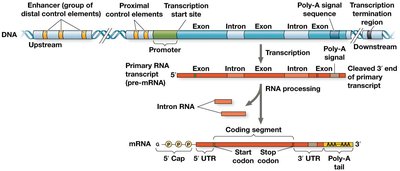
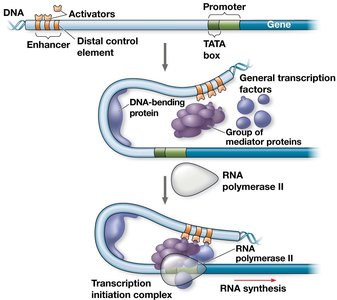
Control elements are noncoding DNA sequences that bind transcription factors. Proximal control elements are near the promoter, while distal control elements (enhancers) may be far from the gene. General transcription factors are required for transcription initiation, while specific transcription factors regulate particular genes.

Enhancers and Activators
Enhancers are groups of distal control elements. Activators are transcription factors that bind enhancers and stimulate transcription. DNA bending brings activators near the promoter, helping assemble the transcription initiation complex.
Combinatorial Control of Gene Activation
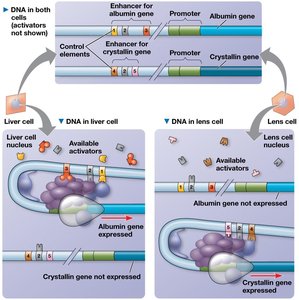
Different genes require different combinations of activators. Different cell types contain different activators, resulting in the expression of different genes.
Post-Transcriptional Regulation
Gene expression can be regulated after transcription through RNA processing, mRNA degradation, translation, and protein processing/degradation.
Alternative RNA Processing
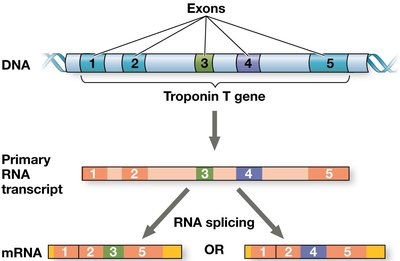
The same primary RNA transcript can be spliced in different ways, producing different mRNAs and proteins.
Regulation of Translation and mRNA Stability
Cells can control whether an mRNA is translated by using regulatory proteins.
The life span of an mRNA affects how much protein can be produced; longer-lived mRNAs allow more translation.
The poly-A tail influences mRNA stability.
Protein Processing and Degradation
After translation, proteins may be modified to become functional.
Proteins can be selectively degraded; ubiquitin tags proteins for degradation, and proteasomes recognize and degrade tagged proteins.
Summary Table: Regulation of Gene Expression
Stage | Mechanism | Example |
|---|---|---|
Chromatin | Acetylation (opens), Methylation (represses) | Histone acetylation increases transcription |
Transcription | Control elements, TFs, enhancers | Activators bind enhancers to stimulate transcription |
RNA/mRNA | Alternative splicing, mRNA stability | Different mRNAs from same transcript |
Translation | Control initiation | Regulatory proteins block translation |
Protein | Processing, ubiquitin-proteasome degradation | Ubiquitin tags proteins for degradation |
Key Message
Cells regulate gene expression at multiple checkpoints from DNA to RNA to protein, enabling complex control of cellular function and specialization.
