 Indietro
Regulation of Gene Expression: Step-by-Step Study Guide with Visuals
Guida di studio - Note intelligenti
 Appunti personalizzati basati sui tuoi materiali, ampliati con definizioni chiave, esempi e contesto.
Q5. What is histone acetylation/deacetylation and how does this affect chromatin structure and transcription?
Background
Topic: Epigenetic Regulation of Gene Expression
This question explores how chemical modifications to histone proteins, specifically acetylation and deacetylation, influence the structure of chromatin and the accessibility of DNA for transcription in eukaryotic cells.
Key Terms and Concepts:
Histone Acetylation: The addition of acetyl groups (–COCH3) to lysine residues on histone tails, usually by enzymes called histone acetyltransferases (HATs).
Histone Deacetylation: The removal of acetyl groups from histone tails, typically by histone deacetylases (HDACs).
Chromatin: The complex of DNA and proteins (mainly histones) that forms chromosomes within the nucleus of eukaryotic cells.
Transcription: The process by which RNA is synthesized from a DNA template.
Key Concept:
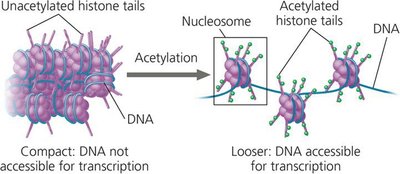
Acetylation of histones generally loosens chromatin structure, making DNA more accessible for transcription, while deacetylation condenses chromatin, making DNA less accessible.
Step-by-Step Guidance
Recall that DNA wraps around histone proteins to form nucleosomes, which can be packed tightly (heterochromatin) or loosely (euchromatin).
Understand that the tails of histone proteins can be chemically modified, affecting how tightly DNA is wound around them.
When histone tails are acetylated, the positive charge on lysine residues is neutralized. This reduces the interaction between histones and the negatively charged DNA, resulting in a more relaxed chromatin structure.
Conversely, when histone tails are deacetylated, the chromatin becomes more compact, and DNA is less accessible to transcription machinery.
Think about how these changes in chromatin structure would influence the ability of RNA polymerase and transcription factors to access genes and initiate transcription.
Try solving on your own before revealing the answer!
Final Answer:
Histone acetylation adds acetyl groups to histone tails, loosening chromatin structure and making DNA more accessible for transcription. This generally increases gene expression. Histone deacetylation removes acetyl groups, resulting in tighter chromatin packing and reduced accessibility of DNA, which decreases gene expression. This reversible modification is a key mechanism for regulating which genes are turned on or off in eukaryotic cells.
