 Indietro
Regulation of Gene Expression: Study Guide and Case Studies
Guida di studio - Note intelligenti
 Appunti personalizzati basati sui tuoi materiali, ampliati con definizioni chiave, esempi e contesto.
Q1. What is differential gene expression?
Background
Topic: Regulation of Gene Expression
This question tests your understanding of how cells with identical genetic information can develop into different cell types and perform distinct functions.
Key Terms:
Differential gene expression: The process by which cells express different sets of genes, leading to cell specialization.
Phenotype: Observable characteristics resulting from gene expression.
Step-by-Step Guidance
Recall that all somatic cells in an organism contain the same DNA.
Think about how only certain genes are "turned on" or "off" in each cell type.
Consider how this selective expression leads to different proteins being produced in different cells.
Reflect on how this process results in the diversity of cell types and functions in multicellular organisms.
Try solving on your own before revealing the answer!
Final Answer:
Differential gene expression is the process by which cells with the same genetic material express different genes, resulting in distinct cell types and functions. This selective expression is responsible for the diversity seen among cells and tissues in multicellular organisms.
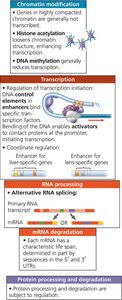
Q2. Using figure 15.6 in your textbook, describe the stages in gene expression that can be regulated in eukaryotes.
Background
Topic: Regulation of Gene Expression in Eukaryotes
This question focuses on the multiple points at which gene expression can be controlled in eukaryotic cells.
Key Terms and Concepts:
Transcriptional regulation
Post-transcriptional regulation
Translational regulation
Post-translational regulation
Step-by-Step Guidance
Identify the main stages of gene expression: transcription, RNA processing, translation, and protein processing.
Consider how each stage can be regulated (e.g., chromatin modification, transcription factors, RNA splicing, mRNA degradation).
Think about examples of regulation at each stage, such as histone acetylation for transcriptional regulation or alternative splicing for post-transcriptional regulation.
Review figure 15.6 for visual representation of these regulatory points.
Try solving on your own before revealing the answer!
Final Answer:
Gene expression in eukaryotes can be regulated at multiple stages: chromatin modification (e.g., histone acetylation and DNA methylation), transcription initiation, RNA processing (including alternative splicing and mRNA degradation), translation, and post-translational modifications. Each stage offers opportunities for cells to control which proteins are produced and when.
Q3. Describe the nature of chromatin structure.
Background
Topic: Chromatin Structure
This question tests your understanding of how DNA is packaged in eukaryotic cells and how this packaging affects gene expression.
Key Terms:
Chromatin: Complex of DNA and proteins (mainly histones) that forms chromosomes.
Nucleosome: Basic unit of chromatin, consisting of DNA wrapped around histone proteins.
Histone tails: Extensions of histone proteins that can be chemically modified.
Step-by-Step Guidance
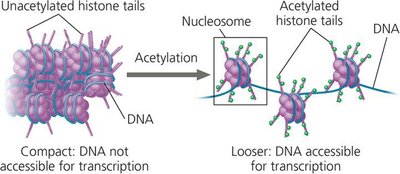
Recall that DNA is wrapped around histone proteins to form nucleosomes.
Consider how nucleosomes are organized into higher-order structures, making chromatin either compact or loose.
Think about how the compactness of chromatin affects accessibility for transcription.
Reflect on the role of histone modifications in changing chromatin structure.
Try solving on your own before revealing the answer!
Final Answer:
Chromatin is composed of DNA wrapped around histone proteins, forming nucleosomes. The structure can be compact (heterochromatin), making DNA inaccessible for transcription, or loose (euchromatin), allowing transcription. Histone modifications, such as acetylation, play a key role in regulating chromatin structure and gene accessibility.
Q4. Describe 3 ways that can regulate chromatin structure and how you can access the DNA (promoter).
Background
Topic: Chromatin Regulation
This question tests your knowledge of mechanisms that modify chromatin to control gene expression.
Key Terms and Mechanisms:
Histone acetylation
Histone methylation
Chromatin remodeling complexes
Step-by-Step Guidance
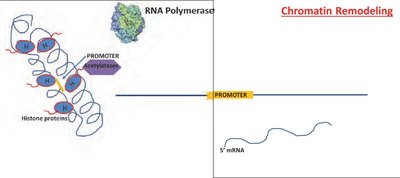
Identify histone acetylation as a process that loosens chromatin, making DNA accessible.
Recognize histone methylation, which can either activate or repress gene expression depending on the context.
Consider chromatin remodeling complexes that physically reposition nucleosomes to expose promoter regions.
Think about how these modifications allow transcription factors and RNA polymerase to access the DNA.
Try solving on your own before revealing the answer!
Final Answer:
Three ways to regulate chromatin structure include histone acetylation (loosens chromatin), histone methylation (can activate or repress), and chromatin remodeling complexes (reposition nucleosomes). These mechanisms make the DNA promoter region accessible for transcription initiation.
Q5. What is histone acetylation/deacetylation and how does this affect chromatin structure and transcription?
Background
Topic: Epigenetic Regulation
This question focuses on the chemical modification of histones and its impact on gene expression.
Key Terms:
Histone acetylation: Addition of acetyl groups to histone tails.
Histone deacetylation: Removal of acetyl groups from histone tails.
Transcription: Process of making RNA from DNA.
Step-by-Step Guidance
Recall that acetylation of histone tails reduces their positive charge, decreasing their affinity for DNA.
Understand that this loosens chromatin structure, making DNA more accessible for transcription.
Recognize that deacetylation restores tight binding, making chromatin more compact and less accessible.
Think about how these modifications regulate the ability of RNA polymerase to initiate transcription.
Try solving on your own before revealing the answer!
Final Answer:
Histone acetylation loosens chromatin structure, making DNA accessible for transcription, while deacetylation compacts chromatin, repressing transcription. These modifications are key mechanisms for regulating gene expression.
Q8. Describe how DNA methylation regulates gene expression.
Background
Topic: Epigenetic Regulation
This question tests your understanding of how chemical modifications to DNA can affect gene activity.
Key Terms:
DNA methylation: Addition of methyl groups to cytosine bases in DNA.
Gene silencing: Inactivation of gene expression.
Step-by-Step Guidance
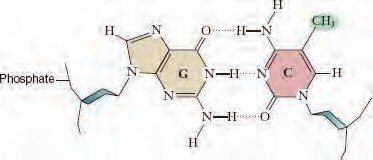
Recall that methylation typically occurs at cytosine bases in CpG islands.
Understand that methylation can block transcription factor binding or recruit proteins that compact chromatin.
Think about how this leads to reduced gene expression or gene silencing.
Consider the role of methylation in development and disease.
Try solving on your own before revealing the answer!
Final Answer:
DNA methylation involves adding methyl groups to cytosine bases, which typically silences gene expression by preventing transcription factor binding or recruiting proteins that compact chromatin. This is a key mechanism for regulating genes in development and disease.
Q14. How can alternative RNA splicing result in different proteins derived from the same initial RNA transcript?
Background
Topic: Post-Transcriptional Regulation
This question tests your understanding of how a single gene can produce multiple protein products.
Key Terms:
Alternative splicing: Process by which different combinations of exons are joined to produce multiple mRNA variants.
Exons and introns: Coding and non-coding regions of RNA.
Step-by-Step Guidance
Recall that the initial RNA transcript contains both exons and introns.
Understand that splicing removes introns and joins exons together.
Consider how different patterns of exon inclusion or exclusion can create different mRNA variants.
Think about how these mRNA variants are translated into different proteins.
Try solving on your own before revealing the answer!
Final Answer:
Alternative RNA splicing allows a single gene to produce multiple proteins by joining exons in different combinations, resulting in different mRNA transcripts and protein products. This increases protein diversity without increasing the number of genes.
Q15. What are some ways that degradation of mRNA controls gene expression?
Background
Topic: Post-Transcriptional Regulation
This question tests your understanding of how mRNA stability affects protein production.
Key Terms:
mRNA degradation: Breakdown of messenger RNA molecules.
Poly-A tail and 5' cap: Structures that protect mRNA from degradation.
Step-by-Step Guidance
Recall that mRNA molecules are degraded over time, limiting how long they can be translated.
Understand that removal of the poly-A tail or 5' cap accelerates degradation.
Consider how regulatory proteins or non-coding RNAs can target specific mRNAs for degradation.
Think about how this process controls the amount of protein produced from each mRNA.
Try solving on your own before revealing the answer!
Final Answer:
Degradation of mRNA controls gene expression by determining how long an mRNA is available for translation. Mechanisms include removal of the poly-A tail or 5' cap, and targeting by regulatory proteins or non-coding RNAs, which can rapidly decrease protein production.
Q17. Describe the function of microRNAs (miRNA) and small interfering RNAs (siRNA).
Background
Topic: Non-coding RNA Regulation
This question tests your understanding of how small RNA molecules regulate gene expression.
Key Terms:
miRNA: MicroRNA, a small RNA molecule that regulates gene expression post-transcriptionally.
siRNA: Small interfering RNA, a molecule that silences gene expression by degrading mRNA.
Step-by-Step Guidance
Recall that miRNAs and siRNAs are both short RNA molecules.
Understand that miRNAs bind to complementary sequences in mRNA, blocking translation or causing degradation.
Recognize that siRNAs are often used in defense against viruses and transposons, leading to mRNA cleavage.
Think about how these mechanisms reduce protein production from targeted mRNAs.
Try solving on your own before revealing the answer!
Final Answer:
MicroRNAs (miRNA) and small interfering RNAs (siRNA) regulate gene expression by binding to mRNA and either blocking translation or causing mRNA degradation. This post-transcriptional regulation is important for controlling protein levels and defending against genetic elements.
Q20. Describe types of eukaryotic posttranslational regulation and the role ubiquitin plays in this process.
Background
Topic: Post-Translational Regulation
This question tests your understanding of how proteins are modified after translation to regulate their activity or stability.
Key Terms:
Post-translational modification: Chemical changes to proteins after they are made.
Ubiquitin: Small protein that tags other proteins for degradation.
Proteasome: Cellular machinery that degrades ubiquitin-tagged proteins.
Step-by-Step Guidance
Recall that proteins can be modified by phosphorylation, methylation, acetylation, or glycosylation.
Understand that ubiquitin tagging marks proteins for destruction by the proteasome.
Consider how these modifications affect protein function, localization, or stability.
Think about the importance of protein degradation in regulating cellular processes.
Try solving on your own before revealing the answer!
Final Answer:
Eukaryotic posttranslational regulation includes modifications like phosphorylation and ubiquitin tagging. Ubiquitin marks proteins for degradation by the proteasome, controlling protein levels and activity in the cell.
Case Study #1 Q1. What would happen to transcription if you inhibit DNA methylation?
Background
Topic: Epigenetic Regulation in Cancer
This question tests your understanding of how DNA methylation affects gene expression, especially in cancer cells.
Key Terms:
DNA methylation: Addition of methyl groups to DNA, often silencing genes.
Transcription: Synthesis of RNA from DNA.
AZA: Drug that inhibits DNA methylation.
Step-by-Step Guidance
Recall that methylation typically represses gene expression.
Consider what happens when methylation is inhibited (e.g., by AZA).
Think about how this could affect transcription of previously silenced genes.
Reflect on the implications for cancer cell growth and survival.
Try solving on your own before revealing the answer!
Final Answer:
Inhibiting DNA methylation increases transcription of genes that were previously silenced, potentially activating tumor suppressor genes and reducing cancer cell survival.
Case Study #1 Q2. TSA inhibits histone deacetylase. What is happening to chromatin structure and transcription?
Background
Topic: Chromatin Regulation in Cancer
This question tests your understanding of how histone modifications affect gene expression in cancer cells.
Key Terms:
Histone deacetylase: Enzyme that removes acetyl groups from histones, compacting chromatin.
TSA: Drug that inhibits histone deacetylase.
Transcription: Synthesis of RNA from DNA.
Step-by-Step Guidance
Recall that deacetylation compacts chromatin, repressing transcription.
Consider what happens when deacetylase is inhibited (e.g., by TSA).
Think about how chromatin structure changes and how this affects gene accessibility.
Reflect on the potential for increased transcription of certain genes.
Try solving on your own before revealing the answer!
Final Answer:
TSA inhibits histone deacetylase, leading to increased histone acetylation, a looser chromatin structure, and enhanced transcription of genes that may suppress cancer cell growth.
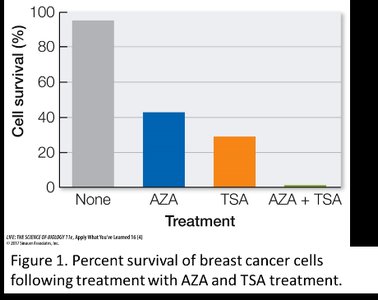
Case Study #1 Q3. Analyze the results shown for the single drugs. What do the data suggest about the roles of DNA methylation and histone deacetylation in gene expression in this cell line?
Background
Topic: Epigenetic Drug Effects in Cancer
This question tests your ability to interpret experimental data on cell survival after treatment with epigenetic inhibitors.
Key Terms:
AZA: DNA methylation inhibitor
TSA: Histone deacetylase inhibitor
Cell survival: Percentage of cells remaining alive after treatment
Step-by-Step Guidance
Examine the bar graph showing cell survival after treatment with AZA and TSA.
Compare the effects of each drug alone to the untreated control.
Consider what reduced cell survival indicates about gene expression changes.
Think about the roles of DNA methylation and histone deacetylation in repressing or activating genes.
Try solving on your own before revealing the answer!
Final Answer:
The data suggest that inhibiting DNA methylation or histone deacetylation reduces cancer cell survival, indicating that both processes play important roles in repressing gene expression and supporting cancer cell growth.
Case Study #1 Q4. Analyze and explain the results shown for both drugs together as they compare with the results for the single drugs. What do the results suggest about the combined effect of DNA methylation and histone acetylation on gene expression in these cells?
Background
Topic: Combined Epigenetic Drug Effects
This question tests your ability to interpret the synergistic effects of two epigenetic inhibitors on cancer cell survival.
Key Terms:
Synergy: Combined effect greater than the sum of individual effects
Epigenetic regulation: Control of gene expression by DNA and histone modifications
Step-by-Step Guidance
Compare cell survival after combined treatment (AZA + TSA) to single drug treatments.
Note the dramatic reduction in cell survival with both drugs.
Consider how inhibiting both DNA methylation and histone deacetylation might activate more genes.
Think about the implications for cancer therapy.
Try solving on your own before revealing the answer!
Final Answer:
The combined treatment with AZA and TSA results in much lower cell survival than either drug alone, suggesting a synergistic effect. Inhibiting both DNA methylation and histone deacetylation activates more genes, leading to greater suppression of cancer cell growth.
Case Study #2 Q1. What is the most likely effect of methylation of the MGMT promoter on gene expression?
Background
Topic: Epigenetic Regulation in Glioblastoma
This question tests your understanding of how promoter methylation affects gene expression and cancer treatment response.
Key Terms:
MGMT: Gene involved in DNA repair
Promoter methylation: Addition of methyl groups to promoter region, silencing gene expression
Step-by-Step Guidance
Recall that methylation of promoter regions typically silences gene expression.
Consider the role of MGMT in repairing DNA damage.
Think about how silencing MGMT affects response to chemotherapy.
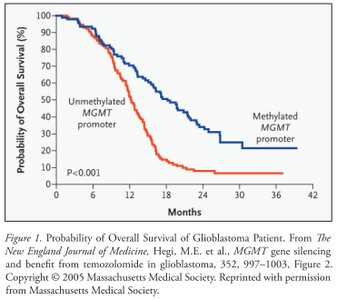
Review the survival curve for patients with methylated vs unmethylated MGMT promoters.
Try solving on your own before revealing the answer!
Final Answer:
Methylation of the MGMT promoter silences the gene, reducing DNA repair activity and increasing sensitivity to chemotherapy, which improves patient survival.
Case Study #2 Q2. Why does methylation of the MGMT promoter improve patient response to temozolomide treatment?
Background
Topic: Epigenetic Regulation and Chemotherapy
This question tests your understanding of the relationship between gene silencing and drug effectiveness.
Key Terms:
Temozolomide: Chemotherapy drug
MGMT: DNA repair gene
Promoter methylation: Silencing gene expression
Step-by-Step Guidance
Recall that temozolomide causes DNA damage in cancer cells.
Understand that MGMT repairs this damage, reducing drug effectiveness.
Consider how methylation silences MGMT, preventing DNA repair.
Think about how this increases cancer cell sensitivity to the drug.
Try solving on your own before revealing the answer!
Final Answer:
Methylation of the MGMT promoter silences the gene, preventing DNA repair and making cancer cells more sensitive to temozolomide, which improves treatment response and patient survival.
Case Study #4 Q1. Why did researchers feed all offspring a normal diet after weaning?
Background
Topic: Experimental Design in Epigenetics
This question tests your understanding of how to control variables in an experiment studying maternal effects.
Key Terms:
Control group: Group receiving standard treatment
Experimental group: Group receiving altered treatment
Epigenetic effects: Changes in gene expression due to environmental factors
Step-by-Step Guidance
Recall the purpose of controlling variables in an experiment.
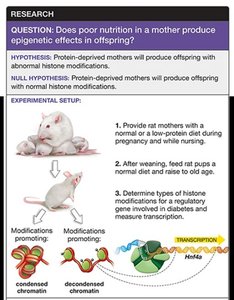
Consider how feeding all offspring a normal diet after weaning isolates the effect of the maternal diet.
Think about how this design allows researchers to attribute differences to prenatal and early postnatal nutrition.
Review the experimental setup in the figure.
Try solving on your own before revealing the answer!
Final Answer:
Researchers fed all offspring a normal diet after weaning to ensure that any observed effects on gene expression and chromatin modifications were due to the maternal diet, not differences in post-weaning nutrition.
Case Study #4 Q2. What conclusion is best supported by the results?
Background
Topic: Epigenetic Effects of Maternal Diet
This question tests your ability to interpret experimental data on chromatin modifications and gene expression.
Key Terms:
Chromatin modification: Changes to DNA or histone proteins affecting gene expression
Gene expression: Production of mRNA and protein from a gene
Step-by-Step Guidance
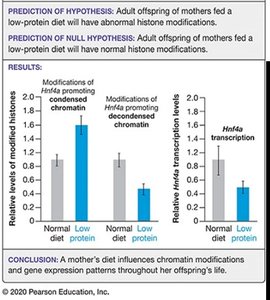
Examine the bar graphs showing chromatin modifications and Hnf4a transcription levels.
Compare results for offspring of mothers fed normal vs low-protein diets.
Consider how maternal diet affects chromatin structure and gene expression in offspring.
Review the conclusion in the figure.
Try solving on your own before revealing the answer!
Final Answer:
The results support the conclusion that a mother's diet influences chromatin modifications and gene expression patterns in her offspring throughout their life.
