 Indietro
Regulation of the Eukaryotic Cell Cycle: Control Systems, Checkpoints, and Key Regulatory Proteins Part 2
Guida di studio - Note intelligenti
 Appunti personalizzati basati sui tuoi materiali, ampliati con definizioni chiave, esempi e contesto.
The Eukaryotic Cell Cycle: Regulation and Control
Overview of Cell Cycle Regulation
The cell cycle is a highly regulated process that ensures proper cell growth, DNA replication, and division. Regulation occurs at the molecular level, allowing cells to respond to internal and external signals. Cancer cells can escape these controls, leading to uncontrolled division.
Cell division frequency varies by cell type due to regulatory mechanisms.
Cell cycle regulation is essential for maintaining tissue integrity and organismal health.
Cancer cells bypass normal cell cycle controls, resulting in abnormal proliferation.
Role of Cytoplasmic Signals in Cell Cycle Regulation
Specific signaling molecules in the cytoplasm control the progression of the cell cycle. Experimental evidence from cell fusion studies demonstrates that cytoplasmic factors can induce cell cycle transitions in fused cells.
Internal signals drive cell cycle progression, not random chance.
Cell fusion experiments show that cytoplasmic molecules from one cell can trigger cell cycle events in another.
Key conclusion: The cytoplasm contains regulatory molecules that act as cell cycle regulators.
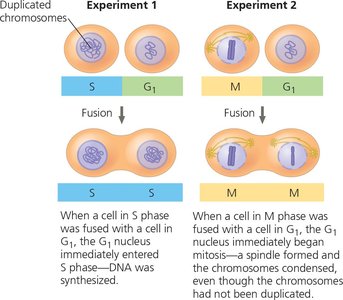
The Cell Cycle Control System
The cell cycle control system is a regulatory network that ensures the correct order and timing of cell cycle events. It responds to both internal signals (such as DNA damage) and external signals (such as growth factors).
Phases: G1 → S → G2 → M
Checkpoints: Control points where the cycle pauses until a go-ahead signal is received.
Signal transmission: Regulatory signals are passed via signal transduction pathways.
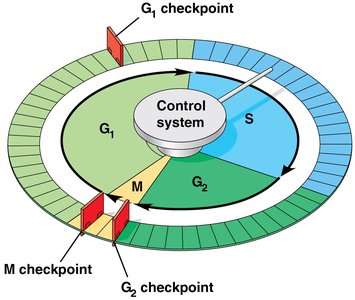
Checkpoints in the Cell Cycle
Checkpoints are critical control points that regulate progression through the cell cycle. The most important checkpoints are found in the G1, G2, and M phases.
G1 checkpoint (Restriction Point): Determines whether a cell will continue to divide.
G2 checkpoint: Ensures DNA replication is complete and undamaged before mitosis.
M checkpoint: Ensures chromosomes are properly attached to spindle fibers before segregation.
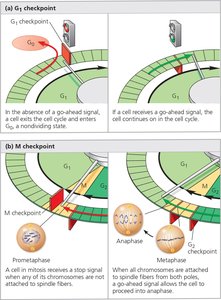
G1 Checkpoint and the G0 Phase
The G1 checkpoint is the most important in determining cell division. If a cell does not receive a go-ahead signal, it enters the G0 phase, a non-dividing state.
G0 phase: Most human cells are in G0 under normal conditions.
Liver cells: Usually in G0, but can re-enter the cycle during tissue repair.
Nerve and muscle cells: Permanently in G0; do not divide once fully developed.
Cell Cycle Clock: Cyclins and Cyclin-Dependent Kinases (Cdks)
Cyclins and Cdks are key regulatory proteins that control the timing and progression of the cell cycle. Their activity is tightly regulated to ensure proper cell cycle transitions.
Cyclins: Proteins whose concentrations fluctuate cyclically during the cell cycle.
Cyclin-dependent kinases (Cdks): Enzymes that are activated only when bound to cyclins; they phosphorylate target proteins to trigger cell cycle events.
MPF (Maturation-Promoting Factor): A specific cyclin-Cdk complex that triggers passage through the G2 checkpoint into M phase.
Key equations:
Activation:
Phosphorylation:
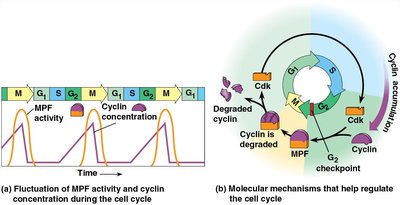
MPF's Role in Mitosis Initiation
MPF acts as a kinase, phosphorylating proteins of the nuclear lamina to break down the nuclear envelope, and also contributes to chromosome condensation and spindle fiber formation during prophase.
Direct action: Adds phosphate groups to proteins.
Indirect action: Activates other kinases for downstream effects.
Peak activity: MPF activity peaks when cyclin levels are highest.
Stop and Go Signs: Internal and External Signals at Checkpoints
Checkpoints register signals from both within and outside the cell. These signals determine whether the cell will proceed through the cycle or pause for repairs or other responses.
Internal signals: DNA damage, incomplete replication, spindle attachment.
External signals: Growth factors, cell density, environmental cues.
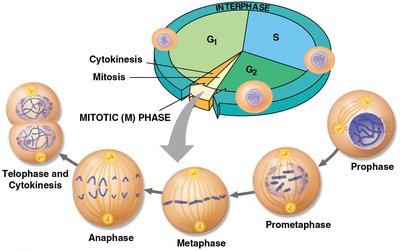
Mitotic (M) Phase and Its Stages
The M phase consists of mitosis and cytokinesis, which are tightly regulated to ensure accurate chromosome segregation and cell division.
Stages of mitosis: Prophase, Prometaphase, Metaphase, Anaphase, Telophase
Cytokinesis: Division of the cytoplasm following mitosis
Summary Table: Cell Cycle Checkpoints and Regulatory Proteins
Checkpoint | Main Function | Key Regulatory Proteins |
|---|---|---|
G1 | Restriction point; decides cell division | Cyclins, Cdks |
G2 | Ensures DNA replication is complete | MPF (Cyclin-Cdk complex) |
M | Ensures chromosomes are attached to spindle fibers | Cyclins, Cdks |
Practice Questions (with Answers)
Which phase is the non-dividing phase of mammalian cells? Answer: e) G0
Cells which are not dividing are likely to be at Answer: c) G0
Which of the following statements is TRUE? Answer: a) Chromosome replication occurs during S phase.
Place the following steps in the cell cycle into the order in which they occur. Answer: e) I (G1), III (S phase), II (G2), IV (M phase)
Which of the following is not a part of interphase? Answer: b) M
How many cell cycle checkpoints are there? Answer: c) 3
What is the first checkpoint of the cell cycle? Answer: b) G1 checkpoint
Which checkpoint ensures that each of the chromosomes is appropriately attached to spindle fibers in order to segregate properly? Answer: a) Metaphase checkpoint
Cdks bind with ____, enabling the Cdks to function as enzymes. Answer: b) cyclins
Mitosis is controlled at the _____________ checkpoint. Answer: d) M
At the center of the cell cycle control system is Cdk, a protein that Answer: c) that binds to different cyclins
_____ is a cell cycle protein complex that regulates the passage of a cell from the G2 growth phase to the M phase. Answer: a) Maturation promoting factor (MPF)
The decline of MPF activity at the end of mitosis is due to Answer: c) the degradation of cyclin
