 Indietro
Scientific Method and Determination of Density: Metric Measurements and Laboratory Techniques
Guida di studio - Note intelligenti
 Appunti personalizzati basati sui tuoi materiali, ampliati con definizioni chiave, esempi e contesto.
Scientific Method and Laboratory Safety
Introduction to the Scientific Method
The scientific method is a systematic approach used in scientific investigation. It involves making observations, forming hypotheses, conducting experiments, collecting data, and drawing conclusions. In this lab, the scientific method is applied to determine the density of various objects using metric measurements and laboratory equipment.
Hypothesis: A proposed explanation based on limited evidence, serving as a starting point for further investigation.
Observation: Gathering information using the senses or instruments.
Experiment: A procedure to test the hypothesis under controlled conditions.
Conclusion: A decision based on the analysis of experimental data.
Laboratory Safety
Proper safety procedures are essential in the laboratory to prevent accidents and injuries. Always follow instructions and handle equipment with care.
Never pipet by mouth. Use pipet pumps to avoid ingestion of hazardous substances.
Handle glassware carefully to prevent breakage and injury.
Report any broken glass or injuries to your instructor immediately.
Metric System and Measurement Units
Metric Units in Biology
The metric system is the standard system of measurement in science. It is based on units of ten and is used to measure length, mass, volume, and temperature.
Length: Meter (m), centimeter (cm), millimeter (mm)
Mass: Gram (g), kilogram (kg)
Volume: Liter (L), milliliter (mL), cubic centimeter (cm3)
Temperature: Degrees Celsius (°C)
Measuring Length
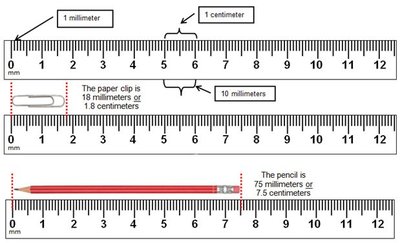
Length is measured using a metric ruler or meter stick. The meter is the base unit, with centimeters and millimeters as subunits.
1 meter (m) = 100 centimeters (cm)
1 centimeter (cm) = 10 millimeters (mm)
Area and Volume Calculations
Calculating Area
Area is a two-dimensional measurement calculated as length times width. Units are squared (e.g., cm2).
Formula:
Example:
Calculating Volume
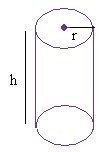
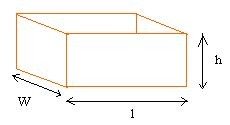
Volume is a three-dimensional measurement. The most common units are cubic centimeters (cm3) and milliliters (mL). 1 mL = 1 cm3.
For a cube:
For a cylinder:
For a rectangular solid:
For a sphere:
For a cone:
For a pyramid: (where B is the area of the base)
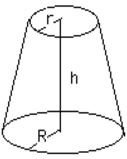
For a frustum of a cone:
Laboratory Equipment and Their Uses
Common Laboratory Equipment
Understanding and correctly using laboratory equipment is essential for accurate measurements.
Electronic balance: Used to measure mass in grams.
Metric ruler: Used to measure length in centimeters or millimeters.
Graduated cylinder: Used to measure liquid volume accurately.
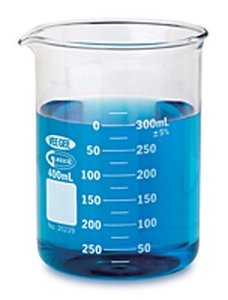
Beaker: Used to hold and mix liquids; not for precise measurements.
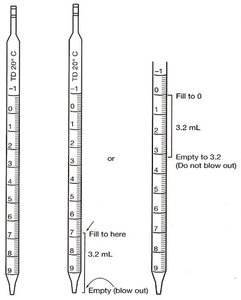
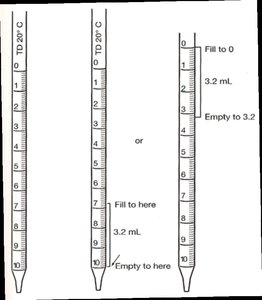
Pipets (serological, measuring, volumetric): Used to transfer and measure small volumes of liquid.
Pipet pump: Used to safely draw liquid into a pipet.
Measuring Volume: Graduated Cylinder, Beaker, and Pipet
Graduated Cylinder vs. Beaker vs. Pipet
Different equipment provides different levels of accuracy for measuring liquid volumes.
Graduated cylinder: Most accurate for measuring liquid volume.
Beaker: Used for approximate measurements and mixing; not precise.
Pipet: Most accurate for small/intermediate volumes; types include serological, measuring, and volumetric pipets.
Serological pipets are calibrated to the tip and should be emptied completely. Measuring pipets (Mohr pipets) are not calibrated to the tip and should only be used to transfer volumes between gradations.
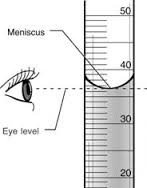
Reading the Meniscus
Meniscus and Accurate Volume Measurement
When measuring liquids, the surface forms a curve called the meniscus due to adhesion of water to the container walls. Always read the volume at the bottom of the meniscus at eye level for accuracy.
Calculating Density
Definition and Calculation of Density
Density is defined as mass per unit volume. It is a physical property that can be used to identify substances and predict whether an object will float or sink in water.
Formula:
Units: grams per milliliter (g/mL) or grams per cubic centimeter (g/cm3)
Water has a density of approximately 1.0 g/mL at 4°C.
Objects with density < 1.0 g/mL float in water; those with density > 1.0 g/mL sink.
Measuring Volume of Irregular Objects: Water Displacement
For irregularly shaped objects, volume is best measured by water displacement. The increase in water level equals the object's volume.
Initial volume (mL) is recorded before submerging the object.
Final volume (mL) is recorded after submerging the object.
Object volume = Final volume - Initial volume
Summary Table: Density Determination
Sample Data Table
The following table summarizes the mass, volume (by displacement), and calculated density for various objects:
Object | Mass (g) | Volume (mL) | Density (g/mL) |
|---|---|---|---|
Dice | 5.9 | 4 | 1.475 |
Marble | 5.4 | 2 | 1.35 |
Pencil | 2.6 | 3 | 0.866 |
Cork | 0.6 | 4 | 0.15 |
Rock | 7.1 | 2 | 3.55 |
Rubber stopper | 6.2 | 4 | 1.55 |
Key Terms and Definitions
Hypothesis: A testable prediction based on observations.
Precision: The consistency of repeated measurements.
Accuracy: How close a measurement is to the true value.
Meniscus: The curved surface of a liquid in a container.
Density: Mass per unit volume ().
Displacement: The method of measuring volume by the amount of liquid an object displaces.
Mass: The amount of matter in an object, measured in grams (g).
Length: The measurement of something from end to end, measured in meters (m), centimeters (cm), or millimeters (mm).
Area: The extent of a surface, measured in square units (e.g., cm2).
Volume: The amount of space an object occupies, measured in cubic centimeters (cm3) or milliliters (mL).
Aqueous solution: A solution in which water is the solvent.
Conclusion and Best Practices
Graduated cylinders and pipets provide more accurate volume measurements than beakers.
Water displacement is the preferred method for measuring the volume of irregularly shaped objects.
Always read liquid volumes at the bottom of the meniscus at eye level for accuracy.
Use the appropriate formula for calculating area and volume based on the shape of the object.
Record all measurements with correct units for clarity and scientific validity.
