 Indietro
Scientific Method and Experimental Design: Effects of Chemicals on Daphnia Heart Rate
Guida di studio - Note intelligenti
 Appunti personalizzati basati sui tuoi materiali, ampliati con definizioni chiave, esempi e contesto.
Scientific Method: Daphnia Experiment
Introduction to the Scientific Method
The scientific method is a systematic approach used by researchers to investigate questions, develop hypotheses, and perform experiments. In this unit, students apply the scientific method to study the effects of caffeine and ethanol on the heart rate of Daphnia magna, a freshwater crustacean.
Observation: Noticing biological functions and responses in organisms.
Hypothesis: A tentative, testable statement based on prior data. Must be falsifiable.
Experiment: Manipulating variables to test the hypothesis.
Data Collection: Recording and analyzing results.
Conclusion: Determining whether the hypothesis is supported or nullified.
Key Terms in Experimental Design
Independent Variable: The variable manipulated by the researcher (e.g., concentration of caffeine or ethanol).
Dependent Variable: The variable measured in response to changes in the independent variable (e.g., heart rate of Daphnia).
Hypothesis Example: "Caffeine will increase the heart rate of Daphnia, while ethanol will decrease it."
Background: Daphnia as a Model Organism
Daphnia magna is ideal for physiological experiments due to its translucent chitin exoskeleton, allowing direct observation of internal organs such as the heart under a microscope. Caffeine acts as a stimulant, increasing heart rate, while ethanol is a depressant, decreasing heart rate.
Stimulants: Chemicals that increase nervous system activity (e.g., caffeine).
Depressants: Chemicals that decrease nervous system activity (e.g., ethanol).
Making Solutions: Dilution Calculations
Preparing solutions of specific concentrations is a fundamental laboratory skill. The relationship between concentration and volume is described by the equation:
Where: C1 = concentration of stock, V1 = volume of stock needed, C2 = desired concentration, V2 = desired final volume.
To solve for the volume of stock needed:
Example: To make 15 mL of a 5% solution from a 30% stock:
Experimental Procedures
Creating Dilutions of Simulated Ethanol
Use a 10% simulated ethanol stock to prepare 2% and 6% solutions.
Calculate volumes using .
Mix stock and water in microfuge tubes, label, and invert to mix.
Concentration of Dilution | Volume of 10% stock needed | Volume of H2O needed | Final volume of dilution |
|---|---|---|---|
2% | 100 μL | 400 μL | 500 μL |
6% | 300 μL | 200 μL | 500 μL |
Additional info: Values inferred based on for 500 μL final volume. |
Determining Baseline Heart Rate of Daphnia
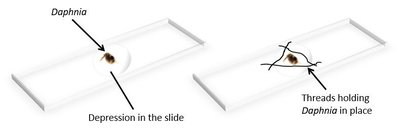
Place Daphnia on a depression slide; use thread to immobilize if necessary.
Observe under 4× or 10× objective lens.
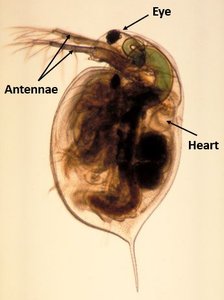
Identify anatomical structures: eye, antennae, heart.
Count heartbeats in three 15-second trials; calculate average beats per minute.
Testing Effects of Caffeine or Ethanol
Apply test solutions of varying concentrations to Daphnia.
Measure heart rate after exposure; compare to baseline.
Goal: Identify concentration causing a 20% change in heart rate.
Allow recovery between tests; repeat for at least three concentrations.
Data Collection and Analysis
Experiment | Concentration | Beats per 15 sec (3 trials) | Average beats per 15 sec | Beats per minute |
|---|---|---|---|---|
Control—Untreated | Baseline | ... | ... | ... |
Caffeine or Ethanol | ... | ... | ... | ... |
Caffeine or Ethanol | ... | ... | ... | ... |
Caffeine or Ethanol | ... | ... | ... | ... |
Graph average heart rate per minute vs. solution concentration.
Estimate concentration needed for 20% change if not exact.
Discussion and Interpretation
Summarize data and effects of test chemical.
Discuss how heart rate changes with increasing concentration.
Evaluate whether predictions were correct.
Identify concentration causing 20% change; note unexpected effects and possible explanations.
Applications and Academic Context
Understanding the effects of stimulants and depressants on heart rate is relevant to physiology, pharmacology, and toxicology.
Experimental design principles (variables, controls, data analysis) are foundational in biological research.
Additional info: The experiment reinforces concepts of experimental design, physiological responses, and quantitative analysis in biology.
