 Indietro
Seed Plants: Structure, Function, and Diversity
Guida di studio - Note intelligenti
 Appunti personalizzati basati sui tuoi materiali, ampliati con definizioni chiave, esempi e contesto.
Seed Plants: Structure, Function, and Diversity
Important Seed Traits
Seed plants exhibit several adaptations that distinguish them from other plant groups. These traits are crucial for reproduction, survival, and dispersal in diverse environments.
Female gametophyte (including the egg) is retained on the parent plant, providing protection and nourishment.
Male gametophyte (including sperm) becomes the pollen grain, which is adapted for travel to the female gametophyte.
Pollen travels to the female, and sperm moves down the pollen tube to reach the egg, enabling fertilization without water.
The parent plant nourishes the developing embryo, supporting early growth.
Dormancy and dispersal are key adaptations, allowing seeds to survive unfavorable conditions and spread to new locations.
Adaptation: These traits are evolutionary responses to terrestrial life, increasing reproductive success and colonization ability.
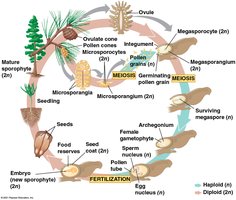
Seed Plant Terminology
Understanding seed plant terminology is essential for studying their biology and reproduction.
Ovule: The structure in seed plants that develops into a seed after fertilization.
Seed: A mature ovule containing an embryo, food supply, and protective coat.
Cotyledon: Seed leaf; monocots have one, eudicots have two.
Pollination: Transfer of pollen from male to female structures.
Fertilization: Fusion of sperm and egg to form a zygote.
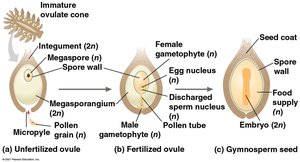
Types of Seed Plants
Seed plants are divided into two major groups: gymnosperms and angiosperms. Each group has unique characteristics and evolutionary significance.
Conifers: Gymnosperms with needle-like leaves and cones (e.g., pine, fir).
Ginkgos: Gymnosperms with fan-shaped leaves; only one living species.
Other gymnosperms: Includes cycads and others.
Flowering plants (Angiosperms): Plants with flowers and fruit; most diverse plant group.
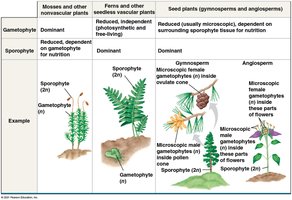
Seed Plant Life Cycle
The life cycle of seed plants involves alternation of generations, with a dominant sporophyte and reduced gametophyte. Fertilization and seed development are central processes.
Sporophyte (2n): Dominant generation; produces spores by meiosis.
Gametophyte (n): Reduced, microscopic; produces gametes.
Pollination: Pollen grain lands on ovule, forms pollen tube.
Fertilization: Sperm travels down pollen tube, fuses with egg.
Seed formation: Embryo develops within seed, surrounded by food supply and seed coat.
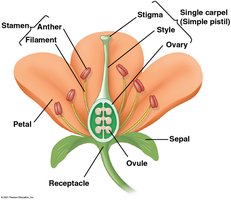
Flower Structure (Angiosperms)
Flowers are the reproductive organs of angiosperms, facilitating pollination and seed formation. Each part has a specific function.
Stamen: Male part; includes anther (produces pollen) and filament.
Carpel (Pistil): Female part; includes stigma (receives pollen), style, and ovary (contains ovules).
Petal: Often colorful, attracts pollinators.
Sepal: Protects flower bud.
Receptacle: Base of flower.
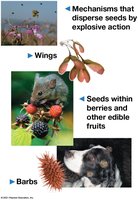
Seed Dispersal Mechanisms
Seed plants have evolved various mechanisms to disperse their seeds, increasing their chances of survival and colonization.
Explosive action: Seeds are ejected forcefully from the parent plant.
Wings: Seeds are carried by wind.
Edible fruits: Seeds are dispersed by animals that eat the fruit.
Barbs: Seeds attach to animal fur for transport.
Seed and Fruit Diversity
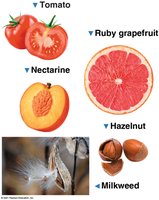
Angiosperms produce a wide variety of seeds and fruits, each adapted for specific dispersal strategies and environments.
Fleshy fruits: (e.g., tomato, nectarine, grapefruit) attract animals for dispersal.
Dry fruits: (e.g., hazelnut, milkweed) may use wind or mechanical dispersal.
Monocots vs. Eudicots
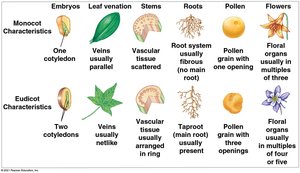
Angiosperms are classified into monocots and eudicots based on several structural features. These differences are important for identification and understanding plant evolution.
Characteristic | Monocots | Eudicots |
|---|---|---|
Embryos | One cotyledon | Two cotyledons |
Leaf venation | Veins usually parallel | Veins usually netlike |
Stems | Vascular tissue scattered | Vascular tissue arranged in ring |
Roots | Fibrous root system (no main root) | Taproot (main root) usually present |
Pollen | Pollen grain with one opening | Pollen grain with three openings |
Flowers | Floral organs usually in multiples of three | Floral organs usually in multiples of four or five |
Seed Plant Evolution and Adaptation
Seed plants have evolved complex reproductive strategies and structural adaptations to thrive in terrestrial environments. Their dominance is a result of innovations such as seeds, pollen, and flowers.
Seeds: Provide protection, nourishment, and dispersal ability.
Pollen: Enables fertilization without water.
Flowers and fruits: Enhance pollination and seed dispersal.
Additional info: Seed plant evolution is covered in General Biology chapters on plant diversity, reproduction, and adaptation. These notes integrate textbook-level context for exam preparation.
