 Indietro
lecture 22: Sex Determination and Chromosomal Disorders: Study Notes
Guida di studio - Note intelligenti
 Appunti personalizzati basati sui tuoi materiali, ampliati con definizioni chiave, esempi e contesto.
Sex Determination
Chromosomal Basis of Sex Determination
Sex determination in humans is governed by the presence or absence of specific sex chromosomes. The X and Y chromosomes play a central role, with the Y chromosome being crucial for male development.
XX and XY: Females have two X chromosomes (XX), while males have one X and one Y chromosome (XY).
Y Chromosome: The presence of the Y chromosome determines maleness, primarily due to the SRY gene.
SRY Gene: The Sex-determining Region Y (SRY) gene encodes the Testis-Determining Factor (TDF), which initiates male development at 6–8 weeks of embryonic growth.
Pseudoautosomal Regions (PARs): Regions on the Y chromosome that share homology with the X chromosome and allow recombination during meiosis.
Male-Specific Region of the Y (MSY): Nonrecombining region containing genes specific to male development.
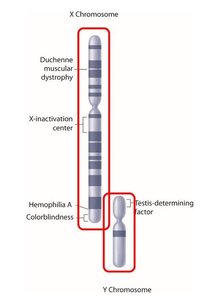
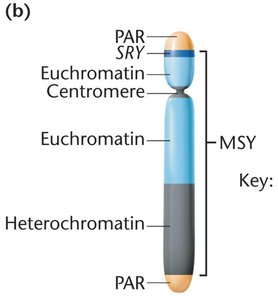
Example: The SRY gene is only found on the Y chromosome and is responsible for triggering the development of testes in XY embryos.
Sex Ratios
Sex ratios refer to the proportion of males to females in a population. These ratios can vary due to biological and social factors.
Secondary Sex Ratio: The ratio of males to females at birth. For example, in the United States, the ratio is approximately 1.06 males for every female.
Factors Affecting Sex Ratio: Policies such as the one-child policy and sex-specific abortion can influence sex ratios in certain countries.
Theoretical Basis: Assumes equal production and viability of X- and Y-bearing sperm, and equal receptivity of the egg.
Example: In Korea, the sex ratio is higher (1.15), possibly due to social policies and practices.
Chromosomal Disorders and Aneuploidy
Nondisjunction and Aneuploidy
Nondisjunction is the failure of chromosomes to separate properly during meiosis, resulting in gametes with abnormal chromosome numbers. Aneuploidy refers to the presence of an abnormal number of chromosomes in a cell.
Nondisjunction: Can occur during meiosis I or II, leading to gametes with extra or missing chromosomes.
Aneuploidy: Examples include trisomy (an extra chromosome) or monosomy (a missing chromosome).
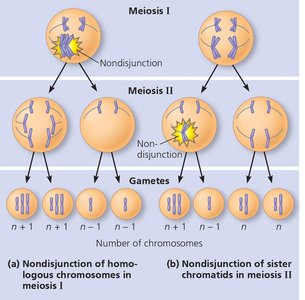
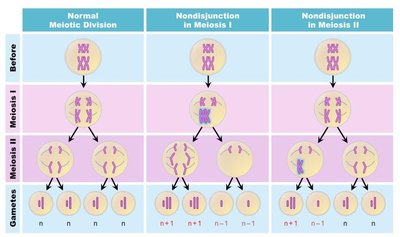
Equation: Chromosome number in aneuploid gametes can be represented as:
Example: If nondisjunction occurs, a gamete may have 24 chromosomes instead of the normal 23.
Sex Chromosome Aneuploidies
Several disorders result from abnormal numbers of sex chromosomes, often due to nondisjunction.
Klinefelter Syndrome (47,XXY): Males with an extra X chromosome; symptoms include tall stature, male genitalia, sterility, and mild cognitive impairment.
Turner Syndrome (45,X): Females with only one X chromosome; symptoms include underdeveloped female genitalia and short stature.
Triple X Syndrome (47,XXX): Females with an extra X chromosome; may be unaware of the abnormality, sometimes experience delayed development or sterility.
XYY Syndrome (47,XYY): Males with an extra Y chromosome; often tall, sometimes with subnormal intelligence and behavioral issues.
Example: Klinefelter syndrome is caused by nondisjunction resulting in a male with two X chromosomes and one Y chromosome.
Differences in Sex Development (DSD/Intersex)
DSDs are conditions where individuals have atypical development of chromosomal, gonadal, or anatomical sex.
Congenital Adrenal Hyperplasia (CAH): A disorder affecting hormone production, leading to ambiguous genitalia.
Androgen Insensitivity Syndrome (AIS): Individuals with XY chromosomes are resistant to male hormones, resulting in female physical traits.
Prevalence: DSDs occur in approximately 0.018% of the population.
Example: AIS results in individuals who are genetically male (XY) but develop female characteristics due to insensitivity to androgens.
Treatments and Current Research
Medical and Psychological Interventions
Individuals with DSDs or chromosomal disorders may require medical and psychological support.
Hormone Treatments: Used to address hormonal imbalances or support desired physical development.
Counseling: Provides psychological support for affected individuals and families.
Other Treatments: May include surgery or other medical interventions.
Example: Hormone therapy can help individuals with Turner syndrome develop secondary sexual characteristics.
Genome Editing and Research
Recent advances in genome editing technology offer potential for correcting chromosomal abnormalities, such as aneuploidy, in research and clinical settings.
Genome Editing: Techniques like CRISPR-Cas9 are being explored to eliminate extra chromosomes or correct genetic mutations.
Applications: Research focuses on converting aneuploid cells into normal diploid cells and studying the effects of gene editing on chromosomal disorders.
Example: Studies are investigating the use of genome editing to treat Down syndrome and other chromosomal disorders.
