 Indietro
Speciation: Mechanisms and Concepts in Evolutionary Biology
Guida di studio - Note intelligenti
 Appunti personalizzati basati sui tuoi materiali, ampliati con definizioni chiave, esempi e contesto.
Speciation
Introduction to Speciation
Speciation is a fundamental process in evolutionary biology, describing how new species arise from ancestral populations. It involves the accumulation of genetic differences and the interruption of gene flow between populations, leading to evolutionary independence.
Species: A group of populations that are genetically similar and evolutionarily independent.
Gene flow: The movement of alleles between populations, maintaining genetic similarity.
Speciation: The splitting event that creates two or more distinct species from an ancestral species. This can be rapid or gradual.
Genetic isolation: Occurs when a barrier to gene flow isolates populations.
Genetic divergence: Mutation, natural selection, and genetic drift cause populations to evolve independently.
How Are Species Defined and Identified?
Species are defined as evolutionarily independent populations or groups of populations. Three main concepts are used to identify species:
Biological Species Concept: Species are groups of interbreeding populations that are reproductively isolated from other such groups.
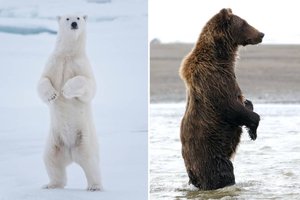
Morphospecies Concept: Species are distinguished by morphological features.
Phylogenetic Species Concept: Species are identified based on evolutionary history and monophyletic groups.
Biological Species Concept
This concept defines species based on reproductive isolation, which prevents gene flow between populations. Members of different populations do not interbreed or fail to produce viable, fertile offspring.
Reproductive isolation: Lack of gene flow between populations.
Viable, fertile offspring: Offspring that survive and can reproduce.
Mechanisms of Reproductive Isolation
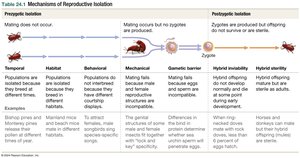
Reproductive isolation can be prezygotic or postzygotic:
Prezygotic isolation: Prevents mating or fertilization.
Postzygotic isolation: Hybrid offspring do not survive or reproduce.
Zygote: A fertilized egg.
Morphospecies Concept
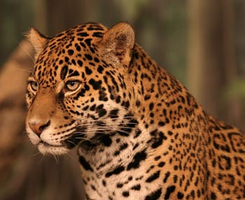
The morphospecies concept distinguishes species based on morphological differences. It is widely applicable, especially when genetic data is unavailable, and can be used for sexual, asexual, and fossil species.
Polymorphic species: Species with more than one form.
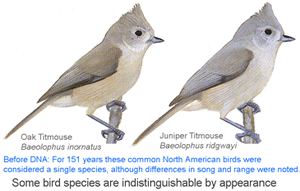
Cryptic species: Species that are indistinguishable by appearance but differ in other traits.
Subjectivity: The features used to distinguish species can be subjective.
Phylogenetic Species Concept
This concept identifies species based on evolutionary history. A monophyletic group (clade) consists of an ancestral population and all its descendants, identified by synapomorphies (unique forms).
Monophyletic group: An ancestral population plus all descendants.
Synapomorphy: Homologous trait found in common ancestor and descendants.
Phylogenetic Species Concept Applied to Elephants
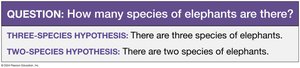
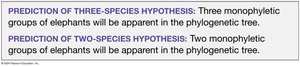
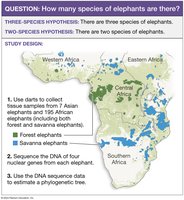
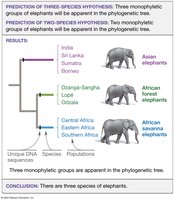
DNA sequence analysis can distinguish between elephant species, supporting the existence of three distinct species: African savanna, African forest, and Asian elephants.
Mechanisms of Speciation
Allopatric Speciation
Allopatric speciation occurs when populations become geographically isolated, preventing gene flow. This can happen through dispersal (movement to a new location) or vicariance (physical splitting of a habitat).
Dispersal: Movement of individuals from one place to another.
Vicariance: Physical barrier splits population into isolated subgroups.
Sympatric Speciation
Sympatric speciation occurs without geographic isolation. Populations in the same area become reproductively isolated through external events (disruptive selection) or internal events (chromosomal mutations).
Disruptive selection: Selection for different ecological niches or mate preferences.
Chromosomal mutations: Genetic changes that lead to reproductive isolation.
Polyploidy and Hybridization
Polyploidy is the condition of possessing more than two complete sets of chromosomes, often leading to speciation, especially in plants.
Autopolyploid: Chromosome doubling within a single species.
Allopolyploid: Chromosome doubling from hybridization between different species.
Outcomes of Secondary Contact
Fusion, Reinforcement, and Hybrid Zones
When isolated populations come into contact, several outcomes are possible:
Fusion: Populations interbreed and distinctions are erased.
Reinforcement: Natural selection favors traits that prevent interbreeding.
Hybrid zone: Geographic area where interbreeding occurs and hybrids are common.
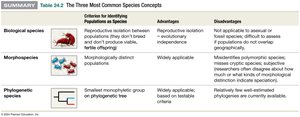
Summary Table: The Three Most Common Species Concepts
Species Concept | Criteria for Identifying Populations as Species | Advantages | Disadvantages |
|---|---|---|---|
Biological species | Reproductive isolation between populations | Evolutionary independence | Not applicable to asexual or fossil species; difficult to assess if populations do not overlap geographically |
Morphospecies | Distinguishing features | Widely applicable | Polymorphic species may be classified as more than one species; cannot identify cryptic species; subjective |
Phylogenetic species | Smallest monophyletic group on phylogenetic tree | Widely applicable; based on testable criteria | Relatively few well-studied phylogenies available |
Summary Table: Mechanisms of Reproductive Isolation
Isolation Type | Mechanism | Example |
|---|---|---|
Prezygotic | Temporal, habitat, behavioral, mechanical, gametic | Different breeding seasons, habitats, mating behaviors, incompatible genitalia, gamete incompatibility |
Postzygotic | Hybrid inviability, hybrid sterility | Hybrid offspring do not survive or are sterile |
Additional info: These notes expand on the original content by providing definitions, examples, and structured tables for clarity. The images included are directly relevant to the explanation of species concepts, reproductive isolation, and speciation mechanisms.
