 Indietro
Species Diversity, Mass Extinction, and the Evolution of Complex Traits
Guida di studio - Note intelligenti
 Appunti personalizzati basati sui tuoi materiali, ampliati con definizioni chiave, esempi e contesto.
Species Diversity: Speciation and Extinction
Balance Between Speciation and Extinction
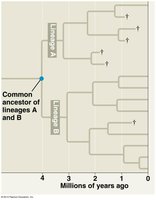
Species diversity within any clade is determined by the interplay between the rates of speciation (the formation of new species) and extinction (the loss of species). This dynamic shapes the evolutionary history and current diversity of life.
Speciation Rate: The rate at which new species arise within a lineage.
Extinction Rate: The rate at which species disappear from a lineage.
Clade Diversity: If speciation and extinction rates are equal, diversity remains stable; higher extinction rates reduce diversity.
Mass Extinction Events
Extinction is a normal evolutionary process, but occasionally, mass extinction events occur, dramatically reducing species diversity. These events have shaped the history of life on Earth.
Mass Extinction: Events where a large proportion of species go extinct in a short period.
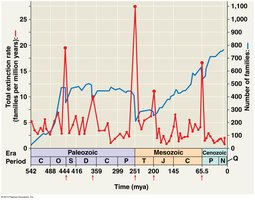
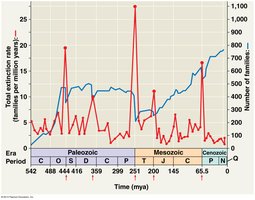
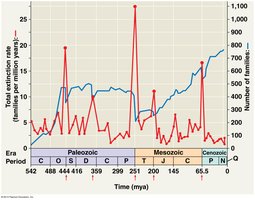
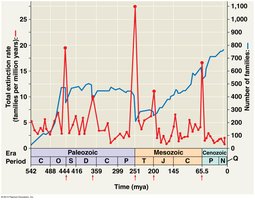
Five Major Events: Over the past 500 million years, five mass extinctions have occurred, each eliminating at least 50% of marine species.
Key Events:
End-Permian (251 mya): Killed 96% of marine species; caused by volcanic eruptions, climate warming, ocean acidification, and anoxia.
End-Cretaceous (65 mya): Killed >50% of marine species, including all dinosaurs except birds; caused by asteroid impact, climate cooling, and reduced photosynthesis.
Extinction Rates Over Time
Extinction rates have fluctuated throughout Earth's history, with spikes corresponding to mass extinction events. The overall trend shows increasing diversity despite periodic losses.
Background Extinction: Ongoing, low-level extinction.
Mass Extinction Spikes: Dramatic increases in extinction rates during specific periods.
Adaptive Radiation and Evolutionary Radiation
Definition and Causes
Adaptive radiation refers to rapid increases in species diversity driven by adaptation to new environments. Evolutionary radiation is any rapid increase in diversity, not necessarily linked to adaptation.
Adaptive Radiation: Rapid speciation due to adaptation to diverse ecological niches.
Evolutionary Radiation: Rapid speciation for any reason.
Conditions Favoring Radiation:
Low competition (many open niches, e.g., after mass extinction or colonization of new habitats).
Key innovations (traits enabling exploitation of new environments).
Examples of Adaptive Radiation
Hawaiian Silverswords: Tarweed colonized Hawaiian islands and diversified into many species, each adapted to different environments.
Plant Innovations: Traits like waxy cuticles and seeds allowed plants to colonize land, leading to a burst of diversification.
The Origin and Loss of Complex Traits
Evolution of Complexity
Evolution does not always lead to increased complexity. Natural selection favors traits that enhance survival and reproduction, whether simple or complex.
Loss of Complexity: Some lineages lose complex traits if simpler forms are more advantageous (e.g., wingless insects, limbless reptiles, simplified parasites).
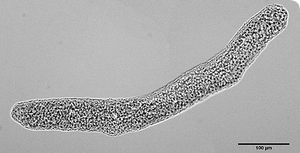
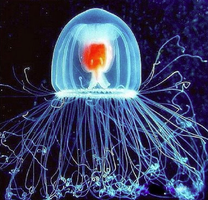
Buddenbrockia: A parasitic worm derived from jellyfish, having lost most jellyfish features.
Evolution of Complex Structures
Complex traits evolve incrementally through natural selection acting on heritable variation. Intermediate forms often exist, showing gradual increases in functional complexity.
Incremental Evolution: Complex adaptations arise from small, heritable changes over generations.
Intermediate States: Transitional forms demonstrate stepwise increases in complexity.
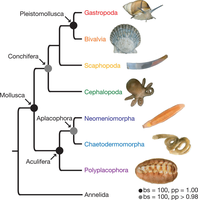
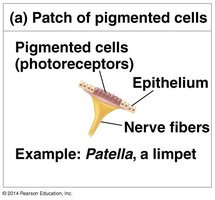
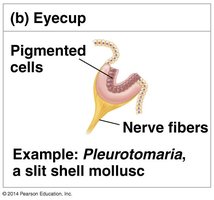
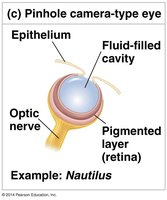
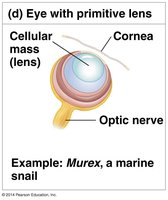
Evolution of Mollusc Eyes: Intermediate States
The evolution of mollusc eyes illustrates incremental adaptation, with each stage providing increased functionality.
Patch of Pigmented Cells: Detects presence/absence of light.
Eyecup: Detects light and some directionality.
Pinhole Camera-Type Eye: Detects light and more precise directionality.
Eye with Primitive Lens: Can focus at different distances.
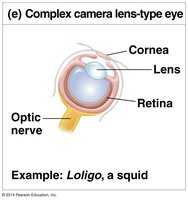
Complex Camera Lens-Type Eye: Provides high-resolution vision and focus.
Summary: Evolution of Complex Adaptations
Complex adaptations are the result of natural selection acting on small-scale, heritable variation. Over many generations, this process can lead to both highly complex and highly simplified structures.
Essential Vocabulary
Mass Extinction: A rapid, widespread decrease in the number of species.
Evolutionary Radiation: Rapid increase in species diversity.
Adaptive Radiation: Rapid speciation driven by adaptation to new environments.
Key Innovation: A novel trait enabling exploitation of new ecological niches.
Study Questions
There have been five major mass extinctions. When did the end-Permian and end-Cretaceous happen? What were their effects and some potential causes for those two events?
How do current extinction rates compare to historical rates?
What's the difference between an "evolutionary radiation" and an "adaptive radiation"?
What conditions lead to radiations?
