 Indietro
Step-by-Step Guidance for General Biology Exam III (Ch 7,8,9)
Guida di studio - Note intelligenti
 Appunti personalizzati basati sui tuoi materiali, ampliati con definizioni chiave, esempi e contesto.
Q1. In the mitochondrion, the processing of ADP to produce ATP is dependent on the:
Background
Topic: Cellular Respiration & ATP Synthesis
This question tests your understanding of how ATP is produced in mitochondria, specifically which process is responsible for converting ADP to ATP.
Key Terms:
ADP (Adenosine Diphosphate): A molecule that can be converted to ATP.
ATP (Adenosine Triphosphate): The main energy currency of the cell.
Oxidative Phosphorylation: The process in mitochondria where most ATP is produced.
Glycolysis, Citric Acid Cycle, Krebs Cycle: Other stages of cellular respiration.
Step-by-Step Guidance
Recall the main stages of cellular respiration: glycolysis, citric acid cycle (Krebs cycle), and oxidative phosphorylation.
Consider where in the mitochondrion ATP is produced in the largest quantity.
Think about which process directly uses ADP and inorganic phosphate to synthesize ATP.
Review the role of the electron transport chain and chemiosmosis in ATP production.
Try solving on your own before revealing the answer!
Final Answer: a. oxidative phosphorylation
Oxidative phosphorylation is the process in mitochondria where ADP is converted to ATP, primarily through the electron transport chain and chemiosmosis.
Q2. The majority of spontaneous reactions ________ the entropy of the system.
Background
Topic: Thermodynamics & Entropy
This question tests your understanding of how entropy changes during spontaneous reactions.
Key Terms:
Spontaneous Reaction: A reaction that occurs without external input.
Entropy: A measure of disorder or randomness in a system.
Step-by-Step Guidance
Recall the second law of thermodynamics and its implications for entropy.
Consider what happens to the disorder of a system during a spontaneous process.
Think about examples of spontaneous reactions and how they affect entropy.
Try solving on your own before revealing the answer!
Final Answer: a. increase
Spontaneous reactions typically increase the entropy of the system, as stated by the second law of thermodynamics.
Q3. In noncompetitive inhibition, the inhibitor binds to the allosteric or alternative site on the enzyme. How does this process inhibit the substrate from binding in the active site?
Background
Topic: Enzyme Regulation & Inhibition
This question tests your understanding of how noncompetitive inhibitors affect enzyme activity.
Key Terms:
Noncompetitive Inhibition: Inhibitor binds to a site other than the active site.
Allosteric Site: A site on the enzyme other than the active site.
Active Site: The region where the substrate binds.
Step-by-Step Guidance
Recall the difference between competitive and noncompetitive inhibition.
Consider what happens to the enzyme's structure when an inhibitor binds to the allosteric site.
Think about how changes in enzyme conformation can affect substrate binding.
Try solving on your own before revealing the answer!
Final Answer: d. By changing the conformation of the active site.
Noncompetitive inhibitors bind to an allosteric site, causing a conformational change that prevents substrate binding at the active site.
Q4. The active site is the specific region in a/an ________ where a/an ________ binds.
Background
Topic: Enzyme Structure & Function
This question tests your understanding of the relationship between enzymes and substrates.
Key Terms:
Active Site: The region of an enzyme where the substrate binds.
Enzyme: A protein that catalyzes reactions.
Substrate: The molecule upon which an enzyme acts.
Step-by-Step Guidance
Recall the definition of an enzyme and its active site.
Think about which molecule binds to the active site during a reaction.
Review the lock-and-key model of enzyme action.
Try solving on your own before revealing the answer!
Final Answer: b. enzyme, substrate
The active site is a region in an enzyme where the substrate binds.
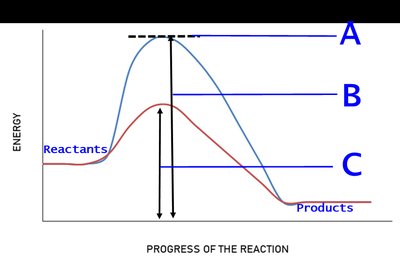
Q5. In the energy diagram for a biological reaction given below, identify the correct labeling for A, B, and C.
Background
Topic: Enzyme Catalysis & Activation Energy
This question tests your ability to interpret an energy diagram and understand how enzymes affect activation energy.
Key Terms and Formulas:
Activation Energy (): The energy required to start a reaction.
Transition State: The highest energy point during the reaction.
Enzyme: A protein that lowers the activation energy of a reaction.
Step-by-Step Guidance
Examine the energy diagram and identify the reactants, products, and the peak (transition state).
Notice the two curves: one with higher activation energy (no enzyme) and one with lower activation energy (with enzyme).
Label A as the highest point (transition state), B as the activation energy without enzyme, and C as the activation energy with enzyme.
Review the definitions of transition state and activation energy in the context of enzyme catalysis.
Try solving on your own before revealing the answer!
Final Answer: a. A - Transition state, B - Activation energy in the absence of an enzyme, C - Activation energy in the presence of an enzyme.
The diagram shows that enzymes lower the activation energy required for a reaction, making it easier for reactants to reach the transition state.
