 Indietro
Structure and Function of Large Biological Molecules: General Biology I Study Notes
Guida di studio - Note intelligenti
 Appunti personalizzati basati sui tuoi materiali, ampliati con definizioni chiave, esempi e contesto.
Macromolecules and Polymers
Definition and Types
Macromolecules are large, complex molecules essential for life, including carbohydrates, proteins, and nucleic acids. These are polymers, which are long molecules made of repeating units called monomers.
Polymer: A long molecule consisting of many similar or identical building blocks (monomers).
Monomer: The repeating unit that serves as a building block for polymers.
Examples: Carbohydrates, proteins, and nucleic acids are all polymers.
Dehydration and Hydrolysis Reactions
Polymers are synthesized and broken down by specific chemical reactions:
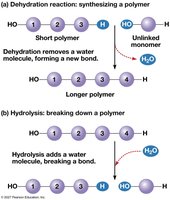
Dehydration Reaction: Joins monomers by removing a water molecule, forming a new bond.
Hydrolysis Reaction: Breaks down polymers by adding a water molecule, breaking a bond.
Carbohydrates
Monosaccharides
Carbohydrates include sugars and their polymers. The simplest carbohydrates are monosaccharides, or simple sugars, which serve as major fuel for cells and as raw material for building molecules.
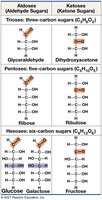
Monosaccharides: Have molecular formulas usually multiples of CH2O.
Classification: Based on the location of the carbonyl group (aldose or ketose) and the number of carbons in the skeleton.
Structure of Glucose
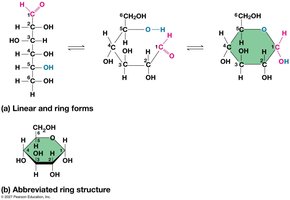
Monosaccharides are often drawn as linear skeletons, but in aqueous solutions, many sugars form rings.
Disaccharides
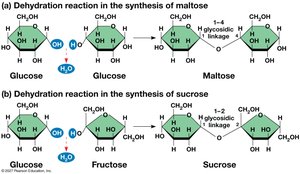
A disaccharide is formed when a dehydration reaction joins two monosaccharides. The covalent bond between them is called a glycosidic linkage.
Polysaccharides
Polysaccharides are polymers of sugars and serve storage and structural roles. Their architecture and function are determined by their sugar monomers and the positions of their glycosidic linkages.
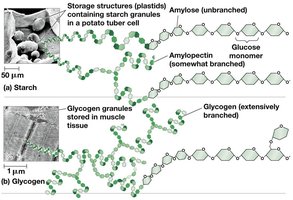
Starch: Storage polysaccharide in plants, consists of glucose monomers. Stored as granules in chloroplasts and other plastids.
Amylose: Simplest form of starch, unbranched.
Glycogen: Storage polysaccharide in animals, stored mainly in liver and muscle cells. Extensively branched.
Structural Polysaccharides
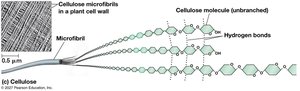
Cellulose is a major component of plant cell walls. Like starch, it is a polymer of glucose, but the glycosidic linkages differ. The difference is based on two ring forms for glucose: alpha (α) and beta (β).
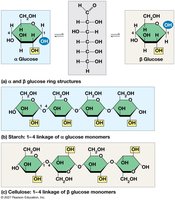
Starch: α configuration, largely helical.
Cellulose: β configuration, straight and unbranched. Enzymes that digest starch cannot hydrolyze β linkages in cellulose.
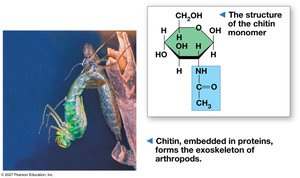
Chitin: Structural polysaccharide found in the exoskeleton of arthropods and cell walls of fungi.
Lipids
Definition and Types
Lipids are a class of large biological molecules that do not include true polymers. They are hydrophobic and consist mostly of hydrocarbon regions. The most biologically important lipids are fats, phospholipids, and steroids.
Fats
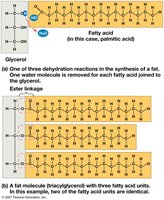
Fats are constructed from glycerol and fatty acids. Glycerol is a three-carbon alcohol, and a fatty acid consists of a carboxyl group attached to a long carbon skeleton. Three fatty acids are joined to glycerol by ester linkage, forming a triacylglycerol (triglyceride).
Saturated and Unsaturated Fats
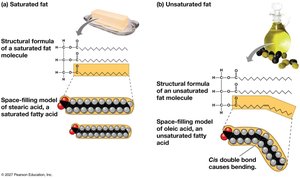
Fatty acids vary in length and in the number and locations of double bonds.
Saturated fatty acids: Maximum number of hydrogen atoms, no double bonds. Solid at room temperature (most animal fats).
Unsaturated fatty acids: One or more double bonds. Liquid at room temperature (plant and fish fats).
Functions of Fats
Energy storage: Long-term food reserves in adipose cells.
Protection: Cushions vital organs.
Insulation: Maintains body temperature.
Phospholipids
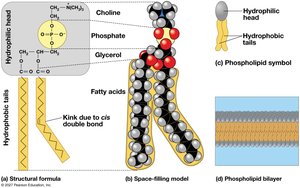
Phospholipids are major components of cell membranes. They self-assemble into bilayers in water, with hydrophobic tails pointing inward and hydrophilic heads outward.
Steroids
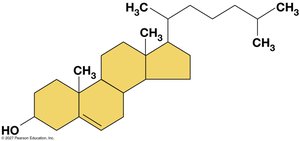
Steroids are lipids characterized by a carbon skeleton consisting of four fused rings. Cholesterol is a type of steroid found in animal cell membranes and is a precursor for other steroids.
Proteins
Functions of Proteins
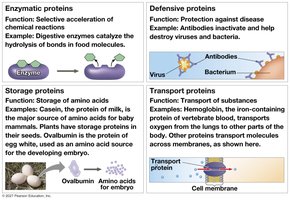
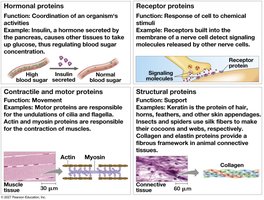
Proteins account for more than 50% of the dry mass of most cells. They perform a wide range of functions, including catalysis, defense, storage, transport, communication, movement, and structural support.
Amino Acids and Polypeptides
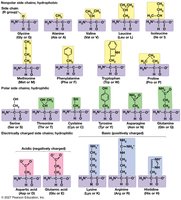
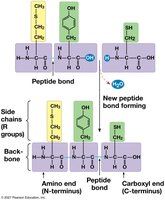
Proteins are constructed from 20 amino acids. Amino acids are organic molecules with amino and carboxyl groups, differing by their side chains (R groups). Polypeptides are unbranched polymers of amino acids, linked by peptide bonds.
Protein Structure
The structure of a protein determines its function. Proteins have four levels of structure:
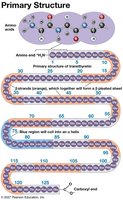
Primary structure: Sequence of amino acids.
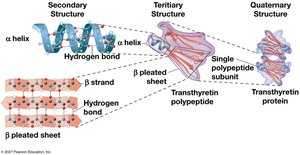
Secondary structure: Coils and folds (α helix and β pleated sheet) due to hydrogen bonding.
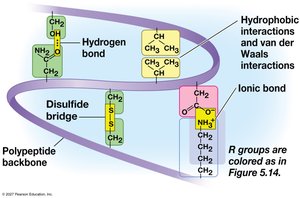
Tertiary structure: Overall shape due to interactions between R groups (hydrogen bonds, ionic bonds, hydrophobic interactions, van der Waals interactions, disulfide bridges).
Quaternary structure: Association of two or more polypeptide chains.
Examples of Quaternary Structure
Collagen: Fibrous protein with three polypeptides coiled like a rope.
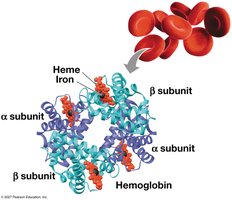
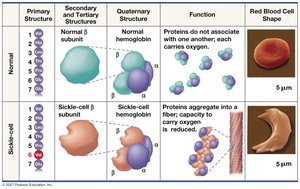
Hemoglobin: Globular protein with four polypeptides (two α and two β subunits).

Sickle-Cell Disease
A single amino acid substitution in a protein can cause sickle-cell disease, affecting the structure and function of hemoglobin.
Protein Denaturation
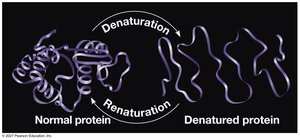
Physical and chemical conditions can affect protein structure. Alterations in pH, salt concentration, temperature, or other environmental factors can cause a protein to unravel, a process called denaturation. Denatured proteins are biologically inactive.
Nucleic Acids
DNA and RNA
Nucleic acids are polymers called polynucleotides, made of monomers called nucleotides. There are two types: deoxyribonucleic acid (DNA) and ribonucleic acid (RNA).
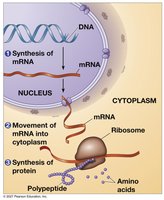
DNA: Provides directions for its own replication and directs synthesis of messenger RNA (mRNA).
RNA: Single-stranded, involved in protein synthesis.
Nucleotide Structure
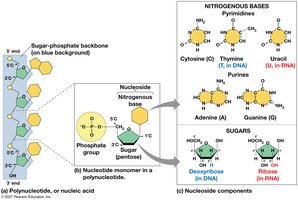
Nucleotide: Consists of a nitrogenous base, a pentose sugar, and one or more phosphate groups.
Nucleoside: Nitrogenous base + sugar (no phosphate group).
Nitrogenous bases: Pyrimidines (cytosine, thymine, uracil) and purines (adenine, guanine).
Sugar: Deoxyribose in DNA, ribose in RNA.
Polynucleotide Formation
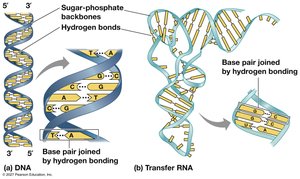
Nucleotides are linked by phosphodiester linkages, creating a sugar-phosphate backbone with nitrogenous bases as appendages. The sequence of bases is unique for each gene.
DNA Structure
Double helix: Two polynucleotides spiraling around an axis.
Antiparallel: Backbones run in opposite 5′→3′ directions.
Complementary base pairing: Adenine (A) pairs with thymine (T), guanine (G) pairs with cytosine (C).
RNA Structure
Single-stranded: Can form complementary pairing within or between RNA molecules.
Uracil (U): Replaces thymine in RNA, pairs with adenine.
Additional info: The notes above expand on brief points with academic context, definitions, and examples to ensure completeness and clarity for General Biology students.
