 Indietro
Structure and Function of Large Biological Molecules
Guida di studio - Note intelligenti
 Appunti personalizzati basati sui tuoi materiali, ampliati con definizioni chiave, esempi e contesto.
The Structure and Function of Large Biological Molecules
Macromolecules and Polymers
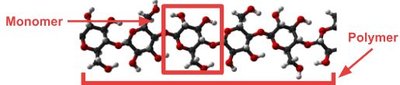
Large biological molecules, or macromolecules, are essential for life and are primarily composed of carbon atoms forming their backbone. Most macromolecules are polymers, which are long chains of repeating subunits called monomers. The four main classes of macromolecules are carbohydrates, lipids, proteins, and nucleic acids.
Polymer: A long molecule consisting of many similar or identical monomers linked together.
Monomer: The repeating unit that serves as the building block of a polymer.
Carbohydrates
Structure and Types
Carbohydrates are composed of carbon (C), hydrogen (H), and oxygen (O), typically with a hydrogen:oxygen ratio of 2:1. They serve as energy sources and structural materials in cells.
Monosaccharides: Simple sugars with one ring structure (e.g., glucose).
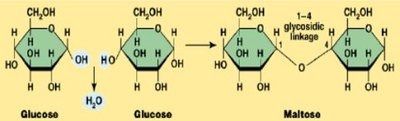
Disaccharides: Two monosaccharides joined by a glycosidic linkage (a type of covalent bond), formed by dehydration synthesis.
Polysaccharides: Many monosaccharides joined together; classified as storage (e.g., starch, glycogen) or structural (e.g., cellulose, chitin).
Storage and Structural Polysaccharides
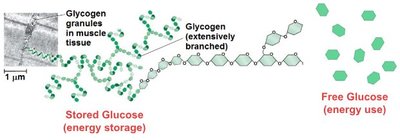
Polysaccharides play key roles in energy storage and structural support. Starch is the main storage carbohydrate in plants, while glycogen is the main storage carbohydrate in animals. Cellulose and chitin are structural polysaccharides found in plants, fungi, and animals.
Hydrolysis: The process by which glucose is released from polysaccharides for energy use.
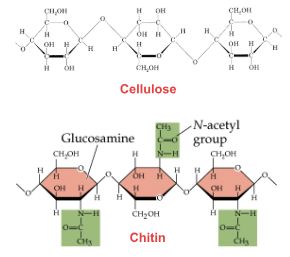
Cellulose: Major component of plant cell walls.
Chitin: Found in exoskeletons of insects and crustaceans, and fungal cell walls.
Structure Determines Function
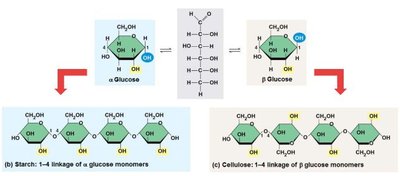
The function of a polysaccharide is determined by its sugar monomers and the positions of glycosidic linkages. For example, starch and cellulose are both composed of glucose monomers, but differ in their glycosidic linkages due to the alpha and beta ring structures of glucose.
Alpha configuration: Found in starch.
Beta configuration: Found in cellulose.
Lipids
Structure and Properties
Lipids are composed of C, H, and O, but not in a fixed ratio. They are hydrophobic due to their nonpolar hydrocarbon chains and include fats, oils, waxes, phospholipids, and steroids. Unlike other macromolecules, lipids do not form true polymers.
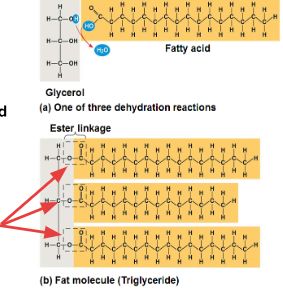
Fats (Triglycerides): Formed from three fatty acids and a glycerol molecule, joined by ester linkages via dehydration synthesis.
Main functions: Energy storage and insulation.
Saturated vs. Unsaturated Fats
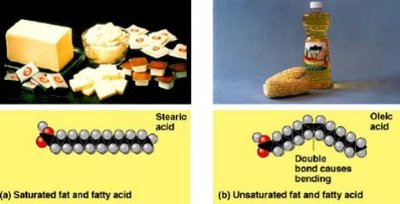
Fats can be classified based on the presence of double bonds in their fatty acid chains.
Saturated fats: All single bonds, solid at room temperature (e.g., butter).
Unsaturated fats: One or more double bonds, liquid at room temperature (e.g., vegetable oil).
Phospholipids
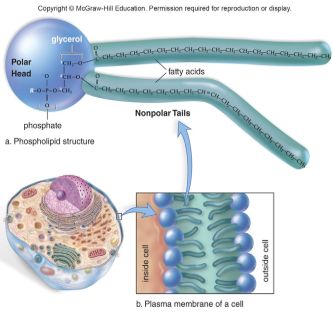
Phospholipids are complex lipids with two fatty acids (hydrophobic) and a phosphate group (hydrophilic). They are the primary building blocks of cell membranes, forming a lipid bilayer in water.
Hydrophilic heads: Face outward, interacting with water.
Hydrophobic tails: Face inward, away from water.
Steroids
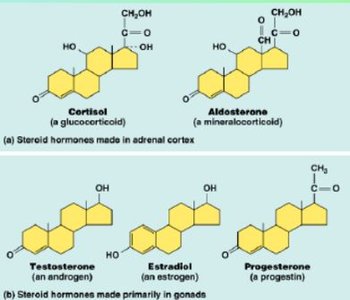
Steroids are lipids with a structure of four fused carbon rings. They serve as structural elements in cell membranes, vitamins, and hormones.
Examples: Cortisol, aldosterone, testosterone, estradiol, progesterone.
Proteins
Structure and Function
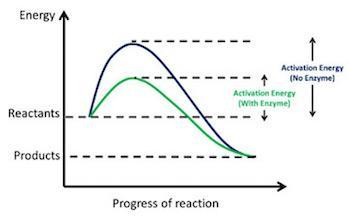
Proteins are composed of C, H, O, N (sometimes S) and are polymers of amino acids joined by peptide bonds. They make up cell structure and act as enzymes to catalyze chemical reactions.
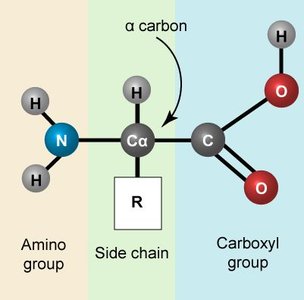
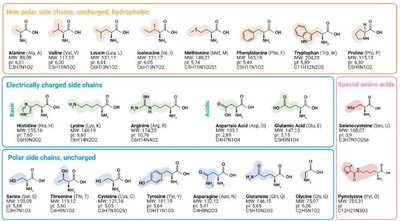
Amino acids: 20 different types, each with an amino group, carboxyl group, hydrogen, and an R group attached to a central (alpha) carbon.
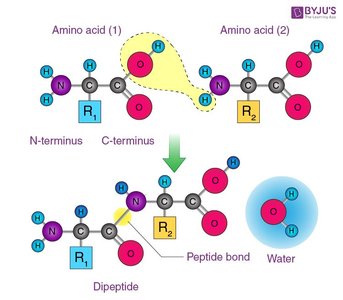
Peptide bond: Covalent bond formed by dehydration synthesis between amino acids.
Amino Acid Classification
Amino acids are classified based on their R groups:
Nonpolar (hydrophobic)
Polar (hydrophilic)
Ionic (charged, hydrophilic)
Polypeptides and Directionality
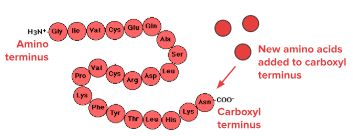
Proteins are polymers called polypeptides, which have directionality due to their chemically distinct ends: the amino (N) terminus and the carboxyl (C) terminus. New amino acids are added to the carboxyl terminus during synthesis.
Dipeptide: Two amino acids joined together.
Polypeptide: Many amino acids joined together.
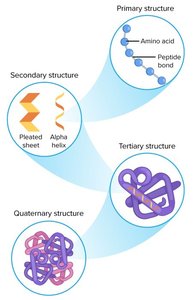
Levels of Protein Structure
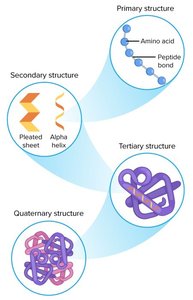
Proteins have four levels of structure:
Primary structure: Linear sequence of amino acids.
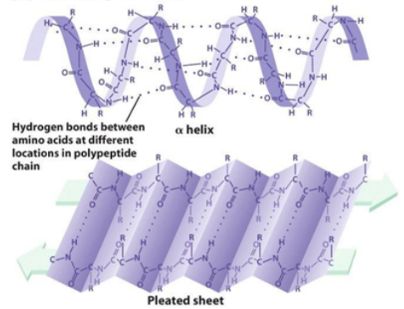
Secondary structure: Regular patterns (alpha helix, beta sheet) formed by hydrogen bonds in the backbone.
Tertiary structure: 3D folding due to interactions between R groups.
Quaternary structure: Association of multiple polypeptide chains (subunits).
Nucleic Acids
Structure and Function
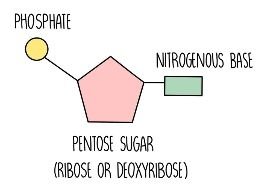
Nucleic acids are polymers made of nucleotide monomers, consisting of C, H, O, N, and P. They store and transmit genetic information in the form of DNA and RNA.
Nucleotide: Composed of a phosphate group, a pentose sugar (ribose or deoxyribose), and a nitrogenous base.
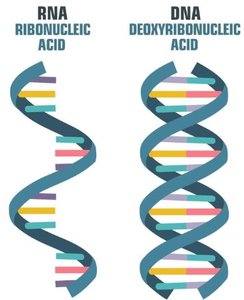
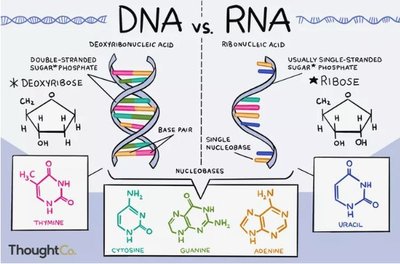
DNA: Double-stranded, contains deoxyribose.
RNA: Single-stranded, contains ribose.
Comparison of DNA and RNA
Feature | DNA | RNA |
|---|---|---|
Strands | Double-stranded | Single-stranded |
Sugar | Deoxyribose | Ribose |
Nitrogenous Bases | A, T, C, G | A, U, C, G |
Example: DNA stores genetic information, while RNA is involved in protein synthesis.
----------------------------------------
