 Indietro
Chapter 5A: Structure and Function of Large Biological Molecules: Carbohydrates, Lipids, and Proteins
Guida di studio - Note intelligenti
 Appunti personalizzati basati sui tuoi materiali, ampliati con definizioni chiave, esempi e contesto.
The Structure and Function of Large Biological Molecules
Overview of Biological Macromolecules
Biological macromolecules are essential for life, forming the structural and functional basis of cells. The four major classes are carbohydrates, lipids, proteins, and nucleic acids. Each class has unique monomers, functions, and examples in living organisms.
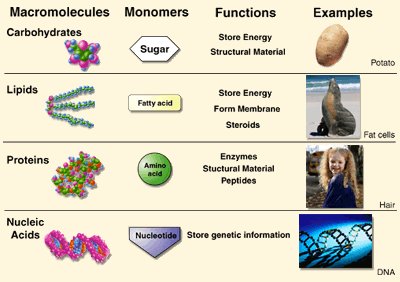
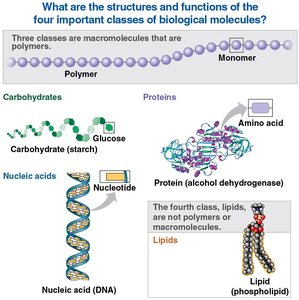
Macromolecules and Polymers
Polymer Formation and Breakdown
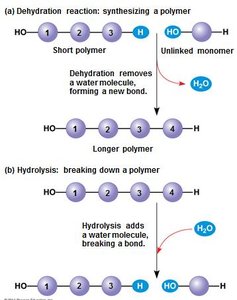
Most biological macromolecules (except lipids) are polymers, formed by linking monomers through covalent bonds. The synthesis and breakdown of polymers involve dehydration and hydrolysis reactions:
Dehydration Reaction: Joins monomers by removing a water molecule, forming a new bond.
Hydrolysis: Breaks polymers into monomers by adding a water molecule, breaking a bond.
Key Point: Lipids are not polymers; they are assembled from smaller molecules but do not form long chains of repeating units.
Carbohydrates
Monosaccharides: Simple Sugars
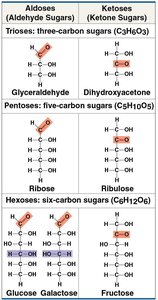
Carbohydrates are composed of monosaccharides, which are the simplest sugars. Their molecular formulas are usually multiples of CH2O. Glucose (C6H12O6) is the most common monosaccharide.
Classification: Based on the location of the carbonyl group (aldose or ketose) and the number of carbons.
Function: Serve as fuel for cells and as building blocks for larger molecules.
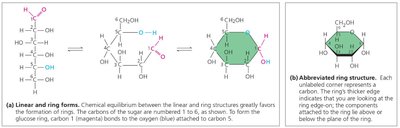
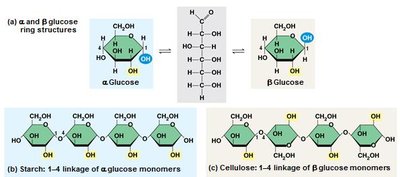
Linear and Ring Forms of Glucose
Monosaccharides often form ring structures in aqueous solutions, which are more stable than linear forms.
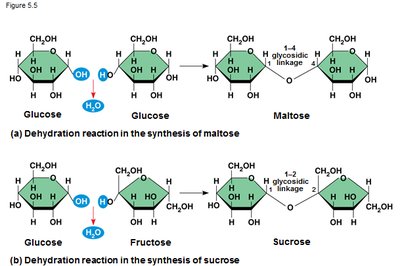
Disaccharides and Glycosidic Linkages
Disaccharides are formed when two monosaccharides join via a dehydration reaction, creating a glycosidic linkage. Examples include maltose and sucrose.
Polysaccharides: Storage and Structural Roles
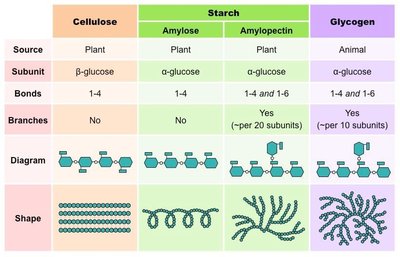
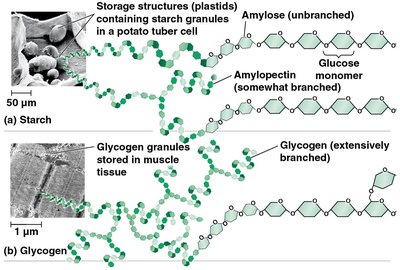
Polysaccharides are polymers of sugars with storage and structural functions. Their properties depend on the type of monomers and the positions of glycosidic linkages.
Storage Polysaccharides: Starch (plants) and glycogen (animals) store energy.
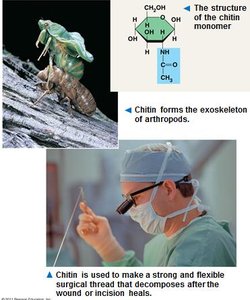
Structural Polysaccharides: Cellulose (plants) and chitin (arthropods, fungi) provide structural support.
Cellulose: Structural Polysaccharide
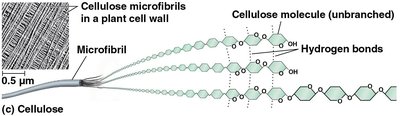
Cellulose is a polymer of glucose with β-glycosidic linkages, forming straight chains that group into microfibrils for plant cell wall strength. Humans cannot digest cellulose due to the inability to hydrolyze β-linkages.
Chitin: Structural Polysaccharide
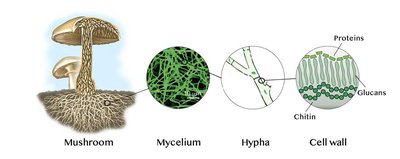
Chitin is found in the exoskeletons of arthropods and cell walls of fungi, providing structural support.
Lipids
General Properties and Types
Lipids are hydrophobic molecules, including fats, phospholipids, and steroids. They do not form polymers and are characterized by their insolubility in water due to nonpolar hydrocarbon chains.
Fats (Triacylglycerols): Energy storage molecules composed of glycerol and fatty acids.
Phospholipids: Major component of cell membranes, amphipathic with hydrophobic tails and hydrophilic heads.
Steroids: Lipids with four fused rings, including cholesterol and hormones.

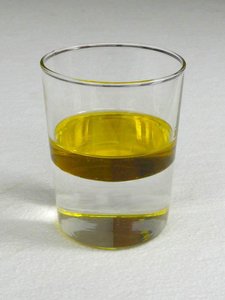
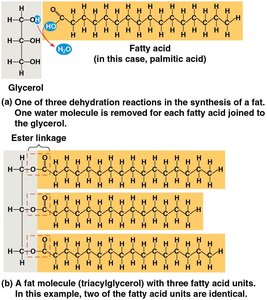
Structure of Fats
Fats are constructed from glycerol and fatty acids, joined by ester linkages. Three fatty acids combine with one glycerol to form a triacylglycerol.
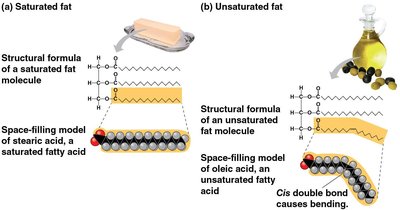
Saturated vs. Unsaturated Fatty Acids
Saturated fatty acids have no double bonds and are solid at room temperature. Unsaturated fatty acids have one or more double bonds, causing kinks and making them liquid at room temperature.
Saturated Fats: Mostly animal fats; high intake may contribute to heart disease.
Unsaturated Fats: Plant and fish fats; include essential omega-3 fatty acids.

Phospholipids and Cell Membranes
Phospholipids have two fatty acids and a phosphate group attached to glycerol. Their amphipathic nature allows them to form bilayers, which are the foundation of cell membranes.
Steroids
Steroids are lipids with a four-ring structure. Cholesterol is a key steroid in animal cell membranes and a precursor for other steroid hormones.
Proteins
Functions and Diversity
Proteins are the most diverse macromolecules, accounting for over 50% of cell dry mass. They serve as enzymes, structural materials, transporters, and in defense, communication, and movement.
Amino Acids and Polypeptides
Proteins are polymers of amino acids, linked by peptide bonds. There are 20 amino acids, each with a unique side chain (R group) that determines its properties.
Polypeptides: Unbranched chains of amino acids.
Protein: One or more polypeptides folded into a functional shape.
Levels of Protein Structure
Protein structure is hierarchical, with four levels:
Primary: Sequence of amino acids.
Secondary: Coils and folds (α helix, β pleated sheet) stabilized by hydrogen bonds.
Tertiary: 3D folding due to interactions among R groups (hydrogen bonds, ionic bonds, hydrophobic interactions, disulfide bridges).
Quaternary: Association of multiple polypeptide chains (e.g., hemoglobin).
Protein Structure and Disease
A change in primary structure can affect protein function. For example, sickle-cell disease results from a single amino acid substitution in hemoglobin.
Protein Denaturation and Folding
Physical and chemical conditions (pH, salt, temperature) can cause proteins to denature, losing their functional shape. Chaperonins assist in proper protein folding. Techniques like X-ray crystallography and NMR spectroscopy help determine protein structure.
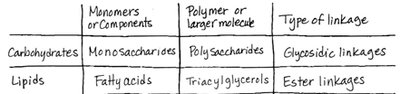
Summary Table: Carbohydrates vs. Lipids
The following table compares carbohydrates and lipids in terms of their monomers, polymers, and linkages:
Type | Monomers or Components | Polymer or Larger Molecule | Type of Linkage |
|---|---|---|---|
Carbohydrates | Monosaccharides | Polysaccharides | Glycosidic linkages |
Lipids | Fatty acids | Triacylglycerols | Ester linkages |
Quick Review Questions
A polymer is made up of monomers.
Make a polymer via dehydration synthesis.
Break a polymer via hydrolysis.
Which of the following is true of unsaturated fats? B. They have double bonds in the carbon chains of their fatty acids.
Additional info: Nucleic acids are another class of macromolecules, but their detailed structure and function are covered in later chapters. This guide focuses on carbohydrates, lipids, and proteins as outlined in Chapter 5.
