 Indietro
Structure and Function of the Liver Lobule
Guida di studio - Note intelligenti
 Appunti personalizzati basati sui tuoi materiali, ampliati con definizioni chiave, esempi e contesto.
Liver Structure and Function
Liver Lobule: The Structural and Functional Unit
The liver is a vital organ with a unique dual blood supply and a highly organized microscopic structure. The basic functional unit of the liver is the liver lobule, which is essential for processing blood from the digestive tract and for bile production.
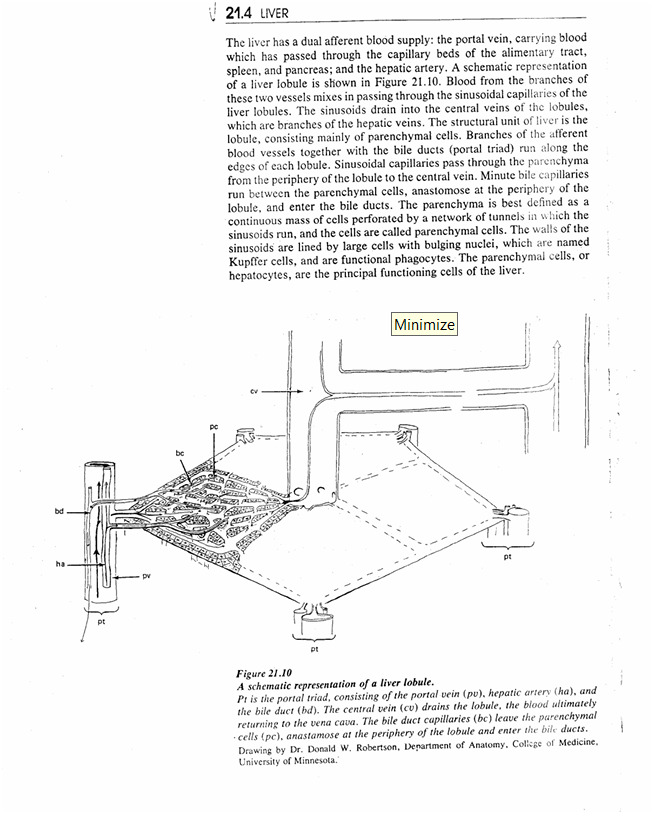
Dual Afferent Blood Supply: The liver receives blood from two sources: the portal vein (carrying nutrient-rich blood from the alimentary tract, spleen, and pancreas) and the hepatic artery (supplying oxygenated blood).
Sinusoidal Capillaries: Blood from both vessels mixes in the sinusoids, specialized capillaries that traverse the lobule and allow for exchange between blood and liver cells.
Central Vein: Sinusoids drain into the central vein of each lobule, which ultimately returns blood to the vena cava via the hepatic veins.
Portal Triad: At the periphery of each lobule, branches of the portal vein, hepatic artery, and bile duct (collectively called the portal triad) run together.
Bile Flow: Bile canaliculi (tiny channels) collect bile produced by hepatocytes, which then flows toward the bile ducts at the lobule's periphery.
Cell Types in the Liver Lobule
The liver lobule contains several specialized cell types, each with distinct functions:
Parenchymal Cells (Hepatocytes): The main functional cells of the liver, responsible for metabolism, detoxification, and bile production.
Kupffer Cells: Large, phagocytic cells lining the sinusoids. They play a key role in removing debris, pathogens, and old red blood cells from the blood.
Summary Table: Key Structures of the Liver Lobule
Structure | Function |
|---|---|
Portal Vein | Brings nutrient-rich blood from the digestive tract |
Hepatic Artery | Supplies oxygenated blood to the liver |
Sinusoids | Mix blood from portal vein and hepatic artery; site of exchange |
Central Vein | Drains blood from the lobule to the hepatic vein |
Bile Canaliculi | Collect bile from hepatocytes and transport it to bile ducts |
Kupffer Cells | Phagocytose debris and pathogens in the blood |
Hepatocytes | Carry out metabolic, synthetic, and detoxification functions |
Example: Blood and Bile Flow in the Liver Lobule
Blood enters the lobule via branches of the portal vein and hepatic artery, mixes in the sinusoids, and flows toward the central vein.
Bile produced by hepatocytes flows in the opposite direction, from the center of the lobule toward the bile ducts at the periphery.
Additional info: The organization of the liver lobule allows for efficient processing of nutrients, toxins, and waste products, as well as the production and secretion of bile necessary for fat digestion.
