 Indietro
Structure and Function of the Plasma Membrane
Guida di studio - Note intelligenti
 Appunti personalizzati basati sui tuoi materiali, ampliati con definizioni chiave, esempi e contesto.
The Plasma Membrane
Purpose and Composition
The plasma membrane is a fundamental structure in all cells, serving as a selective barrier that regulates the entry and exit of substances. It maintains cellular integrity and enables communication with the environment.
Purpose: Separates the cell from its surroundings, controls transport, and facilitates cell signaling.
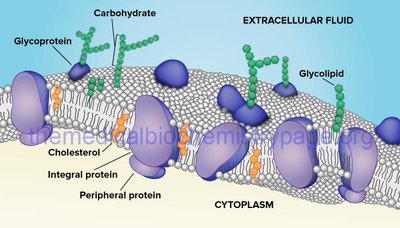
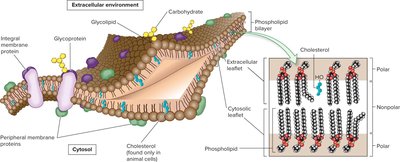
Composition: Primarily composed of a phospholipid bilayer, with embedded proteins, cholesterol, and glycolipids.
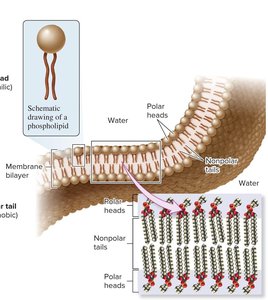
Phospholipids: Amphipathic molecules with a hydrophilic (polar) head and hydrophobic (nonpolar) tails.
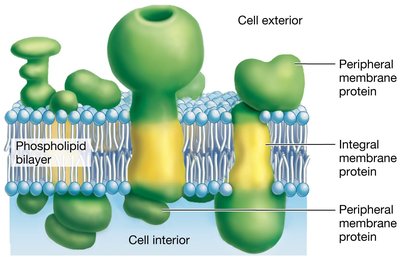
Proteins: Integral and peripheral proteins perform transport, signaling, and structural functions.
Cholesterol: Modulates membrane fluidity and stability.
Glycolipids and Glycoproteins: Involved in cell recognition and signaling.
Phospholipid Structure and Representation
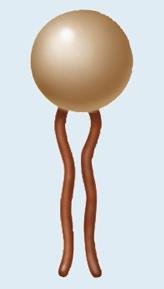
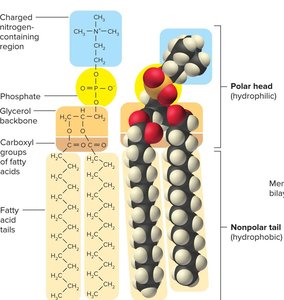
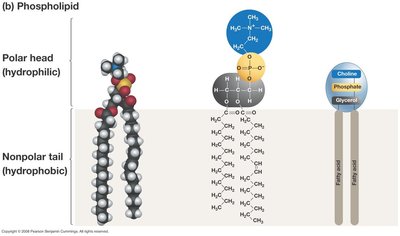
Phospholipids are the main structural component of membranes. Their amphipathic nature allows them to form bilayers spontaneously in aqueous environments.
Polar Head: Hydrophilic, interacts with water.
Nonpolar Tails: Hydrophobic, avoid water and interact with each other.
Three Representations: Ball-and-stick, schematic, and space-filling models.
Amphipathic Lipids and Membrane Formation
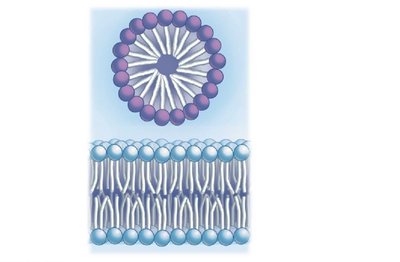
Amphipathic lipids spontaneously assemble into micelles or bilayers in water, driven by their dual affinity for water and avoidance of it.
Lipid Micelles: Spherical structures formed by single fatty acid chains (e.g., soaps).
Lipid Bilayers: Sheet-like structures formed by phospholipids with two fatty acid chains (e.g., cell membranes).
Hydrophilic heads: Face outward toward water.
Hydrophobic tails: Face inward, away from water.
Fluid Mosaic Model
Components and Organization
The fluid mosaic model describes the dynamic and heterogeneous nature of the plasma membrane, where lipids and proteins move laterally within the bilayer.
Lipids: Provide the basic structural framework.
Proteins: Integral (span the membrane) and peripheral (attached to the surface).
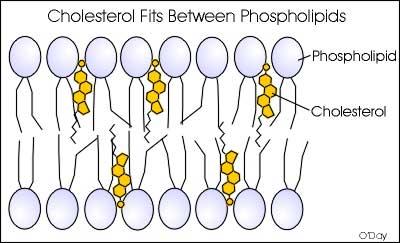
Cholesterol: Intercalates between phospholipids, affecting fluidity.
Carbohydrates: Attached to proteins (glycoproteins) or lipids (glycolipids) for cell recognition.
Membrane Permeability and Fluidity
Selective Permeability
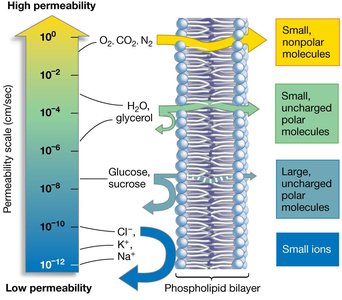
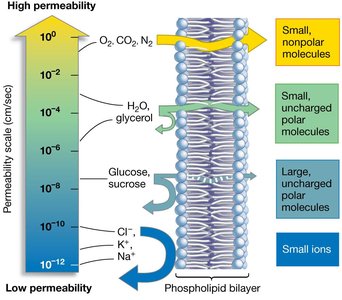
Cell membranes are selectively permeable, allowing certain molecules to pass while restricting others. Permeability depends on molecular size, polarity, and charge.
High permeability: Small, nonpolar molecules (O2, CO2, N2).
Moderate permeability: Small, uncharged polar molecules (H2O, glycerol).
Low permeability: Large, uncharged polar molecules (glucose, sucrose).
Very low permeability: Ions (Cl-, K+, Na+).
Factors Affecting Fluidity and Permeability
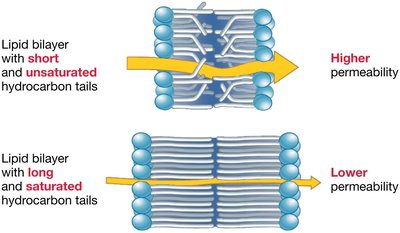
Membrane fluidity and permeability are influenced by fatty acid saturation, chain length, temperature, and cholesterol content.
Fatty Acid Saturation: Unsaturated fatty acids (with double bonds) increase fluidity and permeability; saturated fatty acids decrease them.
Fatty Acid Length: Shorter chains increase fluidity; longer chains decrease it.
Temperature: Higher temperatures increase fluidity; lower temperatures decrease it.
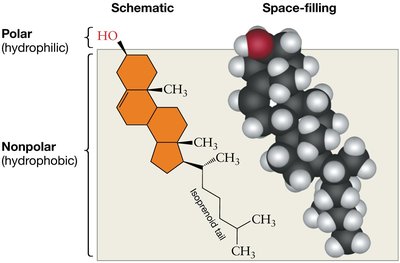
Cholesterol: Reduces fluidity and permeability by fitting between phospholipids.
Diffusion and Osmosis
Diffusion
Diffusion is the passive movement of molecules from regions of high concentration to regions of low concentration, driven by the concentration gradient.
Simple Diffusion: Solutes move across the membrane without assistance.
Equilibrium: Achieved when concentrations are equal on both sides.
Osmosis
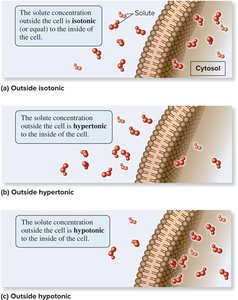
Osmosis is the diffusion of water across a semipermeable membrane, driven by differences in solute concentration.
Isotonic: Equal solute concentration inside and outside; no net water movement.
Hypertonic: Higher solute concentration outside; water moves out, cell shrinks.
Hypotonic: Lower solute concentration outside; water moves in, cell swells.
Membrane Transport Mechanisms
Facilitated Diffusion and Passive Transport
Facilitated diffusion involves membrane proteins that help specific molecules cross the membrane down their concentration gradient.
Channels: Allow ions or water to pass (e.g., aquaporins, ion channels).
Transporters/Carriers: Uniporters (one molecule), symporters (multiple molecules in same direction), antiporters (multiple molecules in opposite directions).
Gated Channels: Open or close in response to signals.
Active Transport
Active transport moves molecules against their concentration gradient, requiring energy (usually ATP).
Primary Active Transport: Direct use of ATP (e.g., Na+/K+-ATPase pump).
Secondary Active Transport: Uses energy stored in electrochemical gradients (e.g., H+/sucrose symporter, Na+/glucose cotransporter).
Pumps: Concentrate nutrients, expel waste, and generate electrochemical gradients.
Summary Table: Membrane Transport Types
Transport Type | Direction | Energy Requirement | Example |
|---|---|---|---|
Simple Diffusion | Down gradient | No | O2, CO2 |
Facilitated Diffusion | Down gradient | No | Aquaporin, ion channels |
Primary Active Transport | Against gradient | Yes (ATP) | Na+/K+-ATPase |
Secondary Active Transport | Against gradient | Yes (gradient energy) | Na+/Glucose symporter |
Key Equations
Diffusion Rate:
Where D is the diffusion coefficient, ΔC is the concentration difference, and Δx is the distance.
Osmotic Pressure:
Where i is the van 't Hoff factor, M is molarity, R is the gas constant, and T is temperature.
Additional info: Academic context was added to clarify the mechanisms of membrane transport, the role of cholesterol, and the impact of fatty acid saturation on membrane properties.
