 Indietro
Study Guidance for Enzyme-Catalyzed and Noncatalyzed Reactions (Energy Diagrams)
Guida di studio - Note intelligenti
 Appunti personalizzati basati sui tuoi materiali, ampliati con definizioni chiave, esempi e contesto.
Q10. Which of the following would be the same in either an enzyme-catalyzed or a noncatalyzed reaction?
Background
Topic: Enzyme Catalysis & Reaction Energy Diagrams
This question is testing your understanding of how enzymes affect the energy profile of a chemical reaction, specifically which aspects remain unchanged whether or not an enzyme is present.
Key Terms and Concepts:
Activation Energy (): The energy barrier that must be overcome for reactants to become products.
Free Energy Change (): The difference in energy between reactants and products; determines whether a reaction is spontaneous.
Enzyme: A biological catalyst that speeds up reactions by lowering the activation energy, but does not change the overall free energy change of the reaction.
Energy Diagram: A graph showing the energy changes during a reaction, with and without an enzyme.
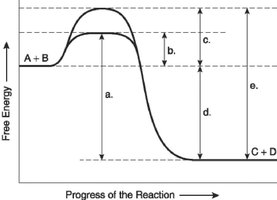
Step-by-Step Guidance
Examine the energy diagram. The vertical axis represents free energy, and the horizontal axis represents the progress of the reaction from reactants (A + B) to products (C + D).
Identify the curves: The higher curve shows the reaction without an enzyme (noncatalyzed), and the lower curve shows the reaction with an enzyme (catalyzed).
Label the points: The diagram uses letters (a, b, c, d, e) to mark different energy differences. For example, 'a' might represent the energy difference between reactants and the transition state for the catalyzed reaction, while 'b' is for the noncatalyzed reaction.
Recall that enzymes lower the activation energy (the energy difference between reactants and the transition state), but do not change the free energy difference between reactants and products ().
To answer the question, determine which labeled energy difference would be the same regardless of whether an enzyme is present. Consider which part of the diagram represents the overall energy change from reactants to products.
Try solving on your own before revealing the answer!
Final Answer: C) c
The energy difference labeled 'c' represents the overall free energy change () between reactants (A + B) and products (C + D). This value is the same for both catalyzed and noncatalyzed reactions because enzymes do not alter the free energy change of a reaction; they only lower the activation energy.
Enzymes speed up reactions by lowering the activation energy, but the total energy released or absorbed (the difference between reactants and products) remains unchanged.
