 Indietro
Study Guidance: Groups of Primates and Mammalian Diversity
Guida di studio - Note intelligenti
 Appunti personalizzati basati sui tuoi materiali, ampliati con definizioni chiave, esempi e contesto.
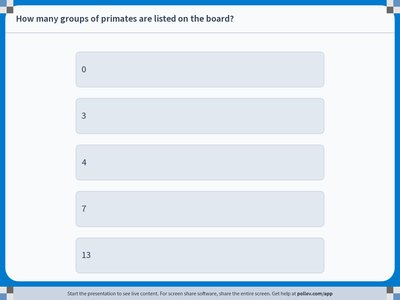
Q1. How many groups of primates are listed on the board?
Background
Topic: Classification and Diversity of Primates
This question is testing your ability to identify and count the major groups of primates based on a list or board presentation. Understanding primate diversity is important for learning about mammalian evolution and taxonomy.
Key Terms:
Primates: An order of mammals that includes lemurs, monkeys, and apes (including humans).
Group: In this context, refers to a distinct lineage or category within primates, such as Old World monkeys, New World monkeys, apes, and lemurs.
Step-by-Step Guidance
Review the list of primate groups provided in your study materials or on the board. Look for distinct categories such as Old World monkeys, New World monkeys, apes, and lemurs.
Identify each group by name and make sure you are not double-counting any subgroups or overlapping categories.
Count the total number of distinct groups listed. Remember, the question is asking for the number of groups, not the number of species or examples within each group.
Compare your count to the answer choices provided (0, 3, 4, 7, 13) and select the one that matches your tally.
Try solving on your own before revealing the answer!
Final Answer: 4
The four groups of primates listed on the board are: Old World monkeys, New World monkeys, apes, and lemurs.
This classification helps illustrate the diversity within primates and is important for understanding evolutionary relationships.
