 Indietro
Study Guide: Evolution by Natural Selection – Phylogenetic Trees and Relatedness
Guida di studio - Note intelligenti
 Appunti personalizzati basati sui tuoi materiali, ampliati con definizioni chiave, esempi e contesto.
Q1. How do you read a phylogenetic tree to determine relatedness among species?
Background
Topic: Phylogenetic Trees and Evolutionary Relationships
This question is testing your understanding of how to interpret phylogenetic trees, which are diagrams that show evolutionary relationships among species based on common ancestry. Phylogenetic trees are a key tool in evolutionary biology for visualizing how species are related through descent from common ancestors.
Key Terms and Concepts:
Phylogenetic Tree: A branching diagram that represents hypotheses about the evolutionary relationships among species.
Node: The point where branches split, representing a common ancestor.
Branch: Represents a lineage evolving through time.
Relatedness: Determined by how recently two species share a common ancestor (i.e., how close their branches are on the tree).
Step-by-Step Guidance
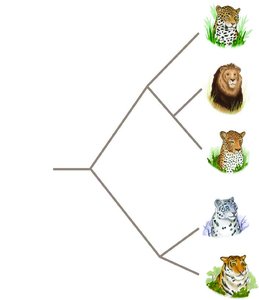
Identify the species you are comparing on the tree. For example, you might be asked which two species are most closely related among the big cats shown.
Trace the branches from each species back to their most recent common node (ancestor). The fewer nodes you pass through, the more closely related the species are.
Compare the positions of the nodes: species that share a more recent (closer to the tips) common ancestor are more closely related than those whose common ancestor is further back (closer to the base of the tree).
Remember that the order of the tips (species) on the tree does not matter; what matters is the branching pattern and the location of the nodes.
To finish, identify which species pair shares the most recent common ancestor, but stop before stating the final pair or conclusion.
Try solving on your own before revealing the answer!
Final Answer:
To determine which species are most closely related, look for the pair that shares the most recent common ancestor (the node closest to the tips of the branches). For example, in the provided tree, the snow leopard and the tiger share a more recent common ancestor with each other than with the lion or the leopard, so they are the most closely related pair among those shown.
This approach can be used for any phylogenetic tree: always trace back to the most recent node to determine relatedness.
