 Indietro
Study Guide for Chapter 2: The Chemical Context of Life (General Biology)
Guida di studio - Note intelligenti
 Appunti personalizzati basati sui tuoi materiali, ampliati con definizioni chiave, esempi e contesto.
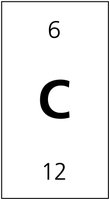
Q7. What is the atomic mass and atomic number of carbon? How many electrons and neutrons does carbon have?
Background
Topic: Atomic Structure and Periodic Table
This question tests your understanding of how to interpret information from the periodic table and relate it to the structure of an atom, specifically carbon.
Key Terms and Formulas:
Atomic number (): Number of protons in the nucleus of an atom.
Atomic mass (mass number, ): Sum of protons and neutrons in the nucleus.
Electrons: In a neutral atom, the number of electrons equals the atomic number.
Neutrons:
Step-by-Step Guidance
Identify the atomic number of carbon from the periodic table entry. This is the number at the top (usually above the element symbol).
Identify the atomic mass (mass number) of carbon from the periodic table entry. This is the number at the bottom (usually below the element symbol).
Recall that the atomic number tells you the number of protons in the atom. In a neutral atom, this also equals the number of electrons.
To find the number of neutrons, subtract the atomic number from the atomic mass:
Set up the calculation for neutrons using the values from the periodic table entry, but do not compute the final value yet.
Try solving on your own before revealing the answer!
Final Answer:
Atomic number of carbon: 6
Atomic mass of carbon: 12
Number of electrons in neutral carbon: 6
Number of neutrons:
Carbon has 6 protons, 6 electrons, and 6 neutrons in its most common isotope.
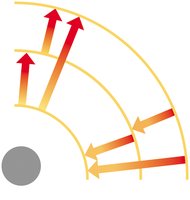
Q13. How is the movement of electrons shown in the diagram related to photosynthesis?
Background
Topic: Electron Movement in Biological Processes
This question is about understanding how electrons move between energy levels and how this movement is central to processes like photosynthesis and cellular respiration.
Key Terms:
Electron shells: Energy levels where electrons reside around the nucleus.
Photosynthesis: Process where light energy is used to move electrons to higher energy states.
Cellular respiration: Process where electrons move to lower energy states, releasing energy.
Step-by-Step Guidance
Observe the diagram: Arrows indicate electrons moving between different shells (energy levels).
Recall that in photosynthesis, electrons are excited by light energy and move to higher energy levels.
Understand that the movement of electrons to higher shells represents energy absorption, while movement to lower shells represents energy release.
Relate this to photosynthesis: Electrons are transferred through a series of molecules, gaining and losing energy as they move.
Set up your explanation for how this electron movement is fundamental to the energy transformations in photosynthesis, but do not write the full explanation yet.
Try solving on your own before revealing the answer!
Final Answer:
The diagram shows electrons moving between energy levels, which is analogous to how electrons are excited by light energy in photosynthesis. In photosynthesis, electrons absorb energy and move to higher shells, then transfer through the electron transport chain, releasing energy for the synthesis of ATP and NADPH.
This movement is essential for converting solar energy into chemical energy in living organisms.
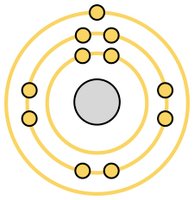
Q16. How many valence electrons does sodium have? Circle the valence electron(s). How many protons does it have?
Background
Topic: Electron Configuration and Atomic Structure
This question tests your ability to interpret electron distribution diagrams and relate them to the chemical properties of elements.
Key Terms:
Valence electrons: Electrons in the outermost shell, important for chemical bonding.
Protons: Positively charged particles in the nucleus; their number equals the atomic number.
Step-by-Step Guidance
Examine the electron distribution diagram for sodium. Count the electrons in each shell.
Identify the outermost shell and count the electrons present there. These are the valence electrons.
Circle the valence electron(s) in the diagram (if working on paper).
Recall that the atomic number of sodium is 11, which tells you the number of protons.
Set up your answer for the number of valence electrons and protons, but do not state the final values yet.
Try solving on your own before revealing the answer!
Final Answer:
Sodium has 1 valence electron in its outermost shell.
It has 11 protons, as indicated by its atomic number.
The single valence electron is responsible for sodium's reactivity and tendency to form ionic bonds.
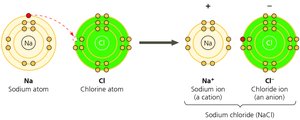
Q26. Explain what is happening in the figure showing the ionic bond between sodium and chloride.
Background
Topic: Ionic Bond Formation
This question is about understanding how atoms transfer electrons to form ions and ionic bonds, using sodium and chloride as an example.
Key Terms:
Ionic bond: A chemical bond formed when one atom transfers an electron to another atom.
Cation: Positively charged ion (e.g., Na+).
Anion: Negatively charged ion (e.g., Cl-).
Step-by-Step Guidance
Examine the electron distribution diagrams for sodium and chloride atoms.
Notice that sodium has one valence electron, while chloride has seven.
Observe the transfer of the valence electron from sodium to chloride, resulting in a sodium ion (Na+) and a chloride ion (Cl-).
Recognize that the resulting ions are attracted to each other due to opposite charges, forming an ionic bond.
Set up your explanation for how this transfer leads to the formation of sodium chloride, but do not write the full explanation yet.
Try solving on your own before revealing the answer!
Final Answer:
Sodium transfers its single valence electron to chloride, forming Na+ (cation) and Cl- (anion). The electrostatic attraction between these oppositely charged ions creates an ionic bond, resulting in sodium chloride (NaCl).
This process stabilizes both atoms by filling their outermost electron shells.
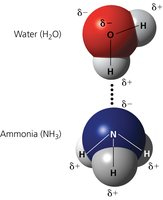
Q28. What is a hydrogen bond? Indicate where the hydrogen bond occurs in the figure.
Background
Topic: Hydrogen Bonding
This question tests your understanding of hydrogen bonds, which are important for the structure and properties of water and other molecules.
Key Terms:
Hydrogen bond: A weak bond between a hydrogen atom (with partial positive charge) and an electronegative atom (with partial negative charge).
Electronegativity: The tendency of an atom to attract electrons.
Step-by-Step Guidance
Examine the figure showing water and ammonia molecules.
Identify the partial positive () and partial negative () regions on the molecules.
Look for the dotted line between the hydrogen atom of water and the nitrogen atom of ammonia, which represents the hydrogen bond.
Recall that hydrogen bonds occur between a hydrogen atom covalently bonded to an electronegative atom and another electronegative atom nearby.
Set up your answer for where the hydrogen bond is located in the figure, but do not state the final location yet.
Try solving on your own before revealing the answer!
Final Answer:
The hydrogen bond is indicated by the dotted line between the hydrogen atom of the water molecule (with ) and the nitrogen atom of the ammonia molecule (with ).
Hydrogen bonds are crucial for the structure and properties of water and many biological molecules.
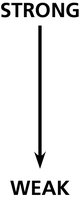
Q30. Place the types of bonds and interactions in order from strongest to weakest: hydrogen bonds, Van der Waals interactions, covalent bonds, ionic bonds.
Background
Topic: Types of Chemical Bonds
This question tests your understanding of the relative strengths of different types of chemical bonds and interactions.
Key Terms:
Covalent bond: Strong bond formed by sharing electrons.
Ionic bond: Bond formed by transfer of electrons and electrostatic attraction.
Hydrogen bond: Weak bond between hydrogen and electronegative atom.
Van der Waals interactions: Very weak attractions between molecules.
Step-by-Step Guidance
Recall the definitions and relative strengths of each bond type.
Arrange the bonds from strongest to weakest based on their typical energy values and biological importance.
Use the diagram as a visual aid to reinforce the order.
Set up your answer for the order, but do not state the final sequence yet.
Try solving on your own before revealing the answer!
Final Answer:
Order from strongest to weakest:
Covalent bonds
Ionic bonds
Hydrogen bonds
Van der Waals interactions
Covalent bonds are the strongest, followed by ionic bonds, then hydrogen bonds, and finally Van der Waals interactions.
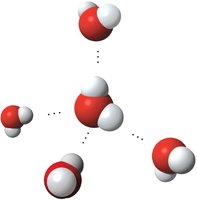
Q35. Study the water molecules below. On the central molecule, label oxygen (O) and hydrogen (H). Add + and − signs to indicate the charged regions. Indicate the hydrogen bonds.
Background
Topic: Water Structure and Hydrogen Bonding
This question tests your understanding of the polarity of water molecules and the formation of hydrogen bonds.
Key Terms:
Polarity: Uneven distribution of charge in a molecule.
Hydrogen bond: Weak bond between hydrogen and electronegative atom.
Step-by-Step Guidance
Examine the diagram of water molecules. Identify the central molecule.
Label the oxygen atom (O) and the hydrogen atoms (H) on the central molecule.
Add + and − signs to indicate the partial positive (hydrogen) and partial negative (oxygen) regions.
Identify the dashed lines between molecules, which represent hydrogen bonds.
Set up your answer for labeling and indicating hydrogen bonds, but do not state the final labeling yet.
Try solving on your own before revealing the answer!
Final Answer:
On the central water molecule, label the large atom as oxygen (O) and the smaller attached atoms as hydrogen (H). Add a − sign near oxygen and + signs near hydrogens. The dashed lines between molecules indicate hydrogen bonds.
This illustrates water's polarity and its ability to form multiple hydrogen bonds.
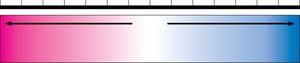
Q65. On the pH scale below, label pH 1–14. Label neutral, acid, and base. Indicate the locations of pure water, urine, gastric juice, and bleach.
Background
Topic: pH Scale and Biological Examples
This question tests your understanding of the pH scale, which measures acidity and basicity, and your ability to place common substances on the scale.
Key Terms:
pH: Measure of hydrogen ion concentration.
Acid: pH less than 7.
Base: pH greater than 7.
Neutral: pH equal to 7.
Step-by-Step Guidance
Recall that the pH scale ranges from 1 (most acidic) to 14 (most basic).
Label the midpoint (pH 7) as neutral.
Label the left side (pH 1–6) as acidic and the right side (pH 8–14) as basic.
Place pure water at pH 7, urine around pH 6, gastric juice around pH 2, and bleach around pH 12.
Set up your answer for labeling and placement, but do not state the final locations yet.
Try solving on your own before revealing the answer!
Final Answer:
pH scale labeled from 1 (acidic) to 14 (basic):
Neutral: pH 7 (pure water)
Acid: pH 1–6 (gastric juice at pH 2, urine at pH 6)
Base: pH 8–14 (bleach at pH 12)
These placements help visualize the relative acidity and basicity of common substances.
