 Indietro
Study Guide: Key Metabolic Pathways in General Biology (with Images)
Guida di studio - Note intelligenti
 Appunti personalizzati basati sui tuoi materiali, ampliati con definizioni chiave, esempi e contesto.
Q1. What metabolic process is represented by the equation: Energy + 6 CO2 + 6 H2O → C6H12O6 + 6 O2?
Background
Topic: Photosynthesis
This equation represents the process by which plants, algae, and some bacteria convert light energy, carbon dioxide, and water into glucose and oxygen. This is a fundamental anabolic pathway in biology.

Key Terms and Formula:
Photosynthesis: The process that converts solar energy into chemical energy stored in glucose.
Reactants: CO2 (carbon dioxide), H2O (water), and energy (usually sunlight).
Products: C6H12O6 (glucose) and O2 (oxygen).
General Equation:
Step-by-Step Guidance
Identify the reactants (left side of the equation): carbon dioxide, water, and energy.
Identify the products (right side of the equation): glucose and oxygen.
Recognize that this process stores energy in the bonds of glucose, making it an anabolic (building) and endergonic (energy-requiring) reaction.
Recall that this process occurs in the chloroplasts of plant cells, specifically in the thylakoid and stroma regions.
Think about the overall purpose: to convert light energy into chemical energy for the organism.
Try solving on your own before revealing the answer!
Final Answer: Photosynthesis
This equation represents photosynthesis, the process by which plants use sunlight to convert carbon dioxide and water into glucose and oxygen.
Q2. What metabolic process is represented by the equation: C6H12O6 + 6 O2 → 6 CO2 + 6 H2O + Energy?
Background
Topic: Cellular Respiration
This equation describes the process by which cells break down glucose in the presence of oxygen to release energy, carbon dioxide, and water. This is a catabolic pathway central to energy production in most organisms.

Key Terms and Formula:
Cellular Respiration: The process of breaking down glucose to produce ATP, the energy currency of the cell.
Reactants: Glucose (C6H12O6) and oxygen (O2).
Products: Carbon dioxide (CO2), water (H2O), and energy (ATP).
General Equation:
Step-by-Step Guidance
Identify the reactants: glucose and oxygen.
Identify the products: carbon dioxide, water, and energy (usually in the form of ATP).
Recognize that this is a catabolic (breaking down) and exergonic (energy-releasing) process.
Recall that this process occurs in the mitochondria of eukaryotic cells.
Think about the overall purpose: to extract energy from glucose for cellular activities.
Try solving on your own before revealing the answer!
Final Answer: Cellular Respiration
This equation represents cellular respiration, the process by which cells convert glucose and oxygen into carbon dioxide, water, and energy (ATP).
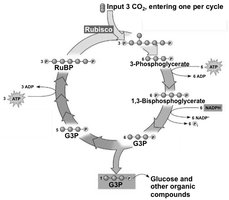
Q3. What cycle is illustrated in the diagram showing RuBP, 3-Phosphoglycerate, and G3P?
Background
Topic: Calvin Cycle (Light-Independent Reactions of Photosynthesis)
This diagram shows the series of biochemical reactions that occur in the stroma of the chloroplast, where atmospheric CO2 is fixed into organic molecules.
Key Terms and Formula:
Calvin Cycle: The set of light-independent reactions in photosynthesis that produce G3P (glyceraldehyde-3-phosphate), which can be used to form glucose and other organic molecules.
Key Molecules: RuBP (ribulose bisphosphate), 3-Phosphoglycerate, G3P, ATP, NADPH, CO2.
Location: Stroma of the chloroplast.
Step-by-Step Guidance
Observe the cycle: CO2 enters and is fixed by the enzyme Rubisco to RuBP.
Follow the transformation of RuBP to 3-phosphoglycerate, then to G3P using ATP and NADPH.
Note that some G3P exits the cycle to form glucose and other organic compounds, while the rest is used to regenerate RuBP.
Recognize that this cycle must turn multiple times to produce one molecule of glucose.
Recall that the Calvin cycle is powered by ATP and NADPH produced in the light reactions.
Try solving on your own before revealing the answer!
Final Answer: Calvin Cycle
The diagram illustrates the Calvin cycle, which is the light-independent pathway of photosynthesis responsible for carbon fixation and synthesis of G3P.
