 Indietro
Study Guide: Meiosis, Genetic Diversity, and Chromosome Behavior
Guida di studio - Note intelligenti
 Appunti personalizzati basati sui tuoi materiali, ampliati con definizioni chiave, esempi e contesto.
Q1. Describe the stages of the sexual life cycle. What are the roles of meiosis, gamete formation, and fertilization in this process?
Background
Topic: Sexual Life Cycle & Genetic Information Flow
This question tests your understanding of how organisms alternate between haploid and diploid stages, and the importance of meiosis, gamete formation, and fertilization in maintaining chromosome number and genetic diversity.
Key Terms:
Meiosis: Cell division that reduces chromosome number by half, producing haploid gametes.
Gamete: Sex cell (sperm or egg) with a haploid chromosome set.
Fertilization: Fusion of two gametes to restore diploid chromosome number.
Diploid (2n): Two sets of chromosomes.
Haploid (n): One set of chromosomes.
Step-by-Step Guidance
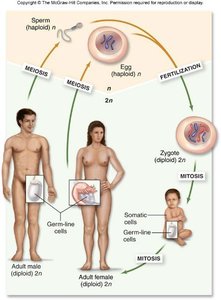
Identify the main stages: meiosis, gamete formation, fertilization, and mitosis in the zygote.
Explain how meiosis produces haploid gametes from diploid germ cells.
Describe how fertilization combines two haploid gametes to form a diploid zygote.
Discuss the role of mitosis in the growth and development of the zygote into an adult organism.
Set up a diagram or summary showing the alternation between haploid and diploid stages.
Try solving on your own before revealing the answer!
Final Answer:
The sexual life cycle alternates between diploid (2n) and haploid (n) stages. Meiosis in germ cells produces haploid gametes (sperm and egg). Fertilization restores the diploid chromosome number in the zygote. Mitosis allows the zygote to grow into an adult, maintaining the diploid state. This cycle ensures genetic diversity and stable chromosome number across generations.
Q2. What are germ cells and how are they involved in the sexual life cycle?
Background
Topic: Germ Cells & Reproduction
This question focuses on the definition and function of germ cells in the context of sexual reproduction.
Key Terms:
Germ Cell: Specialized cell that undergoes meiosis to produce gametes.
Somatic Cell: Any cell in the body that is not a germ cell.
Step-by-Step Guidance
Define germ cells and distinguish them from somatic cells.
Explain where germ cells are located in the body (e.g., testes and ovaries).
Describe how germ cells undergo meiosis to produce gametes.
Discuss the importance of germ cells in passing genetic information to the next generation.
Try solving on your own before revealing the answer!
Final Answer:
Germ cells are specialized cells found in the gonads (testes and ovaries) that undergo meiosis to produce gametes. They are essential for sexual reproduction because they transmit genetic information from one generation to the next.
Q3. How are gametes produced in the sexual life cycle?
Background
Topic: Gametogenesis
This question tests your understanding of the process by which gametes (sperm and eggs) are formed.
Key Terms:
Gametogenesis: The process of forming gametes via meiosis.
Meiosis: Cell division that produces haploid gametes.
Step-by-Step Guidance
Describe the process of meiosis in germ cells.
Explain how meiosis results in four haploid cells from one diploid cell.
Discuss differences in gametogenesis between males (spermatogenesis) and females (oogenesis).
Set up a diagram or summary showing the reduction in chromosome number.
Try solving on your own before revealing the answer!
Final Answer:
Gametes are produced by meiosis in germ cells. In males, spermatogenesis produces sperm; in females, oogenesis produces eggs. Each process results in haploid gametes, ensuring chromosome number is halved for fertilization.
Q4. What is the role of mitosis in the sexual life cycle?
Background
Topic: Mitosis & Growth
This question examines how mitosis contributes to the development and maintenance of multicellular organisms.
Key Terms:
Mitosis: Cell division that produces genetically identical diploid cells.
Zygote: Fertilized egg cell.
Step-by-Step Guidance
Explain how mitosis allows the zygote to grow and develop into an adult organism.
Discuss the role of mitosis in tissue repair and maintenance.
Contrast mitosis with meiosis in terms of genetic outcome and function.
Try solving on your own before revealing the answer!
Final Answer:
Mitosis is responsible for the growth and development of the zygote into an adult, as well as tissue repair and maintenance. It produces genetically identical diploid cells, maintaining chromosome number.
Q5. During fertilization, how is the chromosome number restored?
Background
Topic: Chromosome Number Restoration
This question tests your understanding of how fertilization restores the diploid chromosome number in sexually reproducing organisms.
Key Terms:
Fertilization: Fusion of two haploid gametes.
Diploid (2n): Two sets of chromosomes.
Haploid (n): One set of chromosomes.
Step-by-Step Guidance
Recall that gametes are haploid (n) due to meiosis.
Explain how fertilization combines two haploid gametes to form a diploid zygote.
Set up the equation: .
Try solving on your own before revealing the answer!
Final Answer:
Fertilization restores chromosome number by combining two haploid gametes (n + n) to form a diploid zygote (2n).
Q6. What is the difference between haploid and diploid?
Background
Topic: Chromosome Number
This question tests your understanding of the terms haploid and diploid, which are fundamental to genetics and cell biology.
Key Terms:
Haploid (n): One set of chromosomes.
Diploid (2n): Two sets of chromosomes.
Step-by-Step Guidance
Define haploid and diploid in terms of chromosome sets.
Give examples of cells that are haploid (gametes) and diploid (somatic cells).
Explain why the distinction is important in the sexual life cycle.
Try solving on your own before revealing the answer!
Final Answer:
Haploid cells have one set of chromosomes (n), while diploid cells have two sets (2n). Gametes are haploid; somatic cells and zygotes are diploid.
