 Indietro
Study Guide: Metabolism, Energy, and Enzyme Function (Chapter 6)
Guida di studio - Note intelligenti
 Appunti personalizzati basati sui tuoi materiali, ampliati con definizioni chiave, esempi e contesto.
Q1. Which reactions release energy? Which reactions consume energy? Which reactions build up larger molecules? Which reactions break down molecules? Which reactions are considered “uphill”? Which type of reaction is photosynthesis? Which type of reaction is cellular respiration? In living systems, which reactions require enzymes to catalyze them?
Background
Topic: Metabolic Pathways (Anabolic vs. Catabolic Reactions)
This question tests your understanding of the two main types of metabolic reactions: anabolic (building up) and catabolic (breaking down), and their energy profiles.
Key Terms:
Anabolic reactions: Build larger molecules from smaller ones; usually require energy input.
Catabolic reactions: Break down molecules into smaller units; usually release energy.
Photosynthesis: An anabolic, energy-consuming process.
Cellular respiration: A catabolic, energy-releasing process.
Enzymes: Biological catalysts required for both types of reactions.
Step-by-Step Guidance
Identify which reactions release energy (hint: breaking down molecules often releases energy).
Determine which reactions consume energy (hint: building up molecules usually requires energy input).
Classify reactions as anabolic or catabolic based on whether they build up or break down molecules.
Consider which reactions are “uphill” (require energy) and which are “downhill” (release energy).
Match photosynthesis and cellular respiration to their respective reaction types.
Recall that enzymes catalyze both anabolic and catabolic reactions in living systems.
Try solving on your own before revealing the answer!
Final Answer:
Catabolic reactions release energy and break down molecules (cellular respiration is catabolic).
Anabolic reactions consume energy and build up larger molecules (photosynthesis is anabolic).
“Uphill” reactions are anabolic and require energy input.
Enzymes catalyze both types of reactions in living systems.
Catabolic = energy-releasing, breakdown; Anabolic = energy-consuming, buildup.
Q2. Contrast kinetic energy with potential energy.
Background
Topic: Forms of Energy
This question tests your understanding of the difference between kinetic and potential energy, which are fundamental concepts in biology and physics.
Key Terms:
Kinetic energy: Energy of motion.
Potential energy: Stored energy due to position or structure.
Step-by-Step Guidance
Define kinetic energy and give an example (e.g., moving water, muscle contraction).
Define potential energy and give an example (e.g., water behind a dam, chemical bonds in glucose).
Compare how each type of energy can be transformed in biological systems.
Try solving on your own before revealing the answer!
Final Answer:
Kinetic energy is the energy of motion (e.g., moving molecules), while potential energy is stored energy (e.g., in chemical bonds or position). Both are important in biological processes.
Q3. Which type of energy does water behind a dam have? A mole of glucose?
Background
Topic: Potential Energy in Biological Systems
This question tests your ability to identify potential energy in different contexts.
Key Terms:
Potential energy: Stored energy due to position (water behind a dam) or chemical structure (glucose).
Step-by-Step Guidance
Consider the position of water behind a dam and how it can be released to do work.
Think about the chemical bonds in glucose and how breaking them releases energy.
Try solving on your own before revealing the answer!
Final Answer:
Both water behind a dam and a mole of glucose have potential energy—water due to its position, glucose due to its chemical bonds.
Q4. According to the first law of thermodynamics, what can and cannot happen to energy?
Background
Topic: Laws of Thermodynamics
This question tests your understanding of energy conservation in biological systems.
Key Terms:
First law of thermodynamics: Energy cannot be created or destroyed, only transformed.
Step-by-Step Guidance
Recall the principle of conservation of energy.
Think about how energy can change forms (e.g., chemical to kinetic).
Consider what the law says about the total amount of energy in the universe.
Try solving on your own before revealing the answer!
Final Answer:
Energy can be transformed from one form to another, but it cannot be created or destroyed.
Q5. The second law of thermodynamics states that every energy transfer or transformation increases the entropy (molecular disorder) of the universe. What always happens in each energy transfer that makes this an apt expression?
Background
Topic: Entropy and Energy Transfer
This question tests your understanding of how energy transformations increase disorder.
Key Terms:
Second law of thermodynamics: Entropy increases with every energy transfer.
Entropy: Measure of disorder or randomness.
Step-by-Step Guidance
Recall that some energy is always lost as heat during energy transfers.
Think about how this loss increases disorder in the system.
Consider why this is called the “you always lose rule.”
Try solving on your own before revealing the answer!
Final Answer:
Each energy transfer releases some energy as heat, increasing entropy (disorder) in the universe.
Q6. What is meant by a spontaneous process? What phrase might be a better description of this?
Background
Topic: Spontaneous Processes in Thermodynamics
This question tests your understanding of what makes a process spontaneous in biological systems.
Key Terms:
Spontaneous process: Occurs without energy input; increases entropy.
Step-by-Step Guidance
Define what a spontaneous process is in thermodynamics.
Consider alternative phrases that describe this concept (e.g., energetically favorable).
Try solving on your own before revealing the answer!
Final Answer:
A spontaneous process occurs without energy input; a better phrase might be "energetically favorable."
Q7. What is free energy? What is its symbol?
Background
Topic: Free Energy in Biological Reactions
This question tests your understanding of the concept of free energy and its notation.
Key Terms:
Free energy: Energy available to do work in a system.
Symbol: (Gibbs free energy).
Step-by-Step Guidance
Define free energy in the context of biological systems.
Identify the symbol used for free energy.
Try solving on your own before revealing the answer!
Final Answer:
Free energy is the energy available to do work; its symbol is .
Q8. For an exergonic reaction, is ΔG negative or positive?
Background
Topic: Free Energy Change in Reactions
This question tests your understanding of the sign of ΔG in exergonic reactions.
Key Terms:
Exergonic reaction: Releases energy; ΔG is negative.
ΔG: Change in free energy.
Step-by-Step Guidance
Recall what happens to free energy in exergonic reactions.
Determine whether ΔG is negative or positive for energy-releasing reactions.
Try solving on your own before revealing the answer!
Final Answer:
ΔG is negative for exergonic reactions.
Q9. Is cellular respiration an endergonic or an exergonic reaction? What is ΔG for this reaction?
Background
Topic: Cellular Respiration and Free Energy
This question tests your understanding of the energy profile of cellular respiration.
Key Terms:
Cellular respiration: Exergonic reaction; releases energy.
ΔG: Negative for exergonic reactions.
Step-by-Step Guidance
Recall whether cellular respiration releases or consumes energy.
Determine the sign of ΔG for this process.
Try solving on your own before revealing the answer!
Final Answer:
Cellular respiration is exergonic; ΔG is negative.
Q10. Is photosynthesis endergonic or exergonic? What is the energy source that drives it?
Background
Topic: Photosynthesis and Energy Input
This question tests your understanding of the energy requirements of photosynthesis.
Key Terms:
Photosynthesis: Endergonic reaction; requires energy input.
Energy source: Sunlight.
Step-by-Step Guidance
Recall whether photosynthesis builds up or breaks down molecules.
Identify the energy source for this process.
Try solving on your own before revealing the answer!
Final Answer:
Photosynthesis is endergonic; it is driven by energy from sunlight.
Q11. To summarize, if energy is released, ΔG must be positive/negative. (Circle your choice.)
Background
Topic: Free Energy Change and Energy Release
This question tests your understanding of the relationship between energy release and ΔG.
Key Terms:
ΔG: Negative when energy is released.
Step-by-Step Guidance
Recall the sign of ΔG for exergonic (energy-releasing) reactions.
Choose the correct sign for ΔG when energy is released.
Try solving on your own before revealing the answer!
Final Answer:
ΔG is negative when energy is released.
Q12. Study Figure 6.7 in your textbook. Explain why the light bulb goes off when the system is at equilibrium.
Background
Topic: Equilibrium and Energy Transfer
This question tests your understanding of why no work can be done at equilibrium.
Key Terms:
Equilibrium: No net change; no energy available to do work.
Step-by-Step Guidance
Recall what happens to energy flow at equilibrium.
Explain why the system cannot do work when it reaches equilibrium.
Try solving on your own before revealing the answer!
Final Answer:
At equilibrium, no energy is available to do work, so the light bulb goes off.
Q13. List the three main kinds of work that a cell does. Give an example of each.
Background
Topic: Cellular Work
This question tests your understanding of the types of work cells perform.
Key Terms:
Mechanical work: Movement (e.g., muscle contraction).
Transport work: Moving substances across membranes (e.g., pumping ions).
Chemical work: Building or breaking molecules (e.g., synthesis of proteins).
Step-by-Step Guidance
Identify the three main types of cellular work.
Provide an example for each type.
Try solving on your own before revealing the answer!
Final Answer:
Mechanical work: muscle contraction
Transport work: pumping ions across membranes
Chemical work: synthesis of proteins
Q14. What is energy coupling?
Background
Topic: Energy Coupling in Cells
This question tests your understanding of how cells use energy from exergonic reactions to drive endergonic reactions.
Key Terms:
Energy coupling: Using energy released from one reaction to drive another.
Step-by-Step Guidance
Define energy coupling in the context of cellular metabolism.
Explain how ATP is involved in energy coupling.
Try solving on your own before revealing the answer!
Final Answer:
Energy coupling is the process of using energy released from exergonic reactions to drive endergonic reactions, often via ATP.
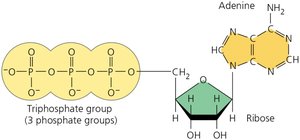
Q15. Here is a molecule of ATP. Label it. Use an arrow to show which bond is likely to break. Then answer a and b below the image.
Background
Topic: ATP Structure and Function
This question tests your understanding of ATP's structure and the bond that releases energy when broken.
Key Terms:
ATP: Adenosine triphosphate, consists of adenine, ribose, and three phosphate groups.
Hydrolysis: Breaking a bond using water.
Step-by-Step Guidance
Identify the three main parts of ATP: adenine, ribose, and triphosphate group.
Locate the bond between the terminal (last) phosphate group and the rest of the molecule.
Consider which bond is most likely to break to release energy.
Recall the process (hydrolysis) that breaks this bond.
List the molecules that make up ATP.
Try solving on your own before revealing the answer!
Final Answer:
The bond most likely to break is the bond between the terminal phosphate group and the rest of the molecule.
a) The process is hydrolysis.
b) ATP is made up of adenine, ribose, and three phosphate groups.
Breaking the terminal phosphate bond releases energy for cellular work.
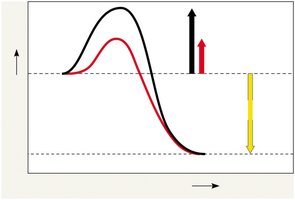
Q21. Label the x-axis of this graph “Progress of the Reaction” and the y-axis “Free Energy.” Label EA on this sketch, both with and without an enzyme. Use this graph to answer questions a-c.
Background
Topic: Activation Energy and Enzyme Function
This question tests your understanding of how enzymes affect activation energy and free energy change in reactions.
Key Terms:
Activation energy (): Energy required to start a reaction.
ΔG: Change in free energy.
Enzyme: Lowers activation energy but does not change ΔG.
Step-by-Step Guidance
Label the axes: x-axis as “Progress of the Reaction,” y-axis as “Free Energy.”
Identify the activation energy () for the reaction without an enzyme (higher peak) and with an enzyme (lower peak).
Label ΔG as the difference between the starting and ending free energy levels.
Consider whether ΔG is positive or negative for the reaction shown.
Think about how the enzyme affects and whether it changes ΔG.
Try solving on your own before revealing the answer!
Final Answer:
a) An enzyme lowers the activation energy () required for the reaction.
b) ΔG is negative for an exergonic reaction.
c) The enzyme does not change ΔG; it only lowers .
Enzymes make reactions proceed faster by lowering the energy barrier, but the overall free energy change remains the same.
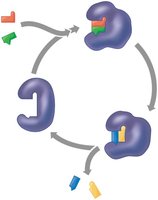
Q22. Define these terms and then use them to label the following figure: enzyme, substrate, active site, products.
Background
Topic: Enzyme Structure and Function
This question tests your understanding of the basic components involved in enzyme-catalyzed reactions.
Key Terms:
Enzyme: Protein that catalyzes reactions.
Substrate: Molecule acted upon by the enzyme.
Active site: Region of enzyme where substrate binds.
Products: Molecules formed from the reaction.
Step-by-Step Guidance
Define each term: enzyme, substrate, active site, products.
Identify these components in the figure.
Label the enzyme (purple shape), substrate (colored shapes entering), active site (region where substrate binds), and products (colored shapes leaving).
Try solving on your own before revealing the answer!
Final Answer:
Enzyme: purple shape
Substrate: colored shapes entering the enzyme
Active site: region on enzyme where substrate binds
Products: colored shapes leaving the enzyme
Enzymes bind substrates at the active site and convert them into products.
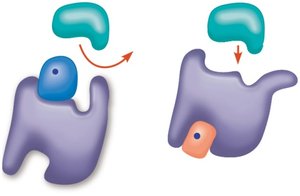
Q31. Compare and contrast competitive inhibitors and noncompetitive inhibitors. Label each type of inhibitor in this figure.
Background
Topic: Enzyme Inhibition
This question tests your understanding of how inhibitors affect enzyme activity.
Key Terms:
Competitive inhibitor: Binds to active site, blocking substrate.
Noncompetitive inhibitor: Binds elsewhere, changing enzyme shape.
Step-by-Step Guidance
Define competitive and noncompetitive inhibition.
Identify which diagram shows competitive inhibition (inhibitor at active site).
Identify which diagram shows noncompetitive inhibition (inhibitor binds elsewhere).
Label each type of inhibitor in the figure.
Try solving on your own before revealing the answer!
Final Answer:
Competitive inhibitor: binds to active site, blocks substrate (left diagram).
Noncompetitive inhibitor: binds elsewhere, changes enzyme shape (right diagram).
Competitive inhibitors compete with substrate for active site; noncompetitive inhibitors change enzyme shape.
Q35. Study this figure from your book (Figure 6.19) and answer the questions a through e.
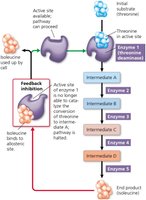
Background
Topic: Feedback Inhibition in Metabolic Pathways
This question tests your understanding of how metabolic pathways are regulated by feedback inhibition.
Key Terms:
Feedback inhibition: End product inhibits pathway.
Allosteric site: Site other than active site where inhibitor binds.
Threonine: Initial substrate.
Isoleucine: End product and inhibitor.
Step-by-Step Guidance
Identify the initial substrate (threonine) and the end product (isoleucine).
Determine which molecule acts as the inhibitor.
Classify the type of inhibitor (allosteric).
Consider when feedback inhibition has the most effect (when end product accumulates).
Name the type of metabolic control shown (feedback inhibition).
Try solving on your own before revealing the answer!
Final Answer:
a) Substrate: threonine
b) Inhibitor: isoleucine
c) Type: allosteric inhibitor
d) Most effect: when isoleucine accumulates
e) Type of control: feedback inhibition
Feedback inhibition prevents overproduction of end products by shutting down the pathway when enough product is made.
