 Indietro
Study Guide: Molecular Basis of Inheritance (DNA Structure, Replication, and Genetic Information)
Guida di studio - Note intelligenti
 Appunti personalizzati basati sui tuoi materiali, ampliati con definizioni chiave, esempi e contesto.
Q1. What is the purpose of DNA replication?
Background
Topic: DNA Replication
This question tests your understanding of why cells need to copy their DNA before cell division and how this process is essential for inheritance and maintaining genetic continuity.
Key Terms:
DNA replication: The process by which a cell copies its DNA before cell division.
Genetic information: The instructions encoded in DNA that determine an organism's traits.
Cell division: The process by which a cell splits into two daughter cells (mitosis or meiosis).
Step-by-Step Guidance
Consider why cells need to duplicate their DNA before dividing. What would happen if DNA was not copied?
Think about the role of DNA as the carrier of genetic information. How does replication ensure that each new cell receives the same genetic instructions?
Reflect on the importance of DNA replication in both growth (mitosis) and reproduction (meiosis).
Try solving on your own before revealing the answer!
Final Answer:
The purpose of DNA replication is to ensure that each daughter cell receives an exact copy of the genetic information during cell division. This process maintains genetic continuity from one generation to the next, allowing organisms to grow, repair tissues, and reproduce.
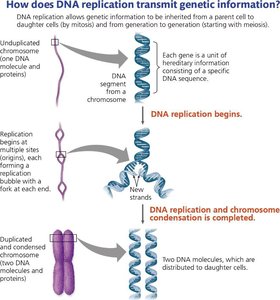
Q2. Describe how DNA replication transmits genetic information to the next generation in a species.
Background
Topic: DNA Replication and Heredity
This question focuses on how the process of DNA replication enables the inheritance of genetic traits from parent to offspring, ensuring continuity of genetic information.
Key Terms:
Genetic information: The sequence of nucleotides in DNA that encodes traits.
Replication: The process of copying DNA.
Inheritance: The transmission of genetic information from one generation to the next.
Step-by-Step Guidance
Recall that DNA replication produces two identical DNA molecules from one original molecule.
Think about how these identical DNA molecules are distributed to daughter cells during cell division.
Consider how this process ensures that offspring inherit the same genetic information as their parents.
Reflect on the role of DNA replication in both mitosis (for somatic cells) and meiosis (for gametes).
Try solving on your own before revealing the answer!
Final Answer:
DNA replication transmits genetic information by copying the DNA so that each new cell receives a complete set of genetic instructions. During reproduction, this ensures that offspring inherit genetic traits from their parents, maintaining species continuity.
Q3. What are the two main types of nucleic acids, and what is the primary function of each?
Background
Topic: Nucleic Acids
This question tests your knowledge of the basic types of nucleic acids and their roles in cells.
Key Terms:
DNA (deoxyribonucleic acid): Stores genetic information.
RNA (ribonucleic acid): Transfers genetic information and helps synthesize proteins.
Step-by-Step Guidance
Identify the two main types of nucleic acids found in cells.
Recall the primary function of DNA in storing genetic information.
Think about the role of RNA in gene expression and protein synthesis.
Try solving on your own before revealing the answer!
Final Answer:
The two main types of nucleic acids are DNA and RNA. DNA stores genetic information, while RNA transfers genetic information and helps synthesize proteins.
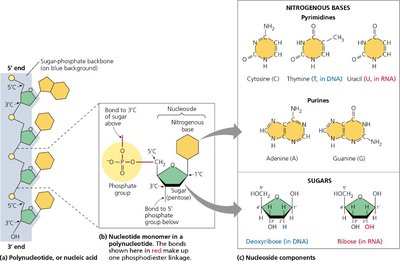
Q4. Using the picture to the right, describe the structure of nucleic acids. Be sure to include the phosphate, sugar, and nucleotide.
Background
Topic: Structure of Nucleic Acids
This question asks you to describe the molecular structure of nucleic acids, focusing on their basic building blocks.
Key Terms and Formulas:
Nucleotide: The basic unit of nucleic acids, consisting of a phosphate group, a sugar (deoxyribose or ribose), and a nitrogenous base.
Phosphodiester bond: The linkage between nucleotides in a strand.
Step-by-Step Guidance
Examine the diagram and identify the three main components of a nucleotide: phosphate, sugar, and nitrogenous base.
Describe how nucleotides are joined together by phosphodiester bonds to form a polynucleotide chain.
Explain the orientation of the sugar-phosphate backbone and how it forms the structural framework of nucleic acids.
Try solving on your own before revealing the answer!
Final Answer:
Nucleic acids are composed of nucleotides, each containing a phosphate group, a sugar (deoxyribose in DNA or ribose in RNA), and a nitrogenous base. Nucleotides are linked by phosphodiester bonds, forming a sugar-phosphate backbone with bases projecting from the sides.
Q5. Using the figure to the right, what are the key differences between the structures of DNA and RNA?
Background
Topic: DNA vs. RNA Structure
This question tests your ability to distinguish between DNA and RNA based on their chemical and structural differences.
Key Terms:
Deoxyribose (DNA) vs. Ribose (RNA): Different sugars in the backbone.
Thymine (DNA) vs. Uracil (RNA): Different nitrogenous bases.
Double-stranded (DNA) vs. single-stranded (RNA): Structural difference.
Step-by-Step Guidance
Look at the diagram and identify the sugar in each nucleic acid (deoxyribose for DNA, ribose for RNA).
Note the nitrogenous bases present in each (DNA has thymine, RNA has uracil).
Compare the overall structure: DNA is usually double-stranded, while RNA is single-stranded.
Try solving on your own before revealing the answer!
Final Answer:
DNA contains deoxyribose sugar and thymine, is typically double-stranded, while RNA contains ribose sugar and uracil, and is usually single-stranded.
Q6. Using the figure above, describe which structure of the nucleotide is responsible for connecting the two nucleotides together.
Background
Topic: Nucleotide Linkage
This question focuses on the chemical bond that links nucleotides together in a nucleic acid strand.
Key Terms:
Phosphodiester bond: The covalent bond between the phosphate group of one nucleotide and the sugar of another.
5' and 3' ends: The directionality of the nucleic acid strand.
Step-by-Step Guidance
Examine the diagram to locate the phosphate group and the sugar in each nucleotide.
Identify the bond formed between the 5' phosphate of one nucleotide and the 3' hydroxyl group of the next.
Describe how this bond creates the sugar-phosphate backbone and gives the strand directionality.
Try solving on your own before revealing the answer!
Final Answer:
The phosphate group of one nucleotide forms a phosphodiester bond with the sugar of the next nucleotide, connecting them and creating the sugar-phosphate backbone of the nucleic acid strand.
