 Indietro
Study Guide: Photosynthesis and Cellular Respiration (Chapters 9 & 10, Campbell Biology 10th Edition)
Guida di studio - Note intelligenti
 Appunti personalizzati basati sui tuoi materiali, ampliati con definizioni chiave, esempi e contesto.
Photosynthesis
Concepts of Photosynthesis, Autotrophs, Photoautotrophs, and Heterotrophs
Photosynthesis is the process by which solar energy is converted into chemical energy within chloroplasts, providing nourishment for nearly all life on Earth.
Autotrophs are organisms that produce organic molecules from CO2 and other inorganic materials, acting as self-feeders.
Photoautotrophs use light as an energy source to synthesize organic substances (e.g., plants, algae).
Heterotrophs cannot produce their own food and rely on consuming other organisms for energy.
Photosynthesis Location and Gas Exchange
Photosynthesis occurs in the chloroplasts of leaf mesophyll cells.
Gas exchange (CO2 in, O2 out) takes place through stomata in leaves.
Chloroplast Structure: Stroma, Thylakoid, Granum
Stroma: Dense fluid inside chloroplasts, surrounded by a double membrane.
Thylakoid: Membranous sacs within the stroma, forming a separate internal compartment (thylakoid space).
Granum: Stack of thylakoids within a chloroplast.
Chlorophyll
Chlorophyll is the green pigment in thylakoid membranes responsible for absorbing light energy.
It gives leaves their green color by reflecting green light.
Source of O2 in Photosynthesis
The O2 produced during photosynthesis comes from H2O, not CO2.
Stages of Photosynthesis
Light Reactions (in thylakoids): Produce O2, ATP, and NADPH.
Calvin Cycle (in stroma): Uses ATP and NADPH to synthesize sugars.
Wavelength and Photons
Wavelength: Distance between crests of electromagnetic waves.
Photons: Discrete packets of light energy; each has a fixed energy amount.
Energy is inversely related to wavelength: shorter wavelengths have higher energy.
Visible Light
Visible light ranges from 380 nm to 750 nm and is crucial for life.
Pigments, Spectrophotometer, and Absorption Spectrum
Pigments: Substances that absorb visible light; chlorophyll is the main pigment in plants.
Spectrophotometer: Instrument measuring pigment absorption at different wavelengths.
Absorption spectrum: Graph showing a pigment’s light absorption versus wavelength.
Why Leaves Are Green
Chlorophyll absorbs red and blue light but reflects green light, making leaves appear green.
Electron Carriers in Photosystems
Plastoquinone
Cytochrome complex
Plastocyanin
Big Picture of Photosynthesis
Light reactions use sunlight to produce ATP and NADPH, which power the Calvin cycle to synthesize carbohydrates.
Phases of the Calvin Cycle
Carbon fixation (catalyzed by rubisco)
Reduction
Regeneration of the CO2 acceptor (RuBP)
Cellular Respiration
Energy Flow and Chemical Recycling in Ecosystems
Energy flows from the sun to plants and then to organisms through food chains.
CO2 and H2O are recycled in photosynthesis and respiration.
Redox Reactions
Redox reactions involve the transfer of electrons between substances.
Oxidation: Loss of electrons.
Reduction: Gain of electrons.
Summary Equation of Cellular Respiration
Overall equation:
Organic compounds (carbohydrates, fats, proteins) + Oxygen → Carbon dioxide + Water + Energy (ATP)
NAD+
NAD+ (Nicotinamide Adenine Dinucleotide) is an electron carrier in cellular respiration.
Electron Transport Chain
Transfers electrons and releases energy used to produce ATP, the cell’s main energy source.
Stages of Cellular Respiration
Glycolysis: Breaks down glucose into two pyruvate molecules, producing 2 ATP (cytoplasm).
Citric Acid Cycle: Completes glucose breakdown, producing CO2 and ATP (mitochondrial matrix).
Oxidative Phosphorylation: Produces most ATP (26–28 ATP) and water (inner mitochondrial membrane).
Two types of phosphorylation: substrate-level and oxidative.
Substrate-Level Phosphorylation
Enzyme transfers a phosphate group directly from an organic molecule to ADP, forming ATP.
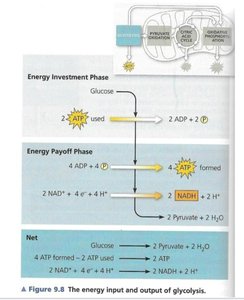
Energy Input and Output of Glycolysis
Glycolysis consists of an energy investment phase (uses 2 ATP) and an energy payoff phase (produces 4 ATP and 2 NADH).
Net gain: 2 ATP and 2 NADH per glucose molecule.
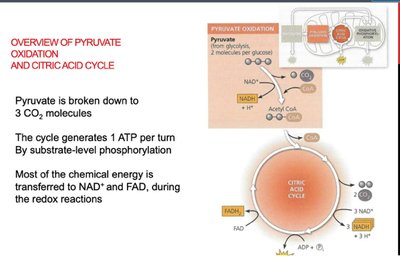
Pyruvate Oxidation and Citric Acid Cycle Overview
Pyruvate is oxidized to produce 3 CO2 molecules per turn of the cycle.
Each cycle generates 1 ATP by substrate-level phosphorylation.
Most chemical energy is transferred to NADH and FADH2 during redox reactions.
Electron Transport and Chemiosmosis
The electron transport chain creates a hydrogen ion gradient across the inner mitochondrial membrane.
Chemiosmosis uses this gradient to drive ATP synthesis.
Oxygen is the final electron acceptor, forming water.
ATP Accounting in Cellular Respiration
One glucose molecule yields about 30–32 ATP in eukaryotic cells (exact number may vary).
Fermentation
Fermentation produces ATP by substrate-level phosphorylation in the absence of oxygen.
Pyruvate as a Key Juncture in Catabolism
Pyruvate’s fate depends on the organism and oxygen availability.
Facultative anaerobes can use aerobic or anaerobic pathways.
Obligate anaerobes cannot tolerate oxygen.
Protein Deamination and Fatty Acid Beta Oxidation
Protein deamination: Removal of amino groups from amino acids before entering respiration pathways.
Fatty acid beta oxidation: Breaks fatty acids into two-carbon fragments (acetyl CoA) for the citric acid cycle.
Difficulty of Losing Fat
The body is evolutionarily adapted to store and protect energy reserves for survival, making fat loss challenging.
Phosphofructokinase: Allosteric Enzyme and Pacemaker of Respiration
Phosphofructokinase is an allosteric enzyme with regulatory sites for inhibitors and activators, controlling the rate of glycolysis and acting as the pacemaker of cellular respiration.
