 Indietro
Study Guide: Structure and Function of the Plasma Membrane
Guida di studio - Note intelligenti
 Appunti personalizzati basati sui tuoi materiali, ampliati con definizioni chiave, esempi e contesto.
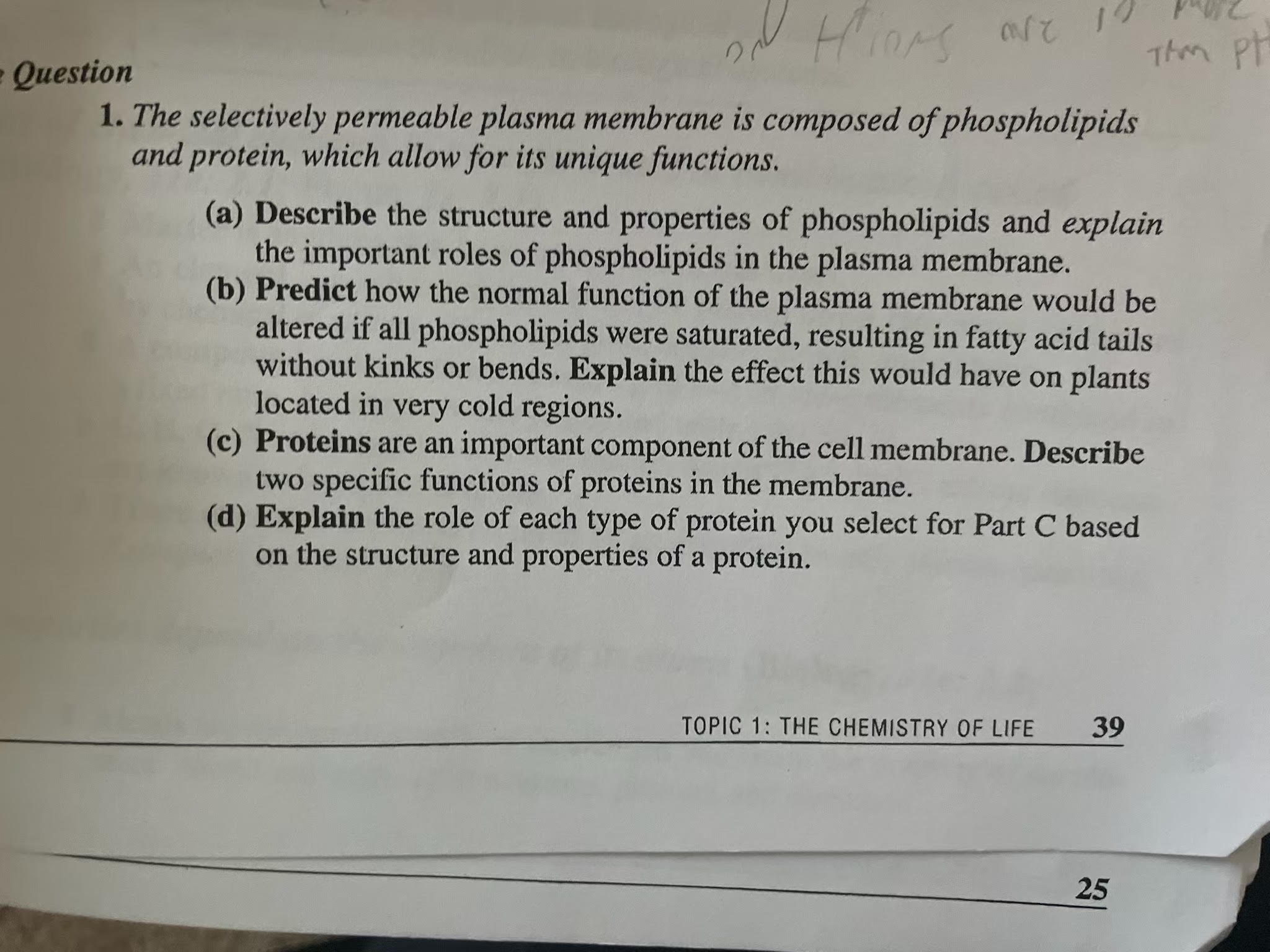
Q1. The selectively permeable plasma membrane is composed of phospholipids and protein, which allow for its unique functions.
(a) Describe the structure and properties of phospholipids and explain the important roles of phospholipids in the plasma membrane.
Background
Topic: Cell Membrane Structure
This question tests your understanding of the molecular structure of phospholipids and their functional significance in the plasma membrane.
Key Terms and Concepts:
Phospholipid: A molecule with a hydrophilic (water-loving) phosphate head and two hydrophobic (water-fearing) fatty acid tails.
Amphipathic: Having both hydrophilic and hydrophobic regions.
Bilayer: The arrangement of phospholipids in two layers, with tails facing inward and heads facing outward.
Step-by-Step Guidance
Start by describing the basic structure of a phospholipid: a glycerol backbone, two fatty acid tails, and a phosphate group.
Explain how the amphipathic nature of phospholipids leads to the formation of a bilayer in water.
Discuss how this bilayer creates a selectively permeable barrier, allowing certain molecules to pass while blocking others.
Consider the importance of fluidity and flexibility in the membrane, which is influenced by the properties of the phospholipids.
Try solving on your own before revealing the answer!
Final Answer:
Phospholipids consist of a hydrophilic phosphate head and two hydrophobic fatty acid tails. Their amphipathic nature causes them to arrange into a bilayer, with heads facing outward toward water and tails inward, away from water. This structure forms a selectively permeable membrane, allowing small, nonpolar molecules to pass while restricting ions and polar molecules. The bilayer's fluidity is essential for membrane function, including cell signaling and transport.
(b) Predict how the normal function of the plasma membrane would be altered if all phospholipids were saturated, resulting in fatty acid tails without kinks or bends. Explain the effect this would have on plants located in very cold regions.
Background
Topic: Membrane Fluidity and Adaptation
This question examines how the saturation of fatty acid tails affects membrane properties and the adaptation of organisms to cold environments.
Key Terms and Concepts:
Saturated fatty acids: No double bonds, straight tails.
Unsaturated fatty acids: One or more double bonds, causing kinks.
Membrane fluidity: The ability of the membrane to move and flex.
Step-by-Step Guidance
Recall that saturated fatty acid tails are straight, while unsaturated tails have kinks due to double bonds.
Consider how straight tails pack tightly together, reducing membrane fluidity.
Think about the importance of membrane fluidity for cell function, especially in cold environments where membranes can become rigid.
Predict how a membrane composed entirely of saturated phospholipids would behave in cold temperatures.
Try solving on your own before revealing the answer!
Final Answer:
If all phospholipids were saturated, the membrane would be less fluid because the tails would pack tightly together. In cold regions, this would cause the membrane to become rigid and less functional, impairing transport and signaling. Plants in cold environments typically have more unsaturated phospholipids to maintain membrane fluidity.
(c) Proteins are an impontant component of the cell membrane. Describe two specific functions of proteins in the membrane.
Background
Topic: Membrane Proteins and Their Functions
This question tests your knowledge of the roles that proteins play in the plasma membrane.
Key Terms and Concepts:
Transport proteins: Facilitate movement of substances across the membrane.
Receptor proteins: Receive and transmit signals from outside the cell.
Enzymatic proteins: Catalyze reactions at the membrane surface.
Step-by-Step Guidance
Identify two types of membrane proteins, such as transport and receptor proteins.
Describe the function of transport proteins in moving molecules across the membrane.
Explain the role of receptor proteins in cell communication and signal transduction.
Try solving on your own before revealing the answer!
Final Answer:
Two specific functions of membrane proteins are: (1) Transport proteins facilitate the movement of ions and molecules across the membrane, and (2) Receptor proteins detect and transmit signals from the external environment to the cell's interior.
(d) Explain the role of each type of protein you select for Part C based on the structure and properties of a protein.
Background
Topic: Structure-Function Relationship in Membrane Proteins
This question asks you to connect the structure of membrane proteins to their specific functions.
Key Terms and Concepts:
Integral proteins: Span the membrane, often involved in transport.
Peripheral proteins: Attached to the membrane surface, often involved in signaling or support.
Step-by-Step Guidance
For transport proteins, consider how their structure allows them to form channels or carriers through the membrane.
For receptor proteins, think about how their extracellular domains bind specific ligands and their intracellular domains transmit signals.
Relate the protein's structure (such as hydrophobic regions embedded in the membrane) to its function.
Try solving on your own before revealing the answer!
Final Answer:
Transport proteins have hydrophobic regions that span the membrane, forming channels or carriers for molecules. Receptor proteins have specific binding sites for ligands on their extracellular domains and transmit signals through conformational changes, connecting external cues to internal responses.
