 Indietro
Study Guide: Systematics, Cladistics, and Phylogenetic Trees (Chapter 26)
Guida di studio - Note intelligenti
 Appunti personalizzati basati sui tuoi materiali, ampliati con definizioni chiave, esempi e contesto.
Q1. Compare the following terms: systematics and cladistics; basal taxon and outgroup; sister taxa and polytomy; clade and grade; shared ancestral character and shared derived character; monophyletic, paraphyletic, and polyphyletic groups.
Background
Topic: Phylogenetics and Classification
This question tests your understanding of key terminology used in evolutionary biology and the study of relationships among organisms.
Key Terms:
Systematics: The scientific study of the diversity and relationships among organisms.
Cladistics: A method of classifying organisms based on common ancestry.
Basal taxon: The earliest diverging lineage in a phylogenetic tree.
Outgroup: A taxon outside the group of interest, used for comparison.
Sister taxa: Two taxa that share an immediate common ancestor.
Polytomy: A branch point with more than two descendant groups.
Clade: A group consisting of an ancestor and all its descendants (monophyletic).
Grade: A group of organisms sharing similar characteristics but not necessarily a common ancestor.
Shared ancestral character: A trait present in the ancestor of a group.
Shared derived character: A trait unique to a particular clade.
Monophyletic group: Includes an ancestor and all its descendants.
Paraphyletic group: Includes an ancestor and some, but not all, descendants.
Polyphyletic group: Includes taxa with different ancestors.
Step-by-Step Guidance
Review the definitions of each term and consider how they relate to evolutionary trees.
Think about how systematics and cladistics differ in their approach to classification.
Compare basal taxon and outgroup by identifying their positions on a phylogenetic tree.
Distinguish between sister taxa and polytomy by considering the number of branches at a node.
Contrast clade and grade, focusing on ancestry versus shared traits.
Identify examples of shared ancestral and shared derived characters in a phylogenetic context.
Use a phylogenetic tree to illustrate monophyletic, paraphyletic, and polyphyletic groups, but stop before drawing the final boxes or giving specific examples.
Try solving on your own before revealing the answer!
Final Answer:
Systematics is the broader field studying organismal relationships, while cladistics is a method within systematics that groups organisms by common ancestry. A basal taxon is the earliest diverging lineage, and an outgroup is used for comparison outside the group of interest. Sister taxa share an immediate common ancestor; a polytomy is a branch point with more than two descendants. A clade is a monophyletic group, while a grade is based on shared traits, not ancestry. Shared ancestral characters are present in the ancestor; shared derived characters are unique to a clade. Monophyletic groups include all descendants of an ancestor, paraphyletic groups include some, and polyphyletic groups include taxa with different ancestors.
Q2. Which of the following taxonomic names includes the fewest number of species?
Background
Topic: Taxonomic Hierarchy
This question tests your understanding of the levels of biological classification and which categories are more specific.
Key Terms:
Taxonomic hierarchy: Domain, Kingdom, Phylum, Class, Order, Family, Genus, Species.
Genus: A group of closely related species.
Species: The most specific level of classification.
Step-by-Step Guidance
Recall the order of taxonomic ranks from broadest to most specific.
Identify which of the provided names (Animalia, Panthera, Felidae, Carnivora, Mammalia) is at the lowest rank.
Consider that the genus level includes fewer species than family, order, or class.
Stop before stating which name is the genus.
Try solving on your own before revealing the answer!
Final Answer: Panthera
Panthera is a genus, which includes fewer species than the other options (which are higher taxonomic ranks).
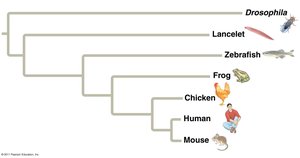
Q3. Which branch point on the following phylogenetic tree represents the most recent common ancestor of chickens and frogs?
Background
Topic: Phylogenetic Trees and Common Ancestors
This question tests your ability to interpret phylogenetic trees and identify the most recent common ancestor between two taxa.
Key Terms:
Branch point (node): Represents a common ancestor.
Most recent common ancestor: The last ancestor shared by two taxa before they diverged.
Step-by-Step Guidance
Locate the positions of chicken and frog on the phylogenetic tree.
Trace back from both taxa to the point where their branches meet.
Identify the branch point number at this intersection, but stop before stating which number it is.
Try solving on your own before revealing the answer!
Final Answer: Branch point 4
Branch point 4 is where the lineages of chicken and frog converge, representing their most recent common ancestor.
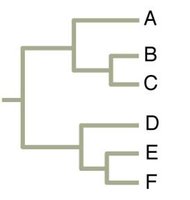
Q4. If new evidence were uncovered indicating that taxon E in the figure is the sister taxon of a group consisting of taxa D and F, how would this change the phylogeny below?
Background
Topic: Phylogenetic Tree Revision
This question tests your understanding of how new evidence can alter the relationships depicted in a phylogenetic tree.
Key Terms:
Sister taxon: Two groups that share an immediate common ancestor.
Phylogeny: The evolutionary history and relationships among taxa.
Step-by-Step Guidance
Examine the original tree and locate taxa D, E, and F.
Consider how the tree would change if E is now the sister taxon to the group containing D and F.
Visualize the new arrangement, but stop before selecting the correct revised tree.
Try solving on your own before revealing the answer!
Final Answer: Option c)
The correct revised tree shows E as the sister taxon to the group containing D and F, reflecting the new evidence.
Q5. Animals that possess homologous structures probably _____.
Background
Topic: Homology and Evolution
This question tests your understanding of homologous structures and their evolutionary significance.
Key Terms:
Homologous structures: Anatomical features inherited from a common ancestor.
Evolution: The process by which species change over time.
Step-by-Step Guidance
Recall what homologous structures are and how they arise.
Consider the evolutionary implications of shared anatomical features.
Eliminate answers that do not relate to common ancestry.
Stop before stating the correct answer.
Try solving on your own before revealing the answer!
Final Answer: evolved from the same ancestor
Homologous structures are inherited from a common ancestor, indicating evolutionary relationships.
Q6. Which cellular structure is common to all 3 domains of life?
Background
Topic: Cell Biology and Domains of Life
This question tests your knowledge of universal cellular structures across Bacteria, Archaea, and Eukarya.
Key Terms:
Domains of life: Bacteria, Archaea, Eukarya.
Cell membrane: A phospholipid bilayer surrounding all cells.
Step-by-Step Guidance
Review the basic structures found in all cells.
Consider which structures are present in prokaryotes and eukaryotes.
Eliminate structures unique to eukaryotes.
Stop before stating the correct answer.
Try solving on your own before revealing the answer!
Final Answer: Phospholipid bilayer cell membrane
All cells, regardless of domain, have a phospholipid bilayer cell membrane.
Q7. Which of the phylogenetic hypotheses concerning the origin of the three domains has the least amount of supporting data?
Background
Topic: Origin of Domains and Phylogenetic Hypotheses
This question tests your ability to interpret phylogenetic hypotheses and evaluate supporting evidence.
Key Terms:
Phylogenetic hypothesis: A proposed evolutionary relationship among groups.
Supporting data: Evidence backing a hypothesis.
Step-by-Step Guidance
Examine the provided phylogenetic trees for the three domains.
Consider which hypothesis is least supported by current molecular and fossil evidence.
Stop before stating which option is least supported.
Try solving on your own before revealing the answer!
Final Answer: Option c)
Option c) is least supported by available data on the origin of the three domains.
Q8. Which of the following is true of all horizontally oriented phylogenetic trees, where time advances to the right?
Background
Topic: Phylogenetic Tree Interpretation
This question tests your understanding of how to read phylogenetic trees and interpret the direction of time.
Key Terms:
Phylogenetic tree: Diagram showing evolutionary relationships.
Branch point: Represents a common ancestor.
Step-by-Step Guidance
Recall that in horizontally oriented trees, time moves from left to right.
Consider what each branch point represents in terms of evolutionary history.
Eliminate answers that misinterpret the direction of time or ancestry.
Stop before stating the correct answer.
Try solving on your own before revealing the answer!
Final Answer: d) The common ancestor represented by the rightmost branch point existed more recently in time than the common ancestors represented at branch points located to the left.
In these trees, the rightmost branch point is the most recent.
Q9. Which statement represents the best explanation for the observation that the nuclear DNA of wolves and domestic dogs has a very high degree of sequence homology?
Background
Topic: Molecular Homology and Evolution
This question tests your understanding of DNA sequence similarity and its evolutionary implications.
Key Terms:
Sequence homology: Similarity in DNA sequences due to shared ancestry.
Common ancestor: The most recent ancestor shared by two species.
Step-by-Step Guidance
Consider why two species might have similar DNA sequences.
Eliminate answers that focus on morphology or geography rather than ancestry.
Stop before stating the correct answer.
Try solving on your own before revealing the answer!
Final Answer: d) Dogs and wolves shared a common ancestor very recently.
High sequence homology is best explained by recent shared ancestry.
Q10. In the following phylogenetic tree, which statements are true?
Background
Topic: Phylogenetic Tree Analysis
This question tests your ability to interpret relationships such as basal taxon, polytomy, and sister taxa.
Key Terms:
Basal taxon: The earliest diverging lineage.
Polytomy: A branch point with more than two descendants.
Sister taxa: Two taxa sharing an immediate common ancestor.
Step-by-Step Guidance
Identify the basal taxon by finding the earliest diverging branch.
Look for branch points with more than two descendants to find polytomies.
Determine which pairs of taxa are sister taxa by finding their shared branch points.
Stop before stating which statements are true.
Try solving on your own before revealing the answer!
Final Answer: Taxa E and F are sister taxa.
Taxa E and F share an immediate common ancestor, making them sister taxa.
Q11. Linnaeus was a "fixist" who believed that species remained fixed in the form in which they had been created. Linnaeus would have been uncomfortable with:
Background
Topic: History of Taxonomy and Evolution
This question tests your understanding of Linnaeus's views and their contrast with modern evolutionary theory.
Key Terms:
Fixism: The belief that species do not change over time.
Phylogeny: The evolutionary history of organisms.
Step-by-Step Guidance
Recall Linnaeus's belief in fixed species.
Consider which scientific concepts challenge fixism.
Eliminate answers that align with Linnaeus's views.
Stop before stating the correct answer.
Try solving on your own before revealing the answer!
Final Answer: c) phylogenies
Phylogenies depict evolutionary change, which contradicts fixism.
Q12. The term homoplasy is most applicable to which of the following structure?
Background
Topic: Homoplasy and Convergent Evolution
This question tests your understanding of homoplasy, which refers to traits that arise independently in different lineages.
Key Terms:
Homoplasy: Similar traits not due to shared ancestry, often due to convergent evolution.
Step-by-Step Guidance
Recall that homoplasy involves traits that are similar but not inherited from a common ancestor.
Consider which structures listed are similar due to convergent evolution.
Eliminate answers that represent homology rather than homoplasy.
Stop before stating the correct answer.
Try solving on your own before revealing the answer!
Final Answer: a) the similar DNA sequence found in lizards and land snails but not in their ancestors or sister species
This is an example of homoplasy, as the similarity is not due to shared ancestry.
Q13. The best classification system is that which most closely:
Background
Topic: Classification and Evolutionary History
This question tests your understanding of the goals of biological classification.
Key Terms:
Classification system: Organizes organisms based on relationships.
Evolutionary history: The lineage and descent of organisms.
Step-by-Step Guidance
Consider the purpose of classification in biology.
Eliminate answers that focus on morphology or traditional practices.
Stop before stating the correct answer.
Try solving on your own before revealing the answer!
Final Answer: c) reflects evolutionary history
The best classification system groups organisms according to their evolutionary relationships.
Q14. The word pardus ________
Background
Topic: Taxonomic Naming
This question tests your understanding of scientific names and their components.
Key Terms:
Species name: The second part of the binomial nomenclature.
Step-by-Step Guidance
Recall the format of binomial nomenclature (Genus species).
Consider which part of the name "pardus" represents.
Stop before stating the correct answer.
Try solving on your own before revealing the answer!
Final Answer: is the species name of leopard
"Pardus" is the species name in Panthera pardus (leopard).
Q15. In which genera are the following animals: cat, rat, dog, and human?
Background
Topic: Taxonomic Classification
This question tests your knowledge of the genus names for common animals.
Key Terms:
Genus: The first part of the scientific name.
Step-by-Step Guidance
Recall the scientific names for cat, rat, dog, and human.
Identify the genus for each animal.
Stop before stating the genus names.
Try solving on your own before revealing the answer!
Final Answer:
Cat: Felis; Rat: Rattus; Dog: Canis; Human: Homo.
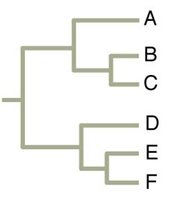
Q16. Assuming taxon A on both of the following two phylogenetic trees are the same taxon and the same holds for all the 6 taxa, are the two phylogenetic trees equivalent? If they are not, which part differs between the two trees?
Background
Topic: Phylogenetic Tree Comparison
This question tests your ability to compare phylogenetic trees and identify differences in relationships.
Key Terms:
Phylogenetic tree: Diagram showing evolutionary relationships.
Equivalent trees: Trees that show the same relationships among taxa.
Step-by-Step Guidance
Compare the branching patterns of both trees.
Identify any differences in the arrangement of taxa.
Focus on which taxa are grouped together in each tree.
Stop before stating whether the trees are equivalent or which part differs.
Try solving on your own before revealing the answer!
Final Answer:
The two trees are not equivalent; the arrangement of taxa D, E, and F differs between the trees.
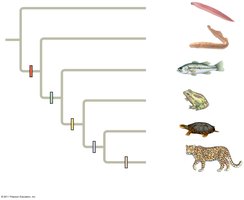
Q17. Describe the relationship of the animals in the following phylogenetic tree. Include terms of recent common ancestor, sister taxa, and basal taxon.
Background
Topic: Phylogenetic Tree Interpretation
This question tests your ability to describe evolutionary relationships using proper terminology.
Key Terms:
Recent common ancestor: The most recent ancestor shared by two taxa.
Sister taxa: Two taxa sharing an immediate common ancestor.
Basal taxon: The earliest diverging lineage.
Step-by-Step Guidance
Identify the basal taxon by finding the earliest diverging branch.
Determine which pairs of animals are sister taxa.
Describe the relationships in terms of recent common ancestors.
Stop before providing the full description.
Try solving on your own before revealing the answer!
Final Answer:
Lancelet is the basal taxon. Lamprey and bass are sister taxa, as are frog and turtle. Leopard shares a recent common ancestor with turtle and frog. Each branch point represents a recent common ancestor for the taxa that diverge from it.
Q18. On the phylogenetic tree of question 3, identify three shared ancestral characters and one shared derived character of mammals; identify two shared ancestral characters and one shared derived character of tetrapods.
Background
Topic: Character Evolution in Phylogenetic Trees
This question tests your ability to distinguish between ancestral and derived characters in evolutionary lineages.
Key Terms:
Shared ancestral character: Trait inherited from a distant ancestor.
Shared derived character: Trait unique to a particular group.
Step-by-Step Guidance
Examine the tree and identify traits present in mammals and their ancestors.
Identify traits unique to mammals (derived characters).
Repeat the process for tetrapods.
Stop before listing the specific characters.
Try solving on your own before revealing the answer!
Final Answer:
For mammals: shared ancestral characters include vertebral column, hinged jaws, and four walking legs; shared derived character is hair. For tetrapods: shared ancestral characters include vertebral column and hinged jaws; shared derived character is four walking legs.
Q19. On the phylogenetic tree of question 3, draw boxes for monophyletic group, paraphyletic group and polyphyletic group.
Background
Topic: Group Types in Phylogenetic Trees
This question tests your ability to identify different types of groups based on evolutionary relationships.
Key Terms:
Monophyletic group: Includes an ancestor and all its descendants.
Paraphyletic group: Includes an ancestor and some descendants.
Polyphyletic group: Includes taxa with different ancestors.
Step-by-Step Guidance
Review the definitions of monophyletic, paraphyletic, and polyphyletic groups.
Identify examples of each group type on the tree.
Visualize where you would draw boxes to indicate each group, but stop before actually drawing or describing the boxes.
Try solving on your own before revealing the answer!
Final Answer:
Monophyletic group: all mammals (including their ancestor). Paraphyletic group: reptiles excluding birds. Polyphyletic group: animals with four walking legs but not including their common ancestor.
