 Indietro
Study Guide: The Origin and Evolution of Vertebrates (Phylum Chordata)
Guida di studio - Note intelligenti
 Appunti personalizzati basati sui tuoi materiali, ampliati con definizioni chiave, esempi e contesto.
Phylum Chordata and Vertebrate Evolution
Overview of Chordate Characteristics
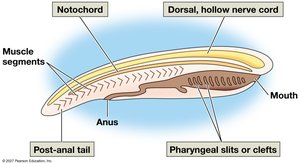
The phylum Chordata includes animals with a notochord, dorsal hollow nerve cord, pharyngeal slits, and a post-anal tail at some stage in their life cycle. These features are fundamental to understanding the evolutionary relationships and adaptations within the group.
Notochord: A flexible, rod-shaped structure that provides support.
Dorsal, hollow nerve cord: Develops into the central nervous system (brain and spinal cord).
Pharyngeal slits or clefts: Openings in the pharynx that function in filter-feeding or gas exchange.
Post-anal tail: An extension of the body past the anal opening, used for locomotion in many species.
Muscle segments: Repeated blocks of muscle along the body, aiding movement.
Chordate Phylogeny and Major Groups
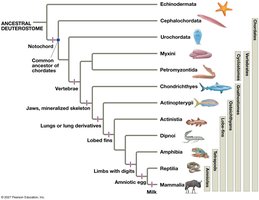
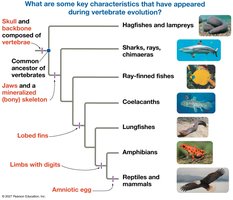
Chordates are divided into several major groups, each with unique evolutionary adaptations. The phylogenetic tree illustrates the relationships among these groups and highlights key innovations.
Cephalochordata: Lancelets, retain all chordate features throughout life.
Urochordata: Tunicates, exhibit chordate features mainly in the larval stage.
Vertebrata: Animals with a backbone and skull, including fish, amphibians, reptiles, birds, and mammals.
Defining Features of Chordate Subgroups
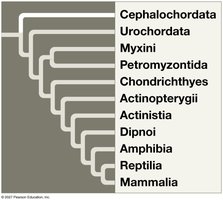
Each subgroup within Chordata is defined by specific derived characteristics. Understanding these features is essential for recognizing evolutionary trends and relationships.
Cephalochordata: Retain notochord, dorsal nerve cord, and pharyngeal slits throughout life.
Urochordata: Larval stage has chordate features; adults are sessile filter feeders.
Vertebrata: Possess a vertebral column and neural crest cells.
Evolutionary Innovations in Vertebrates
Vertebrates are characterized by several key innovations that have appeared over evolutionary time, including the development of jaws, limbs, and the amniotic egg.
Jawless Fish (Cyclostomes): Myxini (hagfish) and Petromyzontida (lampreys) lack jaws and paired fins.
Chondrichthyes: Cartilaginous fish (sharks, rays) with jaws and paired fins.
Osteichthyes: Bony fish, including ray-finned and lobe-finned fishes.
Tetrapods: Vertebrates with limbs and digits, including amphibians, reptiles, birds, and mammals.
Amniotes: Vertebrates with an amniotic egg, reducing dependence on water for reproduction.
Neural Crest and Vertebrate Traits
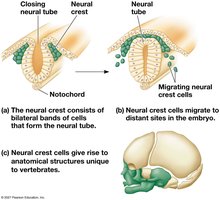
The neural crest is a group of cells unique to vertebrates, contributing to the development of diverse anatomical structures such as the skull, jaws, and sensory organs.
Neural crest cells: Migrate during embryonic development to form structures like peripheral nerves, pigment cells, and facial cartilage.
Phylogenetic Relationships and Clade Descriptions
Chordate evolution is marked by the emergence of distinct clades, each defined by specific morphological and genetic traits. The following table summarizes the main clades and their defining features.
Clade | Defining Feature |
|---|---|
Cephalochordata | Retain all chordate features throughout life |
Urochordata | Chordate features in larval stage |
Myxini | Jawless, slime glands |
Petromyzontida | Jawless, parasitic |
Chondrichthyes | Cartilaginous skeleton, jaws |
Actinopterygii | Ray-finned fish |
Actinistia | Lobe-finned fish |
Dipnoi | Lungfish |
Amphibia | Limbs with digits, life cycle includes water and land |
Reptilia | Amniotic egg, scales |
Mammalia | Milk, hair, differentiated teeth |
Cephalochordata: Lancelets
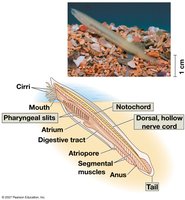
Lancelets (Branchiostoma) are small, marine animals that retain all chordate features throughout their life. They are important for understanding the ancestral chordate body plan.
Body plan: Notochord, dorsal nerve cord, pharyngeal slits, post-anal tail.
Feeding: Filter feeders using pharyngeal slits.
Urochordata: Tunicates
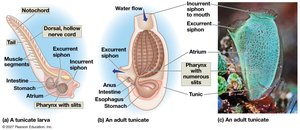
Tunicates are marine animals that exhibit chordate features in their larval stage. Adults are sessile and filter feed using pharyngeal slits.
Larval stage: Free-swimming with notochord and nerve cord.
Adult stage: Sessile, covered by a tunic, filter-feeding.
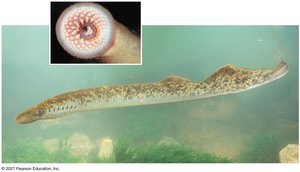
Cyclostomes: Jawless Fish
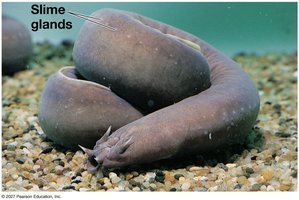
Cyclostomes include hagfish (Myxini) and lampreys (Petromyzontida). They are characterized by the absence of jaws and paired fins.
Hagfish: Produce slime for defense, scavengers.
Lampreys: Parasitic, attach to other fish and feed on blood.
Chondrichthyes: Cartilaginous Fish
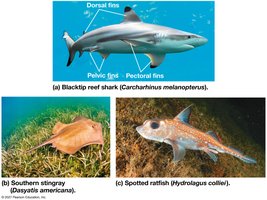
Chondrichthyes include sharks, rays, and chimaeras. Their skeletons are made of cartilage rather than bone, and they possess jaws and paired fins.
Key traits: Cartilaginous skeleton, placoid scales, internal fertilization.
Examples: Blacktip reef shark, southern stingray, spotted ratfish.
Osteichthyes: Bony Fish
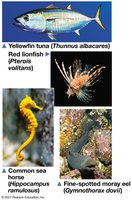
Bony fish are divided into ray-finned (Actinopterygii) and lobe-finned (Sarcopterygii) groups. They have ossified skeletons and are the most diverse vertebrate group.
Ray-finned fish: Fins supported by bony rays, diverse habitats.
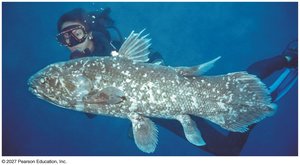
Lobe-finned fish: Fleshy, lobed fins; includes coelacanths and lungfish.
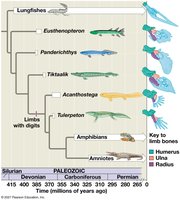
Tetrapods: Limbs and Digits
Tetrapods are vertebrates with four limbs and digits, enabling movement on land. The transition from aquatic to terrestrial life involved significant anatomical changes.
Key innovations: Limbs with digits, lungs for breathing air.
Examples: Amphibians, reptiles, birds, mammals.
Amphibia: Life in Water and Land
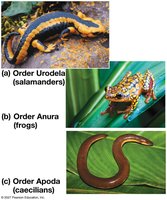
Amphibians are tetrapods that typically have a life cycle involving both aquatic and terrestrial stages. They are sensitive to environmental changes and are indicators of ecosystem health.
Orders: Urodela (salamanders), Anura (frogs), Apoda (caecilians).
Key traits: Moist skin for gas exchange, eggs laid in water.
Amniotes: Adaptations for Terrestrial Life
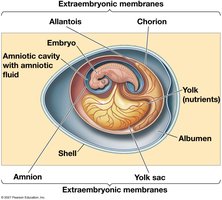
Amniotes include reptiles, birds, and mammals. The amniotic egg is a key adaptation that allows reproduction away from water, providing protection and nutrients to the developing embryo.
Amniotic egg: Contains extraembryonic membranes (amnion, chorion, yolk sac, allantois).
Reduced dependence on water: Enables colonization of terrestrial environments.
Reptilia: Scales and Shelled Eggs
Reptiles are amniotes with scales and shelled eggs. They include turtles, snakes, lizards, and crocodilians. Birds are derived from reptilian ancestors.
Key traits: Scales, shelled eggs, ectothermy (except birds).
Phylogeny: Birds are nested within reptiles, derived from theropod dinosaurs.
Aves: Birds and Their Unique Adaptations
Birds are characterized by feathers, wings, and adaptations for flight. They are derived from theropod dinosaurs and exhibit several unique traits.
Key traits: Feathers, wings, loss of teeth, reduced gonads, loss of urinary bladder.
Species diversity: 9,000-10,000 species.
Mammalia: Milk, Hair, and Differentiated Teeth
Mammals are amniotes that produce milk, have hair, and possess differentiated teeth. These adaptations support endothermy and complex behaviors.
Milk: Provides nutrients for young; lactose intolerance in adults is common.
Hair and subcutaneous fat: Insulation and energy storage.
Differentiated teeth: Specialized for different functions (incisors, canines, molars).
Jaw evolution: Dentary bone becomes dominant; other bones form ear structures.
Summary Table: Major Vertebrate Groups and Their Derived Features
Group | Derived Feature |
|---|---|
Cephalochordata | Retain chordate features throughout life |
Urochordata | Chordate features in larval stage |
Cyclostomes | Jawless, slime glands (hagfish), parasitic (lampreys) |
Chondrichthyes | Cartilaginous skeleton, jaws |
Osteichthyes | Bony skeleton, ray-finned and lobe-finned fish |
Tetrapods | Limbs with digits |
Amniotes | Amniotic egg, reduced dependence on water |
Reptilia | Scales, shelled eggs |
Aves | Feathers, wings, loss of teeth |
Mammalia | Milk, hair, differentiated teeth |
Additional info:
Chordate evolution is marked by increasing complexity and adaptation to terrestrial environments.
Phylogenetic trees are essential for understanding evolutionary relationships and the emergence of key traits.
