 Indietro
Study Notes: Chemistry of Biomolecules – Alcohols, Dehydration, and Reactions
Guida di studio - Note intelligenti
 Appunti personalizzati basati sui tuoi materiali, ampliati con definizioni chiave, esempi e contesto.
Chemistry of Biomolecules
Alcohols: Structure and Properties
Alcohols are organic compounds characterized by the presence of a hydroxyl group (-OH) attached to a carbon atom. Their physical and chemical properties are influenced by the nature of the carbon chain and the position of the hydroxyl group.
Hydroxyl Group: The functional group responsible for alcohol properties.
Classification: Alcohols are classified as primary, secondary, or tertiary based on the number of carbon atoms attached to the carbon bearing the -OH group.
Boiling Point: Alcohols generally have higher boiling points than alkanes due to hydrogen bonding.
Solubility: Alcohols are soluble in water due to their ability to form hydrogen bonds, but solubility decreases as the carbon chain length increases.
Example: Ethanol (CH3CH2OH) is a common alcohol used in biological and industrial processes.
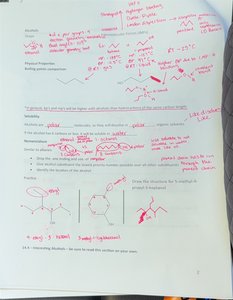
Physical Properties of Alcohols
The boiling points and solubility of alcohols are determined by their molecular structure and the presence of hydrogen bonding.
Hydrogen Bonding: Alcohols can form hydrogen bonds with water and other alcohol molecules, increasing their boiling points.
Boiling Point Trends: As the carbon chain increases, boiling point increases due to greater van der Waals forces, but solubility in water decreases.
Example: Methanol (CH3OH) is highly soluble in water, while octanol (C8H17OH) is much less soluble.
Dehydration of Alcohols
Alcohols can undergo dehydration reactions, typically in the presence of an acid catalyst, to form alkenes and water. This is an important reaction in organic chemistry and biochemistry.
Reaction: Alcohol + Acid → Alkene + Water
Mechanism: The acid protonates the alcohol, making it a better leaving group. Water is eliminated, and a double bond forms.
Example Equation:
Regioselectivity: According to Zaitsev's Rule, the most substituted alkene is usually the major product.
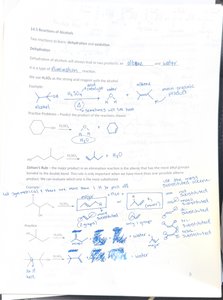
Zaitsev's Rule
Zaitsev's Rule states that in elimination reactions, the most substituted (stable) alkene will be the major product. This is due to the greater stability of more substituted alkenes.
Major Product: The alkene with more alkyl groups attached to the double bond is favored.
Example: Dehydration of 2-butanol yields 2-butene as the major product.
Summary Table: Alcohol Dehydration and Product Formation
Alcohol | Acid Catalyst | Major Product | Minor Product |
|---|---|---|---|
2-butanol | H2SO4 | 2-butene | 1-butene |
1-butanol | H2SO4 | 1-butene | None |
tert-butanol | H2SO4 | isobutene | None |
Applications and Biological Relevance
Alcohol dehydration reactions are important in metabolic pathways, such as the biosynthesis of alkenes and other hydrocarbons. Understanding these reactions is essential for biochemistry and molecular biology.
Example: Enzymatic dehydration of alcohols occurs in metabolic pathways, such as fermentation.
Additional info: The notes also reference the importance of acid catalysts and the stability of carbocation intermediates, which are fundamental concepts in organic chemistry and biochemistry.
