 Indietro
Study Notes: Membranes, Cell Structure, and Metabolism (Chapters 6–9)
Guida di studio - Note intelligenti
 Appunti personalizzati basati sui tuoi materiali, ampliati con definizioni chiave, esempi e contesto.
Chapter 6: Membrane Structure and Function
General Characteristics and Types of Lipids
Lipids are a diverse group of hydrophobic or amphipathic molecules, including fats, phospholipids, and steroids. Their structure and properties are essential for membrane formation and function.
Fats (Triglycerides): Composed of glycerol and three fatty acids, formed via dehydration reactions. Serve as energy storage molecules.
Phospholipids: Consist of a glycerol backbone, two fatty acids, and a phosphate group. Amphipathic nature allows them to form bilayers in aqueous environments.
Steroids: Characterized by a four-ring structure; cholesterol is a key example, contributing to membrane fluidity and stability.
Amphipathic Molecules: Contain both hydrophilic (water-attracting) and hydrophobic (water-repelling) regions, crucial for membrane structure.
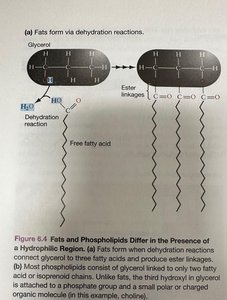
Phospholipid Bilayer Structure and Amphipathic Nature
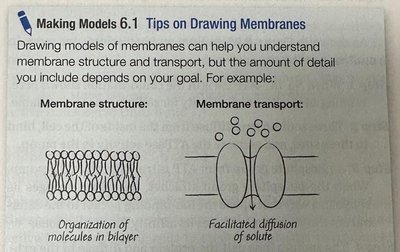
Phospholipids spontaneously arrange into bilayers in water due to their amphipathic properties. The hydrophilic heads face outward toward water, while hydrophobic tails face inward, away from water.
Bilayer Formation: Drives the basic structure of biological membranes.
Amphipathic Nature: Enables selective permeability and compartmentalization.
Selective Permeability of Membranes
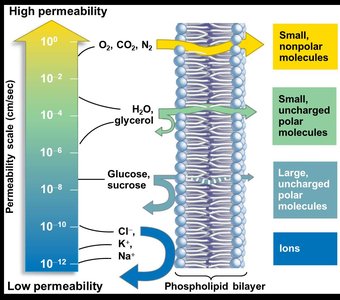
The phospholipid bilayer is selectively permeable, allowing some molecules to cross more easily than others. Permeability depends on molecule size, charge, and polarity.
Small, nonpolar molecules (e.g., O2, CO2) cross easily.
Small, uncharged polar molecules (e.g., H2O, glycerol) cross less readily.
Large, uncharged polar molecules (e.g., glucose) and ions (e.g., Na+, Cl-) cross poorly without assistance.
Factors Affecting Membrane Permeability
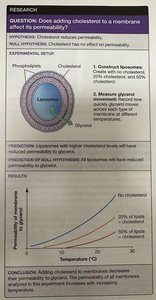
Membrane permeability is influenced by temperature, cholesterol content, and the length and saturation of hydrocarbon tails in phospholipids.
Factor | Effect on Permeability | Reason |
|---|---|---|
Temperature | Increases with higher temperature | Increased molecular motion disrupts packing |
Cholesterol | Decreases permeability | Fills spaces between phospholipids, stabilizing membrane |
Length of hydrocarbon tails | Decreases with longer tails | Longer tails increase van der Waals interactions |
Saturation of hydrocarbon tails | Decreases with more saturation | Saturated tails pack tightly, reducing fluidity |
Diffusion, Osmosis, and Concentration Gradients
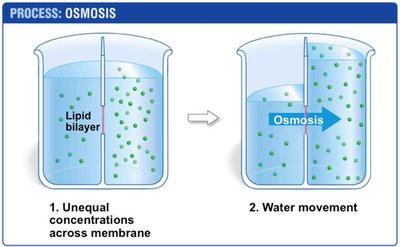
Diffusion is the movement of molecules from high to low concentration. Osmosis is the diffusion of water across a selectively permeable membrane, from low to high solute concentration. These processes are driven by concentration gradients.
Hypertonic Solution: Higher solute concentration outside the cell; water moves out.
Hypotonic Solution: Lower solute concentration outside the cell; water moves in.
Isotonic Solution: Equal solute concentration; no net water movement.
Electrochemical Gradients
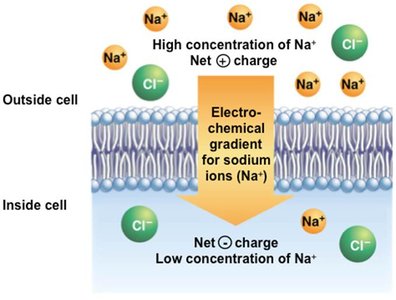
An electrochemical gradient combines both concentration and electrical gradients, influencing the movement of ions across membranes. These gradients are essential for processes like nerve impulse transmission and ATP synthesis.
Membrane Transport Mechanisms
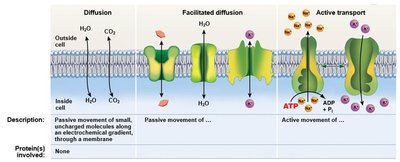
Transport across membranes can be passive or active:
Passive Transport: Movement down a gradient (diffusion, facilitated diffusion via channels or carriers); does not require energy.
Active Transport: Movement against a gradient; requires energy (usually ATP).
Cotransport (Secondary Active Transport): Uses the gradient of one molecule to drive the transport of another.
Chapter 7: Cell Structure and Function
Prokaryotic vs. Eukaryotic Cells
Cells are classified as prokaryotic or eukaryotic based on the presence of a nucleus and membrane-bound organelles.
Prokaryotic Cells: Lack a nucleus; DNA is in the nucleoid region. Key structures include ribosomes, cell wall, plasma membrane, and sometimes flagella.
Eukaryotic Cells: Have a nucleus and various organelles (e.g., mitochondria, ER, Golgi apparatus) compartmentalizing cellular functions.
Major Eukaryotic Cell Components and Functions
Organelle | Structure | Function |
|---|---|---|
Nucleus | Double membrane, nuclear pores | Information storage, ribosome assembly |
Ribosomes | No membrane, RNA and proteins | Protein synthesis |
Rough ER | Network with ribosomes | Protein synthesis and processing |
Smooth ER | Network without ribosomes | Lipid synthesis, detoxification |
Golgi apparatus | Stacked cisternae | Protein, lipid, and carbohydrate processing |
Lysosomes | Acidic vesicles | Digestion and recycling |
Peroxisomes | Single membrane | Fatty acid processing, detoxification |
Mitochondria | Double membrane, own DNA | ATP production |
Chloroplasts (plants) | Double membrane, own DNA | Photosynthesis |
Vacuoles (plants/fungi) | Large vesicles | Storage, digestion, water balance |
Cytoskeleton | Protein fibers | Structural support, movement |
Plasma membrane | Phospholipid bilayer | Selective permeability, communication |
Cell wall (plants, fungi, some protists) | Carbohydrate fibers | Protection, structure |
005
Endomembrane System and Protein Transport
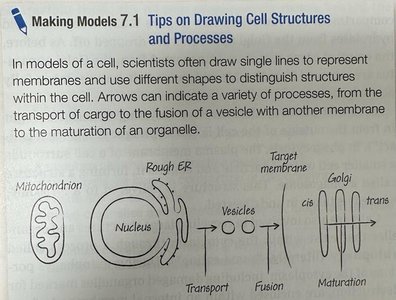
The endomembrane system includes the nuclear envelope, ER, Golgi apparatus, lysosomes, and vesicles. It is responsible for the synthesis, modification, and transport of proteins and lipids.
Protein Pathway: Synthesized in rough ER → transported in vesicles → processed in Golgi → sorted to final destinations (e.g., lysosomes, plasma membrane, secretion).
Chapter 8: Energy, Enzymes, and Metabolism
Energy in Chemical Reactions
Chemical reactions involve changes in energy, described by enthalpy (H), entropy (S), and Gibbs free energy (G).
Gibbs Free Energy Equation:
Exergonic Reactions: (spontaneous)
Endergonic Reactions: (nonspontaneous)
Redox Reactions and ATP
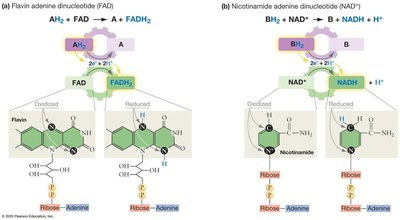
Redox reactions involve the transfer of electrons, often coupled with energy transfer. ATP stores energy in its phosphate bonds; hydrolysis releases energy for cellular work.
Electron Carriers: NADH and FADH2 shuttle electrons during metabolism.
Enzyme Structure and Function
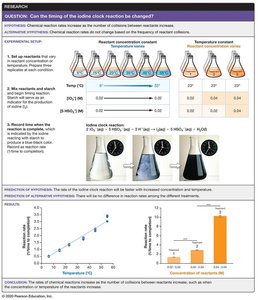
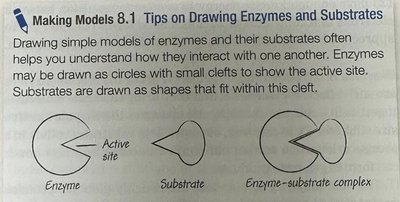
Enzymes are biological catalysts that speed up reactions by lowering activation energy. Their specificity is due to the shape and chemical properties of the active site.
Enzyme-Substrate Complex: Substrate binds to the enzyme's active site, forming a temporary complex.
Regulation: Enzyme activity can be regulated by competitive inhibition, allosteric regulation, or covalent modification (e.g., phosphorylation).
Chapter 9: Cellular Respiration
Overview of Glucose Oxidation
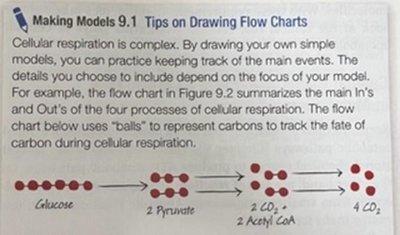
Cellular respiration is the process by which cells extract energy from glucose to produce ATP. It involves glycolysis, pyruvate processing, the citric acid cycle, and oxidative phosphorylation.
Glycolysis: Occurs in the cytosol; glucose is split into two pyruvate molecules.
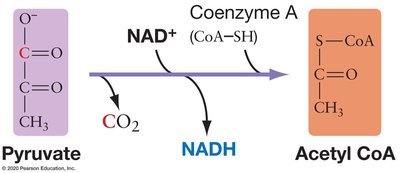
Pyruvate Processing: Pyruvate is converted to acetyl CoA in the mitochondrial matrix.
Citric Acid Cycle: Acetyl CoA is oxidized to CO2; NADH and FADH2 are produced.
Electron Transport Chain (ETC): Electrons from NADH and FADH2 are transferred through protein complexes, creating a proton gradient used to synthesize ATP.
Fermentation
When oxygen is unavailable, cells use fermentation to regenerate NAD+ so glycolysis can continue. Fermentation produces less ATP than aerobic respiration.
Regulation of Cellular Respiration
Cellular respiration is tightly regulated by feedback inhibition and the availability of substrates and electron acceptors. Key enzymes are regulated by ATP, ADP, NADH, and other metabolites.
Additional info: These notes integrate textbook figures and study questions to provide a comprehensive overview of membrane structure, cell components, energy metabolism, and cellular respiration, suitable for exam preparation in a General Biology course.
