 Indietro
Ch. 26 Systematics, Phylogenetics, and Classification: Study Notes for General Biology
Guida di studio - Note intelligenti
 Appunti personalizzati basati sui tuoi materiali, ampliati con definizioni chiave, esempi e contesto.
Systematics and Classification
Linnaean Classification System
The Linnaean system is a hierarchical method for classifying organisms based on shared characteristics. It uses several ranks, including domain, kingdom, phylum, genus, and species. This system helps organize biological diversity and provides a universal language for biologists.
Domain: The highest taxonomic rank, grouping organisms based on fundamental differences (e.g., Eubacteria, Archaea, Eukarya).
Kingdom: Groups within domains (e.g., Animalia, Plantae, Fungi).
Phylum: Groups organisms based on major body plans or organization.
Genus: Groups closely related species.
Species: The basic unit of classification, representing a group of organisms capable of interbreeding.
Connection Between Classification and Phylogeny
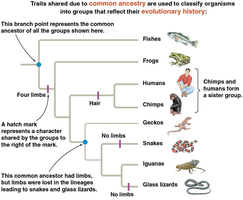
Classification reflects evolutionary relationships. The evolutionary history of a group of organisms is represented by a phylogenetic tree, a branching diagram showing how species are related through common ancestry.
Phylogenetic Trees and Systematics
Phylogenetic Tree Construction
Phylogenetic trees are constructed using morphological and molecular data. Shared characters, especially homologous traits, are used to infer evolutionary relationships. Only homologous characters (those due to shared ancestry) are valid for tree construction.
Homology: Similarity due to shared ancestry.
Analogy: Similarity due to convergent evolution, not shared ancestry.
Homologous vs. Analogous Structures
Homologous structures have the same origin but may serve different functions in different species. Analogous structures arise independently in unrelated groups due to similar environmental pressures.
Example of Homology: Forelimbs of vertebrates (human, bird, whale, etc.) show similar bone structure but different functions.
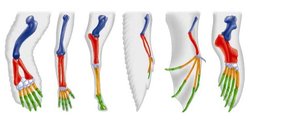
Example of Analogy: Wings of birds and insects serve the same function (flight) but evolved independently.
Cladistics and Cladograms
Cladistics
Cladistics is a method of classification based on common ancestry. A cladogram is a diagram depicting patterns of shared characteristics among taxa. A clade includes an ancestor and all its descendants, and clades can be nested within larger clades.
Monophyletic, Paraphyletic, and Polyphyletic Groups
Groups in phylogenetic trees can be classified as:
Monophyletic: Includes an ancestor and all its descendants (legitimate taxa in cladistics).
Paraphyletic: Includes an ancestor and some, but not all, descendants.
Polyphyletic: Includes distantly related species but not their most recent common ancestor.
Shared Ancestral vs. Shared Derived Characters
Shared ancestral character: Originated in an ancestor of the taxon.
Shared derived character: An evolutionary novelty unique to a particular clade.
Outgroup: A species or group closely related to, but not part of, the group being studied.
Phylogenetic Analysis Methods
Maximum Parsimony and Maximum Likelihood
Maximum Parsimony: The simplest explanation (fewest evolutionary events) is preferred. In DNA-based phylogenies, the most parsimonious tree has the fewest base changes.
Maximum Likelihood: Identifies the tree most likely to have produced a given set of DNA data, based on probability rules about DNA changes over time.
Gene Evolution and Molecular Clocks
Gene Duplications and Gene Families
Gene duplication increases the number of genes in the genome, leading to gene families. These families provide opportunities for evolutionary change.
Orthologous genes: Homology due to speciation; found in different species.
Paralogous genes: Homology due to gene duplication; found within a species.
Molecular Clocks
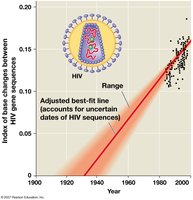
A molecular clock estimates the absolute time of evolutionary change based on the assumption that some genes evolve at a constant rate. The number of nucleotide substitutions is proportional to the time since divergence.
Calibration: Graphing genetic differences against known fossil dates.
Limitations: Some genes evolve in bursts, rates may vary among taxa, and different genes may evolve at different rates.
Diversity and Classification
Three Domains and Five Kingdoms
Biological diversity is organized into three domains and five kingdoms:
Domains: Eubacteria, Archaea, Eukarya
Kingdoms: Monera, Protista, Fungi, Plantae, Animalia
Current Classification
Eubacteria: Bacteria
Archaea: Archaea
Eukarya: Fungi, Plantae, Animalia
Applications: Fish Phylogeny and Character Tables
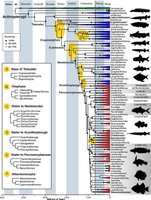
Fossil-Calibrated Phylogeny of Actinopterygians
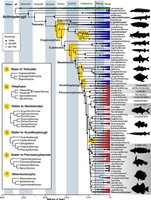
Phylogenetic trees can be calibrated using fossil data to estimate divergence dates among groups, such as actinopterygians (ray-finned fishes).
Character Tables in Phylogenetic Analysis
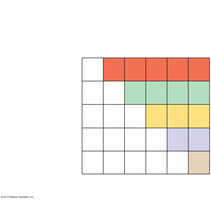
Character tables are used to infer phylogenetic relationships by mapping traits across taxa.
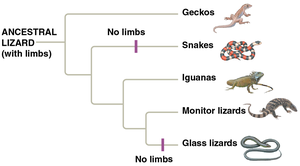
Phylogenetic Relationships Among Lizards
Phylogenetic trees can illustrate evolutionary changes, such as limb loss in lizards.
Summary Table: Types of Groups in Cladistics
Group Type | Definition | Example |
|---|---|---|
Monophyletic | Ancestor and all descendants | Mammals |
Paraphyletic | Ancestor and some descendants | Reptiles (excluding birds) |
Polyphyletic | Distantly related species, not their most recent common ancestor | Marine mammals (whales, seals) |
Key Terms
Systematics: Study of biological diversity and relationships among organisms.
Phylogeny: Evolutionary history of a group of organisms.
Cladistics: Classification based on common ancestry.
Homology: Similarity due to shared ancestry.
Analogy: Similarity due to convergent evolution.
Molecular clock: Method for estimating evolutionary time based on genetic changes.
Additional info: These notes expand on brief points from the original materials, providing definitions, examples, and context for General Biology students.
