 Indietro
Lecture 25 (Unit 2) The Awesome Power of Genetics: Forward and Reverse Genetics in Model Organisms
Guida di studio - Note intelligenti
 Appunti personalizzati basati sui tuoi materiali, ampliati con definizioni chiave, esempi e contesto.
Genetics as an Experimental Approach
Introduction to Genetics in Biology
Genetics is not only the study of heredity but also a powerful experimental approach for discovering new aspects of biology. By analyzing mutants with altered phenotypes, researchers can uncover the genetic basis of biological processes. This unbiased approach allows scientists to identify important genes without prior knowledge of their function.
Forward genetics: Start with a phenotype and identify the gene responsible.
Reverse genetics: Start with a gene and determine its function by studying the phenotype resulting from its mutation.
Model organisms are essential for genetic studies due to their tractability and well-characterized genomes.
Examples of model organisms:
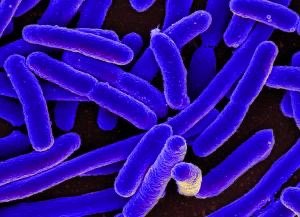
Escherichia coli (bacterium)
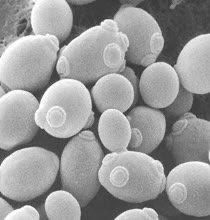
Saccharomyces cerevisiae (yeast)
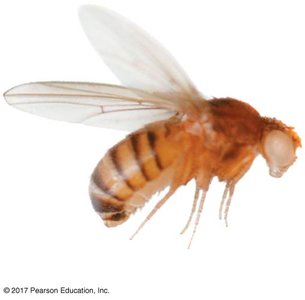
Drosophila melanogaster (fruit fly)
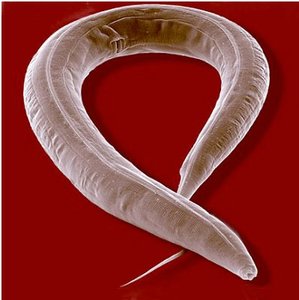
Caenorhabditis elegans (nematode)
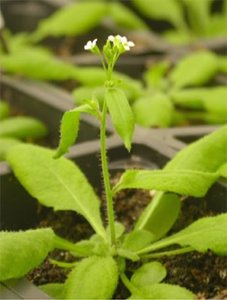
Arabidopsis thaliana (plant)
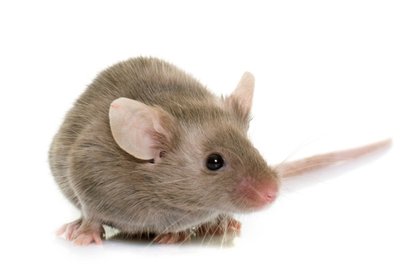
Mouse (Mus musculus)
Forward Genetics: From Phenotype to Gene
Principles and Methods
Forward genetics is a classical approach where researchers begin with an observable mutant phenotype and work to identify the underlying gene. This method has led to the discovery of genes involved in fundamental biological processes.
Mutants are generated, often using chemical mutagens such as EMS (ethyl methanesulfonate).
Mutants are isolated using screens (examining all individuals for the phenotype) or selections (only mutants with the desired phenotype survive).
Genetic crosses are performed to determine dominance and segregation patterns (e.g., Mendelian 3:1 ratio in F2 for recessive mutations).
Key examples:
Lac repressor mutants in E. coli
Cell cycle mutants in yeast
Developmental mutants in Drosophila, C. elegans, and Arabidopsis
Photosynthesis mutants in Arabidopsis, maize, and Chlamydomonas
Chemical Mutagenesis
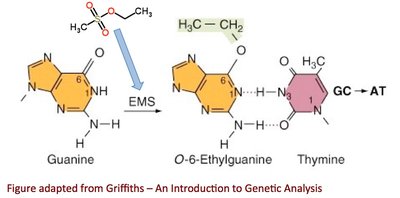
Chemical mutagens like EMS induce random mutations by modifying DNA bases, leading to base-pair mismatches and, if unrepaired, permanent mutations.
EMS adds an ethyl group to guanine, forming O-6-ethylguanine, which pairs with thymine instead of cytosine.
This results in a G/C to A/T transition mutation during DNA replication.
Step-by-Step Genetic Analysis of Mutants
Design a selection or screen for the desired mutants.
Mutagenize the wild type to create a population of mutants.
Isolate mutants with the desired phenotype.
Retest phenotype and establish true-breeding (homozygous) lines.
Cross to wild type and test dominance in F1.
Determine segregation pattern in F2 (e.g., 3:1 ratio for single-gene recessive traits).
Model Organism: Arabidopsis thaliana
Arabidopsis thaliana is a premier model for plant genetics due to its small size, short life cycle, self-pollination, high seed yield, diploid genome, and ease of genetic transformation.
Genome size: ~135 Mb
Produces ~5,000 seeds per plant
Many natural accessions (ecotypes) with DNA polymorphisms

Case Study: Chlorophyll Fluorescence Mutant (roqH1)
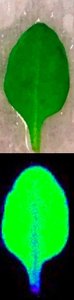
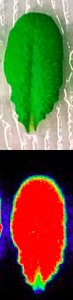
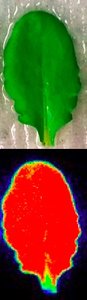
A mutant with altered chlorophyll fluorescence was isolated in Arabidopsis. Chlorophyll fluorescence is used to assess photosynthetic efficiency. The mutant showed much lower fluorescence compared to wild type.

Linkage Mapping and Positional Cloning
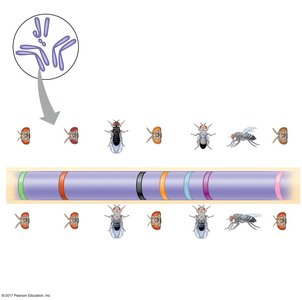
To identify the gene responsible for a mutant phenotype, linkage mapping is used. This method relies on the principle that genes close together on a chromosome are inherited together (linked), while those far apart or on different chromosomes assort independently.
Recombination frequency between unlinked loci: 50%
Recombination frequency between linked loci: <50%
The closer two loci are, the lower the probability of recombination between them.
Positional Cloning by Sequencing
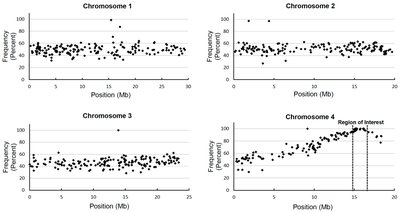
Next-generation sequencing allows researchers to genotype all SNPs in a mutant population. By analyzing the allele frequency of SNPs in F2 progeny homozygous for the mutant phenotype, the causative mutation can be mapped.
SNPs far from the causative mutation have a 50% allele frequency.
SNPs closely linked to the causative mutation approach 100% allele frequency in the mutant pool.
Identification of Candidate Genes
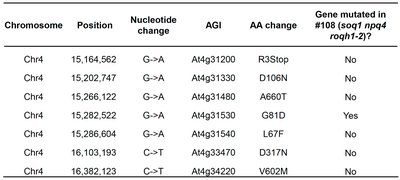
Within the mapped region, candidate genes with nonsense or missense mutations are identified. Additional alleles or complementation tests can confirm the causative gene.
Chromosome | Position | Nucleotide change | AGI | AA change | Gene mutated in #108 (soq1 npq4 roqh1-2)? |
|---|---|---|---|---|---|
Chr4 | 15,164,562 | G>A | At4g31200 | R3Stop | No |
Chr4 | 15,202,747 | G>A | At4g31330 | D106N | No |
Chr4 | 15,266,122 | G>A | At4g31480 | A860T | No |
Chr4 | 15,282,522 | G>A | At4g31530 | G81D | Yes |
Chr4 | 15,286,604 | G>A | At4g31540 | L67F | No |
Chr4 | 16,103,193 | C>T | At4g33470 | D317N | No |
Chr4 | 16,382,123 | C>T | At4g34220 | V602M | No |
Rescue Experiment
To confirm gene identity, the wild-type gene is introduced into the mutant. Restoration of the wild-type phenotype confirms the causative gene.
Reverse Genetics: From Gene to Phenotype
Principles and Methods
Reverse genetics starts with a gene of interest and investigates its function by creating targeted mutations and analyzing the resulting phenotype. This approach is especially useful for genes with unknown functions identified in genome projects.
Gene selection can be based on annotation, biochemical isolation, expression patterns, co-expression, or sequence conservation.
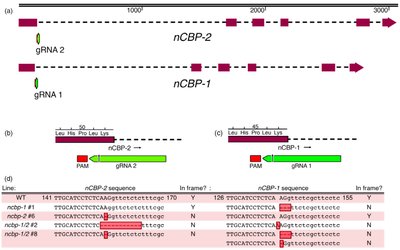
Genome editing tools such as CRISPR-Cas9 are used to create targeted mutations.
CRISPR-Cas9 Genome Editing
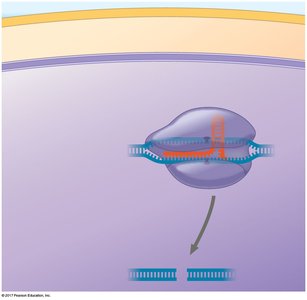
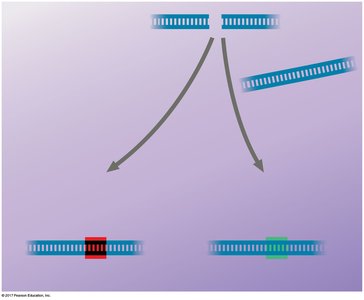
CRISPR-Cas9 is a revolutionary tool for genome editing. It uses a guide RNA to direct the Cas9 nuclease to a specific DNA sequence, where it creates a double-strand break. The break can be repaired by:
Non-homologous end joining (NHEJ): Error-prone, often introduces insertions or deletions (indels) that disrupt gene function.
Homology-directed repair (HDR): Uses a template for precise repair (less common in plants and animals).
Applications in Agriculture: Virus-Resistant Cassava
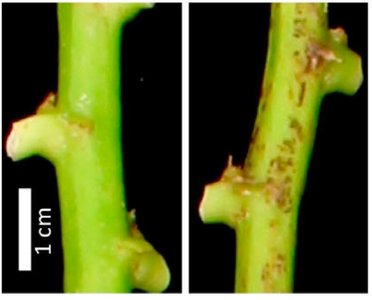
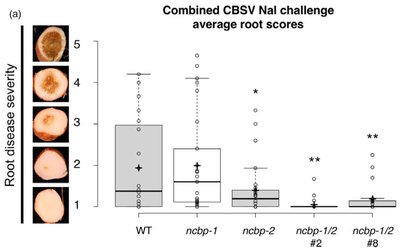
CRISPR-Cas9 has been used to engineer virus resistance in cassava, a staple crop in sub-Saharan Africa. By knocking out two genes encoding eukaryotic translation initiation factors (eIF4E), researchers created plants resistant to cassava brown streak disease (CBSD), caused by potyviruses.
Double mutants showed strong resistance to the virus, as measured by reduced root disease severity.
Summary of Key Concepts
Forward genetics: phenotype to gene, using mutagenesis, screens/selections, and linkage mapping.
Reverse genetics: gene to phenotype, using targeted genome editing (e.g., CRISPR-Cas9).
Model organisms are essential for genetic research due to their tractability and genetic resources.
Genome editing has transformative potential in agriculture and medicine.
Additional info: The principles and examples discussed here are foundational for understanding modern genetics, genomics, and biotechnology, and are directly relevant to topics such as gene expression, inheritance, and genetic engineering.
