 Indietro
The Calvin Cycle and Adaptations in Photosynthesis
Guida di studio - Note intelligenti
 Appunti personalizzati basati sui tuoi materiali, ampliati con definizioni chiave, esempi e contesto.
Photosynthesis: The Calvin Cycle and Plant Adaptations
Overview of Photosynthesis
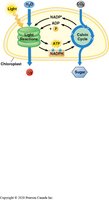
Photosynthesis is the process by which plants convert light energy into chemical energy, producing glucose and oxygen from carbon dioxide and water. It consists of two main stages: the light-dependent reactions and the light-independent reactions (Calvin Cycle).
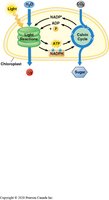
Light-dependent reactions: Occur in the thylakoid membranes, producing ATP and NADPH.
Light-independent reactions (Calvin Cycle): Occur in the stroma, using ATP and NADPH to fix carbon dioxide into sugars.
Overall equation:
The Calvin Cycle: Light-Independent Reactions
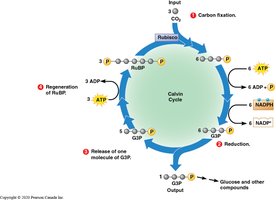
The Calvin Cycle is a cyclical metabolic pathway that reduces carbon dioxide to sugar using the energy from ATP and NADPH produced in the light reactions. It takes place in the stroma of the chloroplast.
Carbon fixation: The process of incorporating inorganic CO2 into organic molecules.
Key molecules: RuBP (ribulose bisphosphate), Rubisco (enzyme), CO2, ATP, NADPH.
Product: G3P (glyceraldehyde-3-phosphate, also called PGAL), which can be converted into glucose or other compounds.
Stepwise Summary of the Calvin Cycle
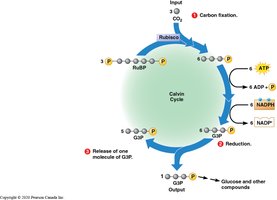
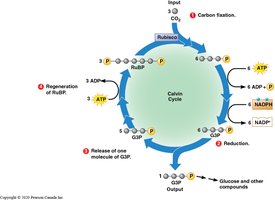
Step 1: Carbon Fixation – Rubisco catalyzes the addition of CO2 to RuBP, forming 3-phosphoglycerate (3-PGA).
Step 2: Reduction – ATP and NADPH are used to convert 3-PGA into G3P (PGAL).
Step 3: Release of G3P – One G3P molecule exits the cycle as a product.
Step 4: Regeneration of RuBP – The remaining G3P molecules are rearranged, using ATP, to regenerate RuBP, allowing the cycle to continue.
Coupling of Light-Dependent and Light-Independent Reactions
The products of the light-dependent reactions (ATP and NADPH) are essential for the Calvin Cycle. Without these energy carriers, carbon fixation and sugar synthesis cannot occur.
Carbon Dioxide Entry: Stomata
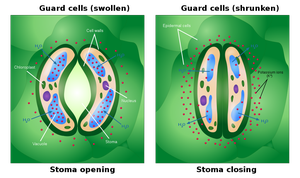
CO2 enters the leaf through specialized structures called stomata. These pores are regulated by guard cells, which control their opening and closing to balance CO2 intake and water loss.
Stomata: Allow CO2 to diffuse in and O2 to diffuse out.
Water loss: Occurs when stomata are open, especially in hot, dry conditions.
Problems with C3 Plants: Photorespiration
C3 plants use the Calvin Cycle as described above. However, in hot and dry environments, they close their stomata to conserve water, leading to a buildup of O2 inside the leaf. Rubisco may then add O2 to RuBP instead of CO2, causing photorespiration, which consumes energy and does not produce sugar.
Photorespiration: A wasteful process that reduces photosynthetic efficiency.
Adaptations: C4 and CAM plants have evolved mechanisms to minimize photorespiration.
Adaptations: C4 and CAM Plants
Plants in hot, dry climates have developed alternative pathways to avoid photorespiration. These adaptations involve changes in carbon fixation and stomatal behavior.
C4 Plants
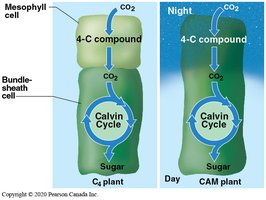
Mechanism: C4 plants fix CO2 into a 4-carbon compound in mesophyll cells using a specialized enzyme.
Transport: The 4-carbon compound is moved to bundle-sheath cells, where CO2 is released for the Calvin Cycle.
Advantage: Allows the Calvin Cycle to continue even when stomata are closed and CO2 is scarce.
CAM Plants
Mechanism: CAM plants open their stomata at night, fixing CO2 into a 4-carbon compound.
Daytime: Stomata are closed; the 4-carbon compound releases CO2 for the Calvin Cycle during the day.
Advantage: Reduces water loss by separating carbon fixation and the Calvin Cycle in time.
Comparison Table: C3, C4, and CAM Plants
Plant Type | First Product of Carbon Fixation | Stomatal Behavior | Photorespiration Risk | Adaptation |
|---|---|---|---|---|
C3 | 3-carbon compound (3-PGA) | Open during day | High in hot, dry climates | None |
C4 | 4-carbon compound | Close when hot | Low | Spatial separation of carbon fixation and Calvin Cycle |
CAM | 4-carbon compound | Open at night, closed during day | Very low | Temporal separation of carbon fixation and Calvin Cycle |
Example: Corn is a C4 plant, while cacti are CAM plants. Most temperate grasses are C3 plants.
Additional info: The Calvin Cycle is essential for all photosynthetic organisms, but its efficiency and regulation are influenced by environmental conditions and plant adaptations.
