 Indietro
The Cell Cycle and Cell Division: Structure, Regulation, and Implications
Guida di studio - Note intelligenti
 Appunti personalizzati basati sui tuoi materiali, ampliati con definizioni chiave, esempi e contesto.
Cell Division and the Cell Cycle
Overview of Cell Division
Cell division is a fundamental process that enables organisms to reproduce, grow, and repair tissues. In unicellular organisms, division of one cell reproduces the entire organism. In multicellular eukaryotes, cell division is essential for embryonic development, growth, and tissue repair.
Cell division distinguishes living things from nonliving matter by enabling reproduction and renewal.
Functions include reproduction in single-celled organisms, development and repair in multicellular organisms, and distribution of identical genetic material to daughter cells.
Cellular Organization of Genetic Material
All the DNA in a cell constitutes its genome, which is packaged into chromosomes. The structure and number of chromosomes vary between prokaryotes and eukaryotes.
Genome: Can be a single DNA molecule (prokaryotes) or multiple DNA molecules (eukaryotes).
Chromatin: The complex of DNA and proteins that forms chromosomes in eukaryotes.
Somatic cells: Have two sets of chromosomes.
Gametes: Have half as many chromosomes as somatic cells.
Phases of the Cell Cycle
Interphase
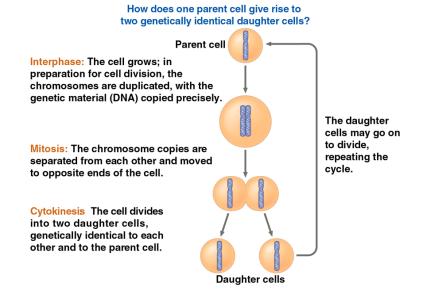
Interphase is the period of cell growth and DNA replication, preparing the cell for division. It is divided into three phases:
G1 phase ("first gap"): Cell growth.
S phase ("synthesis"): DNA replication; chromosomes are duplicated.
G2 phase ("second gap"): Further growth and preparation for mitosis.
Chromosomes are duplicated only during the S phase.
Mitosis
Mitosis is the process by which duplicated chromosomes are separated into two identical sets. It is conventionally broken down into five stages:
Prophase: Chromatin condenses, mitotic spindle forms, nuclear envelope dissolves.
Prometaphase: Nuclear membrane breaks down, spindle microtubules attach to kinetochores.
Metaphase: Chromosomes align at the metaphase plate.
Anaphase: Sister chromatids are separated and moved to opposite poles.
Telophase: Chromosomes reach poles, nuclear envelope reforms, cytokinesis begins.
Cytokinesis
Cytokinesis is the division of the cytoplasm, resulting in two genetically identical daughter cells.
In animal cells, cytokinesis occurs by cleavage, forming a cleavage furrow.
In plant cells, a cell plate forms during cytokinesis.
Mechanisms of Chromosome Movement
The Mitotic Spindle
The mitotic spindle is a structure made of microtubules that controls chromosome movement during mitosis.
Includes centrosomes, spindle microtubules, and asters.
Centrosomes replicate during interphase and migrate to opposite ends during prophase.
Each sister chromatid has a kinetochore for spindle attachment.
Binary Fission in Prokaryotes
Prokaryotes reproduce by binary fission, a simpler form of cell division.
Chromosome replicates at the origin of replication.
Daughter chromosomes move apart, and the plasma membrane pinches inward.
Regulation of the Cell Cycle
Cell Cycle Control System
The cell cycle is regulated by a control system with checkpoints at key stages (G1, G2, M phases).
Regulatory proteins: Cyclins and cyclin-dependent kinases (Cdks).
Cdks must be attached to a cyclin to be active.
MPF (Maturation Promoting Factor): Cyclin-Cdk complex that triggers passage past the G2 checkpoint.
Checkpoints ensure proper cell cycle progression; G1 checkpoint is often the most important.
If a cell does not receive a go-ahead signal at G1, it enters a nondividing state called the G0 phase.
External Factors
External signals such as growth factors influence cell division.
Growth factors: Stimulate cell division (e.g., PDGF for fibroblasts).
Density-dependent inhibition: Crowded cells stop dividing.
Anchorage dependence: Cells must be attached to a substratum to divide.
Loss of Cell Cycle Controls in Cancer
Cancer and Cell Cycle Regulation
Cancer cells bypass normal cell cycle controls, leading to uncontrolled division.
Do not stop dividing when growth factors are depleted.
May produce their own growth factors or have abnormal signaling.
Cells that divide indefinitely have undergone transformation.
Benign tumors: Abnormal cells remain at the original site.
Malignant tumors: Invade tissues and can metastasize to other parts of the body.
Summary Table: Cell Cycle Phases and Key Events
Phase | Main Event | Key Features |
|---|---|---|
G1 | Cell growth | Preparation for DNA replication |
S | DNA synthesis | Chromosome duplication |
G2 | Further growth | Preparation for mitosis |
Mitosis | Chromosome separation | Five stages: prophase, prometaphase, metaphase, anaphase, telophase |
Cytokinesis | Cell division | Formation of two daughter cells |
Example: In human somatic cells, the cell cycle ensures that each daughter cell receives a complete set of chromosomes, maintaining genetic continuity.
Additional info: The cell cycle is tightly regulated to prevent errors in DNA replication and division, which can lead to diseases such as cancer.
